

Quick answer: A normal bed is designed mainly for sleep; a hospital bed is designed around care. Hospital beds can offer sectional positioning, controlled height, brakes, care-compatible accessories and easier caregiver access. The right choice depends on the patient’s mobility and care plan—not simply on which bed looks more comfortable.
Hospital bed vs normal bed at a glance
| Feature | Hospital bed | Normal bed |
|---|---|---|
| Positioning | Back and other sections may adjust | Usually fixed |
| Height | Fixed or adjustable by model | Fixed |
| Mattress | Flexible, sized for the frame | Domestic size and construction |
| Movement | May have braked castors | Not designed for care movement |
| Accessories | Only compatible medical accessories | Domestic accessories |
| Primary purpose | Patient care and positioning | Sleep and household comfort |
Why the differences matter
A fixed household bed can force a caregiver to bend, reach and manually prop the patient with pillows. It may also be difficult to approach from both sides. A hospital bed can change the working height or body angle on models that provide those functions. This can make a planned transfer or daily-care task more manageable, but only when the room layout and technique are safe.
The medical mattress is also part of the system. It must flex with the moving platform and should not create excessive gaps beside the frame or rails. A domestic spring mattress may resist bending, slip, or change the effective rail height.
Comfort, appearance and independence
A familiar normal bed may feel less clinical and can be perfectly appropriate for an independent patient. A hospital bed can offer more control to someone who can safely use the handset, but it can also take more floor space and requires cleaning, brake checks and cable management. Choose the least complex option that safely meets the defined care tasks.
Selection and setup checklist
Start with the care task, not a catalogue photo. Record the patient’s approximate height and weight, ability to turn and sit, transfer method, cognitive status, skin risk and the number of caregivers available. Then confirm the bed’s safe working load, platform dimensions, available functions and the exact mattress specification.
- Measure the doorway, lift, corridor turns and the planned room.
- Leave clear access on the sides needed for transfers and daily care.
- Confirm the mattress bends with the platform and leaves no unsafe gaps.
- Use only rails and accessories approved for that model.
- Check brakes, controls, cranks and emergency procedures at handover.
- Keep cables, oxygen tubing and walking routes free from pinch or trip hazards.
For a practical purchasing sequence, see Sanjeevia’s hospital-bed selection guide, mattress compatibility checklist and safe home setup guide.
Safety points for home use
Bed rails are not a universal fall-prevention device. They can introduce entrapment, climbing or injury risks and should be considered only after an individual assessment. The United States Food and Drug Administration advises evaluating the entire bed system—frame, mattress, rails and accessories—because incompatible components can create hazardous spaces. Keep brakes locked during routine care unless the manufacturer’s instructions require movement, and never exceed the stated load.
Reassess the setup when the patient’s strength, confusion, weight, skin condition or transfer method changes. Stop using a damaged control, loose rail, cracked cable, noisy motor or bent frame and contact the provider. For urgent breathing difficulty, chest pain, sudden weakness, a fall with injury or any medical emergency, seek emergency care rather than trying to solve the problem by changing the bed position.
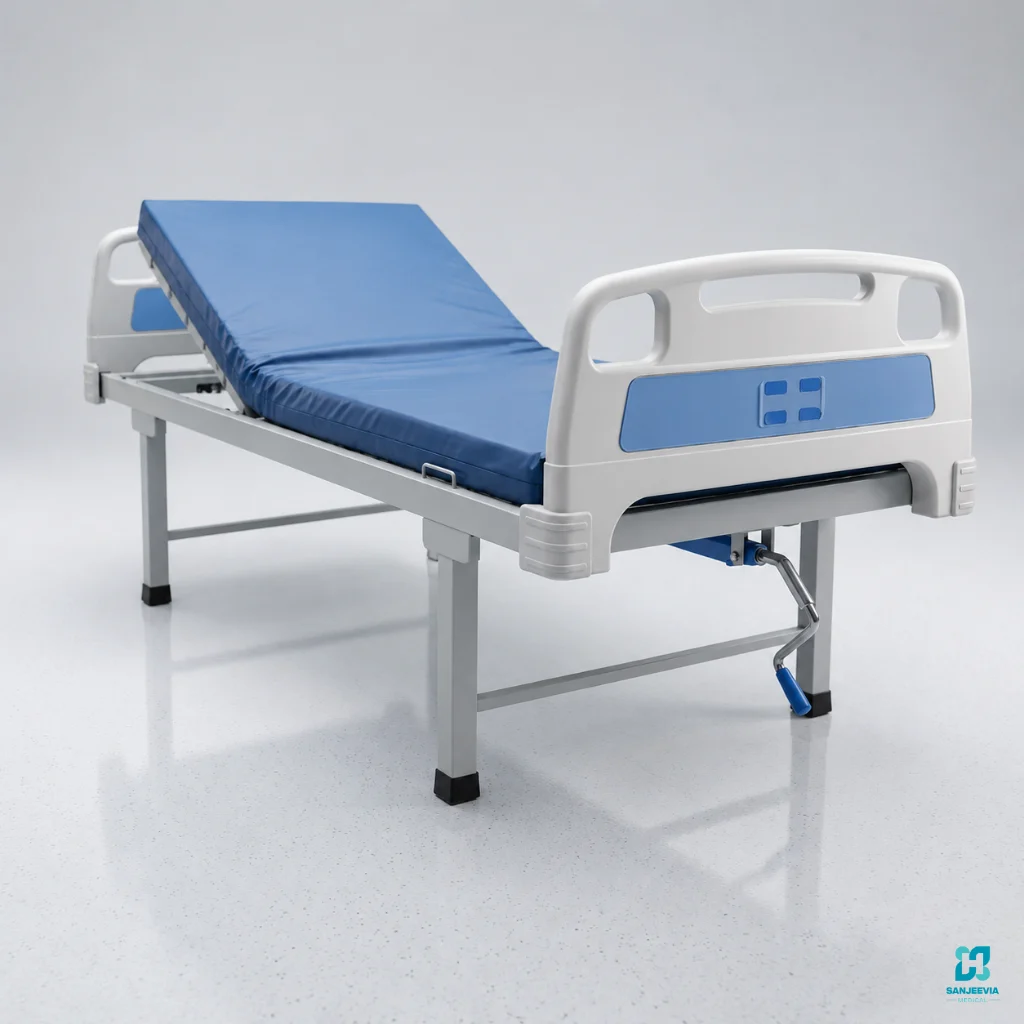
Preparing the room before delivery
Measure the complete delivery route, not only the bedroom. Note the building entrance, stairs, lift-door opening, lift depth, corridor width, tight corners and the final doorway. Remove loose rugs and unnecessary furniture before the installation team arrives. The bed needs a level surface, and the sides used for transfers or personal care need enough working space for the caregiver and any mobility aid.
Choose a location with ventilation, suitable lighting and access to a properly earthed electrical socket if the model is powered. Avoid running an extension cable across a walking route. Think about how the patient will reach the call bell or phone, drinking water and approved bedside items without leaning dangerously. If oxygen equipment is also used, follow the supplier’s fire-safety and separation instructions; do not place electrical equipment or heat sources casually around oxygen.
What to check at delivery and handover
Ask the installer to demonstrate every function while the bed is empty and again with the patient only when the transfer plan allows. Confirm how to lock and release the brakes, operate the handset or cranks, lower and raise approved rails, isolate power, and return the bed to a safe position. Every regular caregiver should practise; a handover understood by only one family member is fragile.
- Confirm the delivered model and load rating match the order.
- Inspect the frame, cable, plug, control, wheels, mattress cover and accessory connections.
- Record the provider’s service number and expected response process.
- Ask who is responsible for preventive maintenance, repairs and replacement during rental.
- Keep the manual and cleaning instructions where caregivers can find them.
- Agree on the return or exchange process if the patient’s care needs change.
During use, wipe the frame and mattress cover with products permitted by the manufacturer. Do not flood motors, controls or joints. Check for loose parts, changes in mattress shape and new gaps after cleaning or repositioning. A short daily visual check and a more careful weekly check can identify problems before the next transfer or night-time adjustment.
Frequently asked questions
Can any mattress be used on a hospital bed?
No. The mattress must match the platform size and moving sections. If rails are used, mattress thickness also affects rail height and gap risk.
Should all patients use side rails?
No. Rails require individual clinical and safety assessment. Use only compatible components and never improvise with furniture or unapproved barriers.
Is renting sensible for short-term recovery?
It can be. Compare the likely duration, delivery and installation, service response, cleaning process, included mattress and total rental terms with the cost and responsibilities of ownership.
Sources and further reading
- U.S. FDA: Hospital Beds
- U.S. FDA: Bed Safety and Bed Rails
- U.S. FDA: Bed-System Accessories and Entrapment Risk
Medical boundary notice: This article is general educational information, not a diagnosis, prescription or substitute for advice from the patient’s doctor, physiotherapist, occupational therapist or trained nurse. Follow the treating team’s positioning, transfer and pressure-care plan and the equipment manufacturer’s instructions.
Need help choosing equipment? Contact Sanjeevia Medical with the prescription or care requirements, patient details and room measurements. The team can help you compare compatible home-care options in Delhi NCR.
Published by Sanjeevia Medical.