
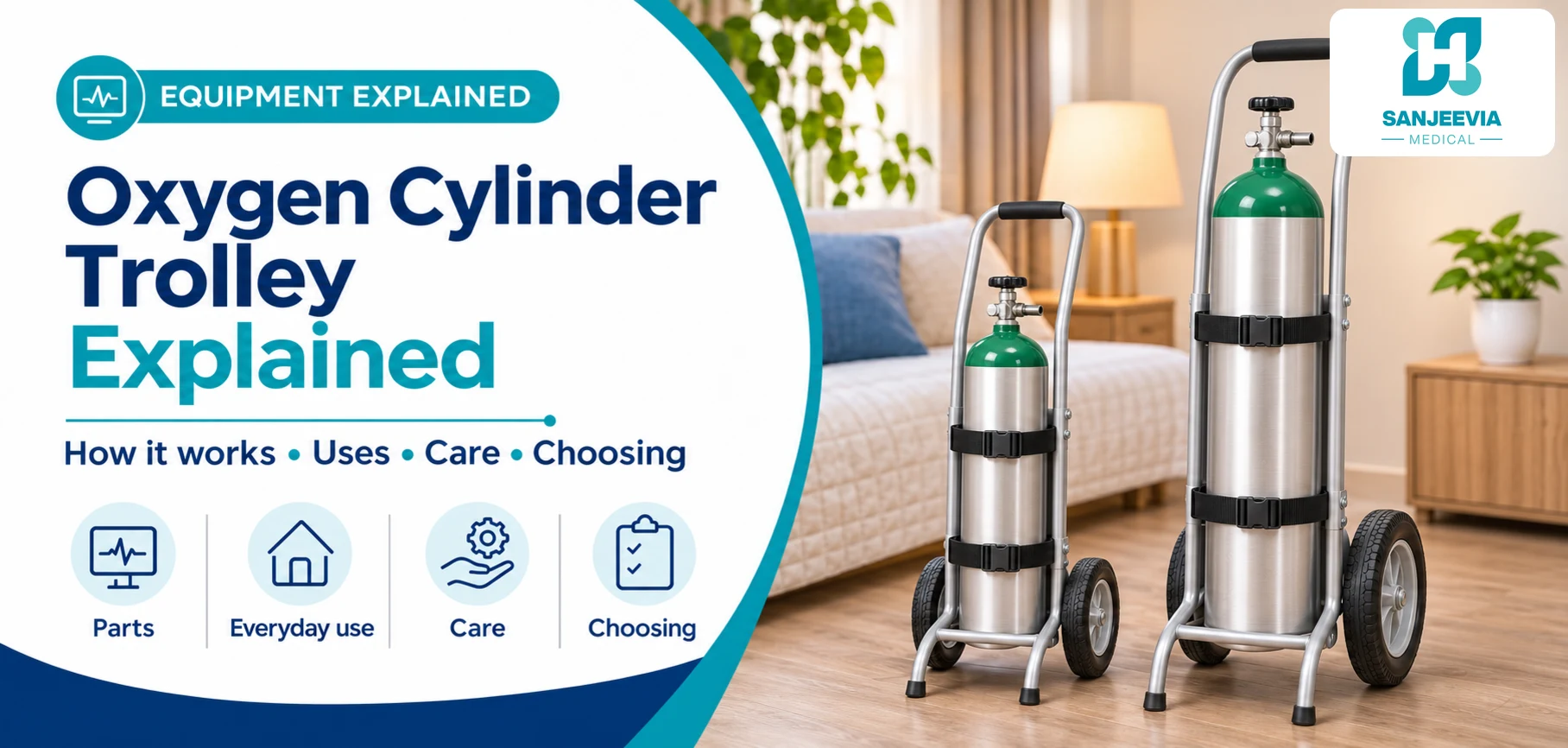
An oxygen cylinder is most vulnerable while being moved: one missed strap or an exposed valve can turn a simple trip between rooms into a dropped high-pressure cylinder. The trolley is safety equipment, not just a convenience.
Quick answer: An oxygen-cylinder trolley supports, secures and moves a compatible cylinder. The base, frame, restraint and valve clearance must match the exact cylinder; the cylinder remains secured upright during storage and is tilted onto the trolley wheels only for controlled movement.
Explore relevant equipment
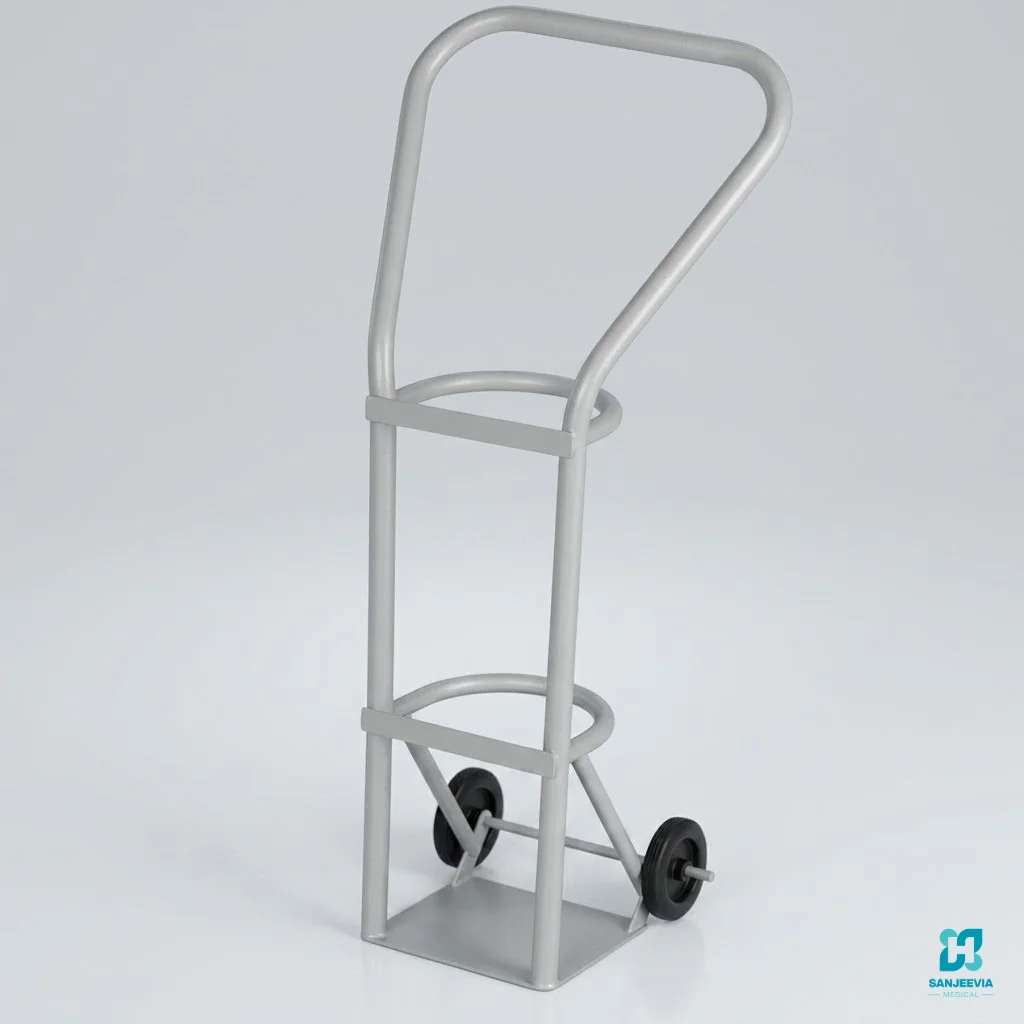
Small Oxygen Cylinder Trolley
Review the live listing for the supplied package, compatible accessories and current rental or purchase options.
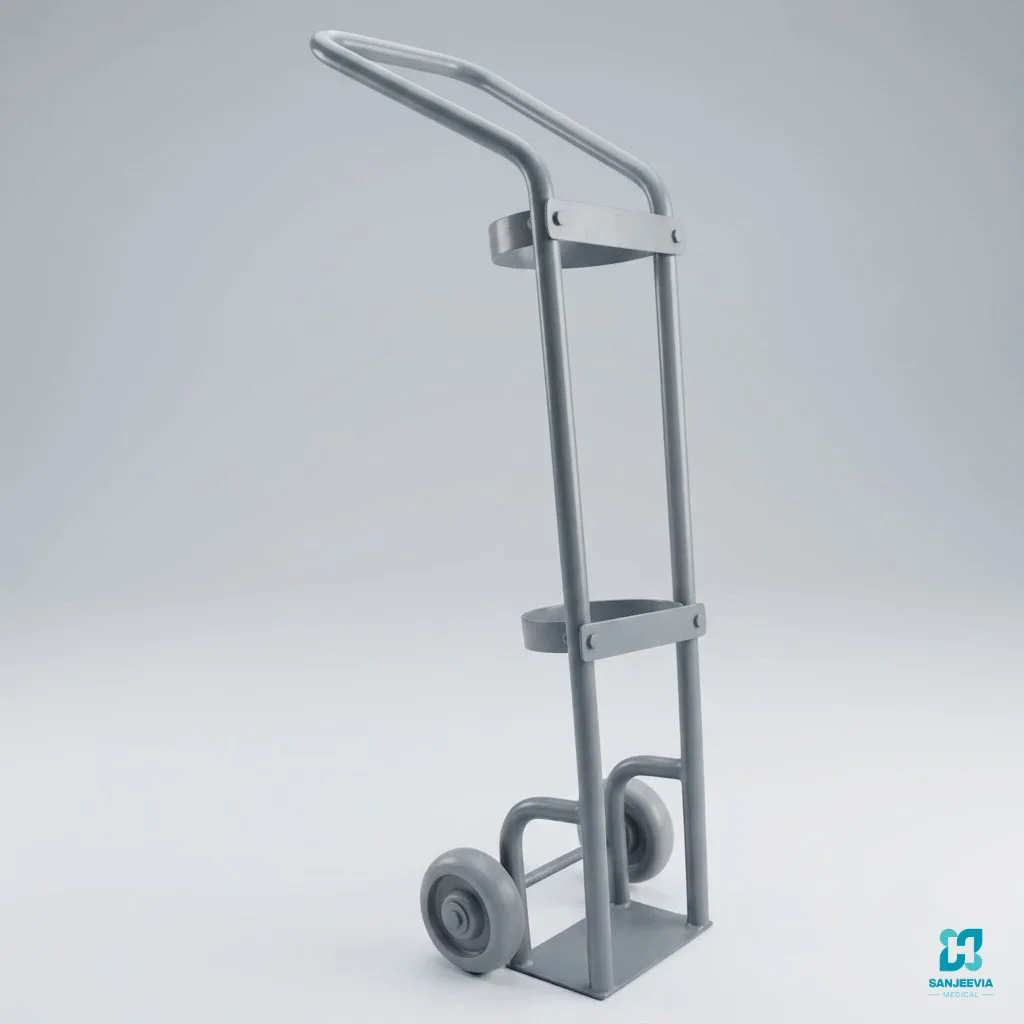
Large Oxygen Cylinder Trolley
Review the live listing for the supplied package, compatible accessories and current rental or purchase options.
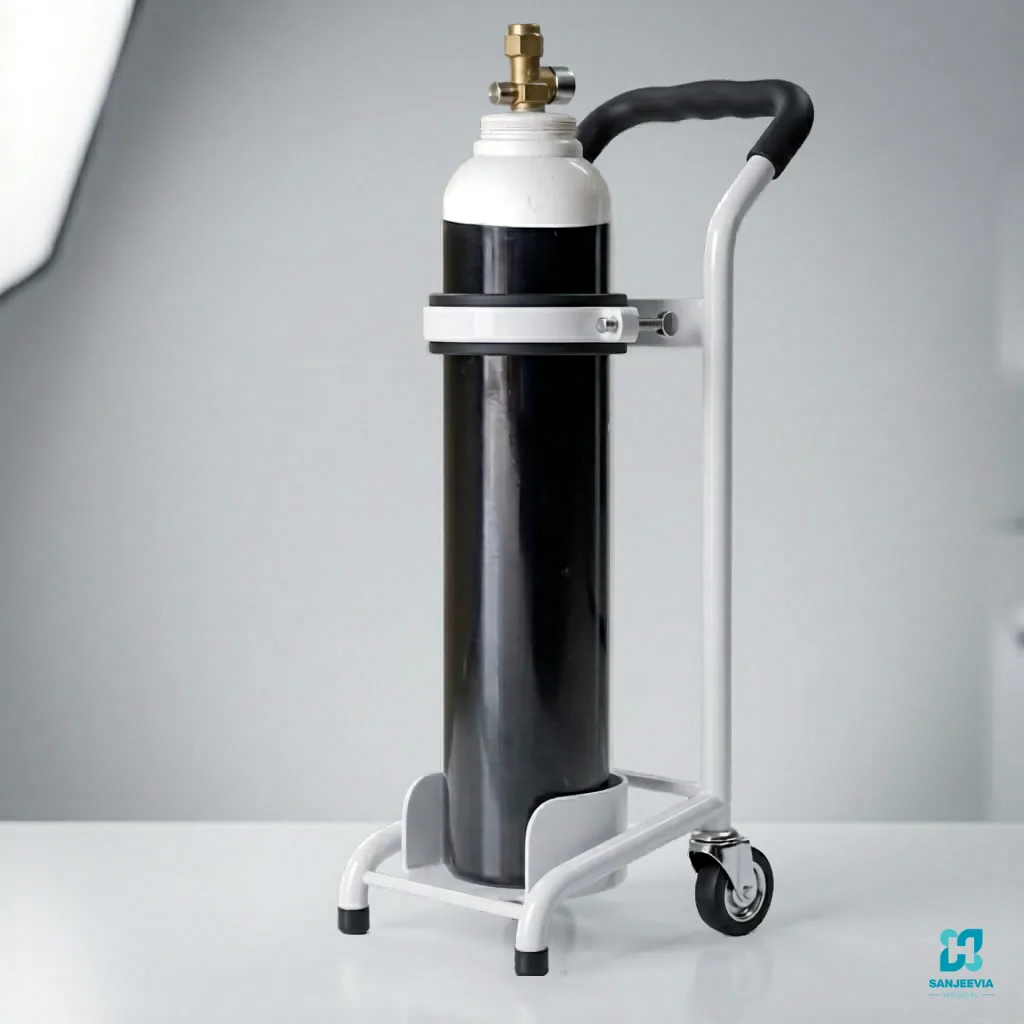
47L Medical Oxygen Cylinder
Review the live listing for the supplied package, compatible accessories and current rental or purchase options.
Confirm the exact supplied model, compatibility, included accessories and delivery availability for your PIN code before booking.
Exact-model demonstration and handover
Sanjeevia’s channel does not currently have a verified demonstration dedicated to the oxygen cylinder trolley. Use the supplied model’s manual and an in-person or live handover for controls, accessories, alarms and permitted operation. The steps below are orientation—not a substitute for trained use.
Jump to equipment details
Small-cylinder and large-cylinder trolleys
A compact two-wheel trolley is intended for a compatible small cylinder. It should have a base that fully supports the cylinder and a restraint that prevents the body from slipping out when the frame is tilted.
A large-cylinder trolley needs a stronger base and frame, with upper and body restraints suitable for the cylinder’s height and diameter. The label “47L trolley” is helpful only after the actual cylinder dimensions and valve arrangement are confirmed. Capacity names are often used loosely in listings.
Neither product includes oxygen therapy parts. The cylinder, gas, regulator, flow meter, humidifier, mask and cannula are separate unless the listing explicitly says otherwise.
How do you confirm compatibility?
- The cylinder base must sit fully inside the trolley support—not balance on an edge.
- The frame and restraint must hold the cylinder body without crushing labels or accessories.
- The valve, protective ring and regulator must clear the frame and handle.
- The combined trolley and cylinder should remain stable when upright on a level surface.
- Wheels, axle and handle must support the load without excessive flex or wobble.
Send the supplier the cylinder manufacturer/markings, height and maximum body diameter, plus clear photographs of the base and valve area. A trolley should not be selected only from “10L” or “47L” wording.
Safe movement step by step
- Plan a clear route: remove rugs, cables, water and obstacles; check thresholds, ramps, lifts and door width.
- Close or protect the cylinder valve as the equipment plan requires. Keep the regulator from striking walls or doorframes.
- Confirm the cylinder is seated and every chain, strap or clamp is secure before tilting.
- Use the handle, tilt only enough to balance on the wheels, and move slowly. Keep hands, feet and tubing clear.
- For stairs, steep slopes, vehicle loading or a very heavy cylinder, use trained help and appropriate lifting equipment. Do not drag, roll, drop or carry the cylinder by its valve or regulator.
- At the destination, return the trolley upright on a level surface and recheck stability.
PESO’s Gas Cylinders Rules state that cylinders must be adequately supported and, as far as possible, moved with trolleys or cradles of adequate strength while protecting the valve from damage.
Where should the trolley stand at home?
Store the secured cylinder upright in a cool, dry, ventilated place away from heat, flames, smoking, cooking areas and likely impact. Do not block exits or narrow the caregiver’s route. Tubing should reach the patient without crossing busy walkways or pulling on the regulator.
A two-wheel trolley may not have brakes. Upright storage therefore depends on a level surface, proper base support and restraint—not on leaning the trolley against furniture. Keep children and visitors from handling the valve or climbing on the frame.
If oxygen is used beside a hospital bed, leave space for bed movement, transfers and emergency access. Recheck the route whenever furniture or equipment changes.
Inspection and maintenance
Before movement, inspect wheels, axle, welds, frame, base, handle, chain, strap and fasteners. Look for loose hardware, cracks, corrosion, bent parts and worn restraints. Verify both wheels turn freely and remain secure.
Wipe the trolley using a material-compatible cleaner and dry it fully. Do not paint over cracks, corrosion or product markings. A damaged frame or restraint should be removed from service rather than tied with rope or repaired informally.
After any drop or collision, assess the cylinder, valve, regulator and trolley before reuse. A trolley can protect the cylinder only when both remain compatible and structurally sound.
Need help matching the equipment?
Share the written requirement, intended use and delivery area. Sanjeevia can help you check the exact model, accessories, rental or purchase option and service coverage in Delhi NCR.
Questions before buying a trolley
- What are the cylinder’s actual height, diameter and filled weight?
- Does the base fully support it, and what restraint is supplied?
- Is valve and regulator clearance adequate?
- Is the trolley intended for two-wheel tilt movement, four-castor movement or stationary support?
- Are brakes present? If not, how will upright stability be maintained?
- Will it pass through the home’s narrowest doorway and lift?
- Who will demonstrate securing, tilting and safe movement?
Read the oxygen cylinder explanation for pressure, runtime and fire-safety planning, and use the regulator-kit listing for delivery components.
Frequently asked questions
Can one trolley fit both small and large cylinders?
Usually not safely. Fit depends on base, frame, restraint, dimensions, load and valve clearance.
Can a cylinder be rolled on its side?
No. Use an appropriate trolley or cradle and keep the cylinder secured as required.
Does the trolley include the cylinder?
No. Sanjeevia’s small and large trolley listings exclude the cylinder and oxygen system.
Can one person move a large cylinder?
Only when the route, load, trolley and training make it safe. Stairs, ramps and vehicle loading often require additional trained help.
Explore your equipment options
Small Oxygen Cylinder Trolley
Review the live listing for the supplied package, compatible accessories and current rental or purchase options.
Large Oxygen Cylinder Trolley
Review the live listing for the supplied package, compatible accessories and current rental or purchase options.
47L Medical Oxygen Cylinder
Review the live listing for the supplied package, compatible accessories and current rental or purchase options.
Confirm the exact supplied model, compatibility, included accessories and delivery availability for your PIN code before booking.
Sources and useful reading
- PESO: Gas Cylinders Rules, 2016 — handling, trolley use, valve protection and storage.
- PESO: Gas Cylinder Rules SOP — transport, securing and valve-protection provisions.
- Sanjeevia small oxygen-cylinder trolley listing.
- Sanjeevia large oxygen-cylinder trolley listing.
- NHSRC: Materiovigilance Programme of India.
Prepared by Sanjeevia’s editorial team. Updated 8 November 2026. This guide explains equipment; diagnosis, treatment, settings and patient-specific suitability must come from the responsible clinical team.
