
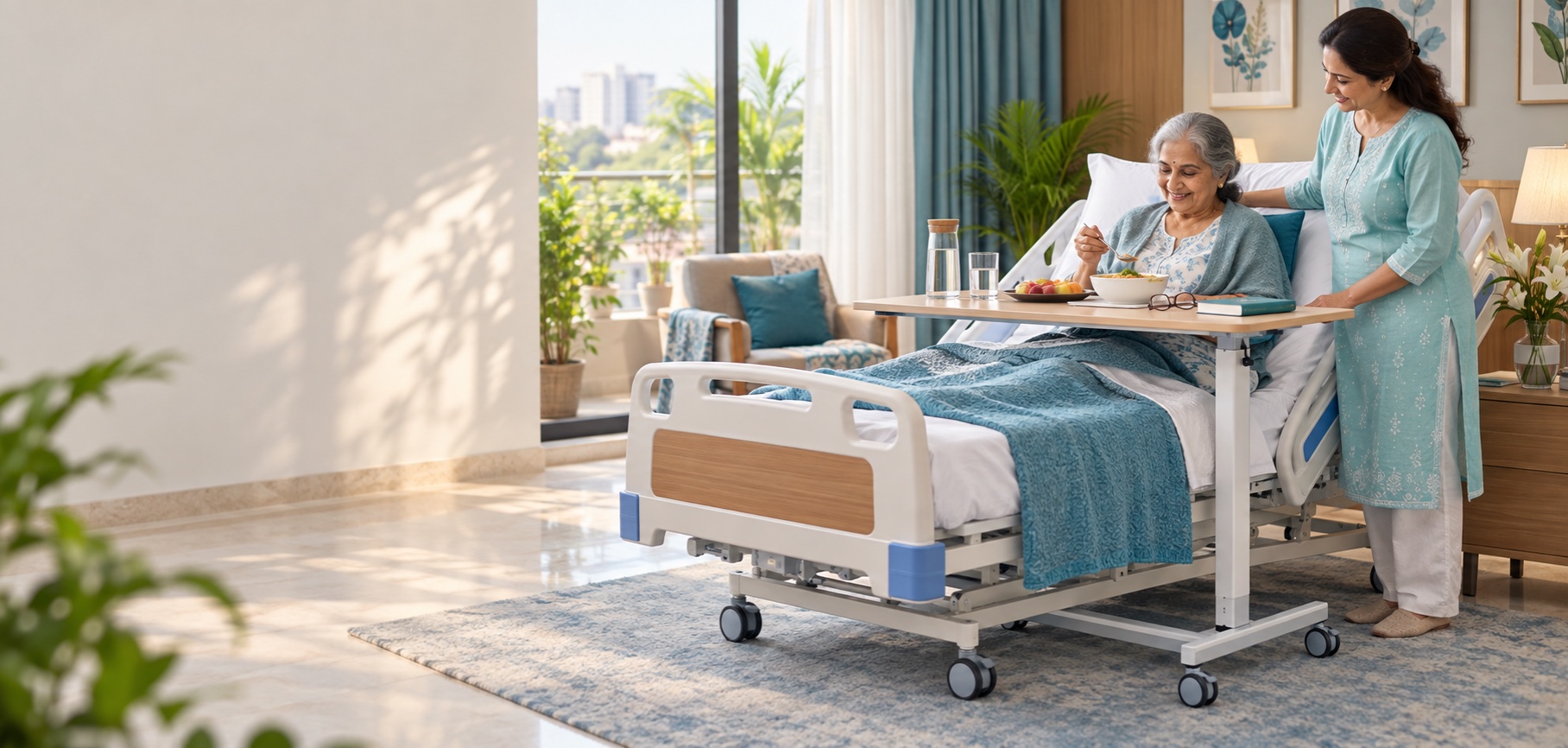
Quick answer: An over-bed table gives a patient a stable surface for meals, reading and light personal items without leaving the bed. Before renting one, check the bed’s under-frame clearance, table height range, top size, castor movement and the patient’s reach. It is a table, not a grab rail or transfer aid.
A small bedside setup can make a large difference when someone is recovering at home. Without a suitable table, meals end up balanced on pillows, medicines are placed beyond reach and caregivers repeatedly move items across the room. A height-adjustable over-bed table can bring everyday objects closer while preserving space beside the patient.
This guide explains how to choose an over-bed table for home patient care, including dimensions, hospital-bed compatibility, safe placement and delivery checks.
What is an over-bed table?
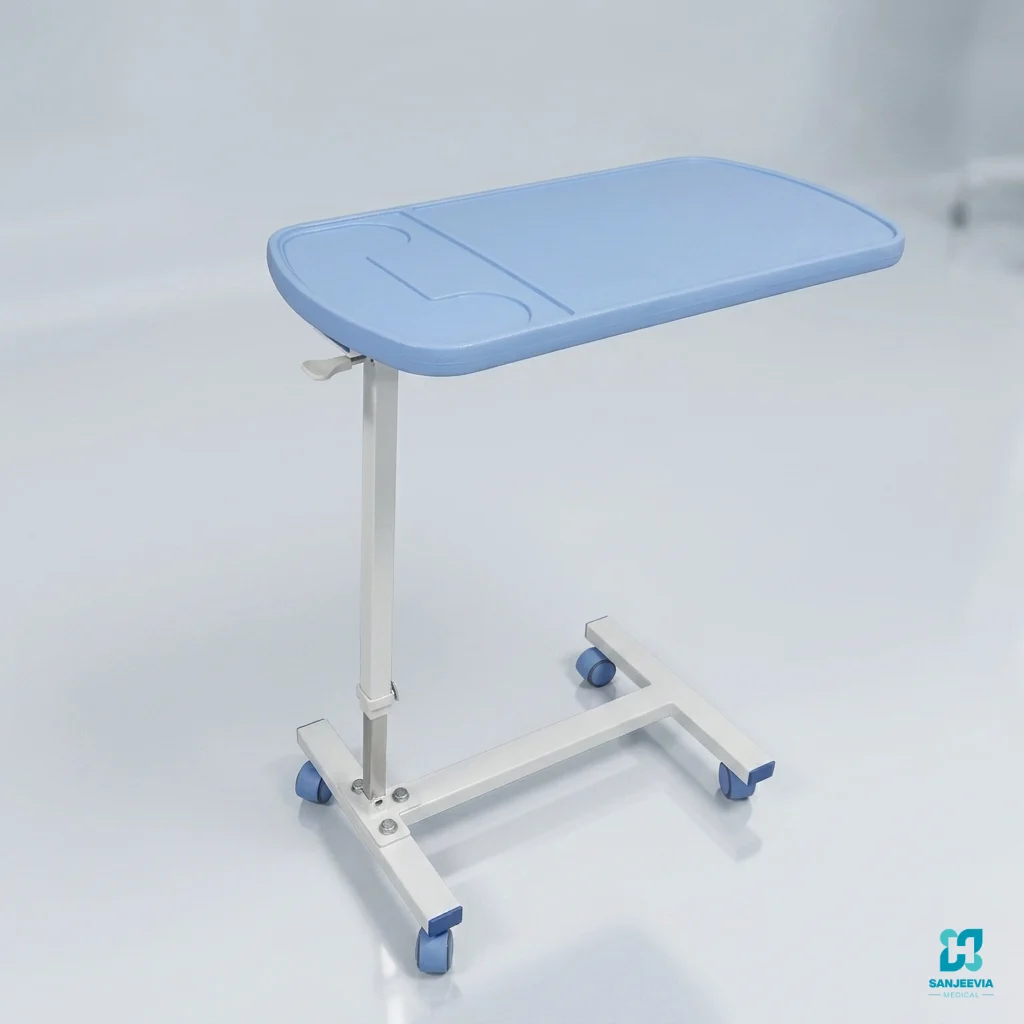
An over-bed table is a mobile table with a base designed to move beneath a compatible bed. Its upright column supports a tabletop that can be positioned over part of the mattress. It can provide a practical surface for eating, reading, using a phone or keeping light personal items within reach.
It differs from a bedside locker. A locker stands beside the bed and provides enclosed storage. An over-bed table moves over the mattress and provides a working surface. Many home-care rooms benefit from both, but each needs its own safe space. Read the bedside locker size and placement guide before placing the two items together.
Sanjeevia over-bed table size and specifications
Sanjeevia’s listed height-adjustable over-bed table has a laminated top measuring approximately 700 × 400 mm. Its stated height adjusts from about 70 to 115 cm. An H-shaped wheeled base is intended to slide beneath a compatible hospital bed.
| Specification | Listed detail | Why it matters |
|---|---|---|
| Tabletop | Approximately 700 × 400 mm | Provides room for a meal tray, book or small personal items |
| Height range | Approximately 70 to 115 cm | Helps align the top with different mattress and patient positions |
| Base style | H-shaped mobile base | Needs clear floor space beneath and around the bed |
| Mobility | Castors | Allows repositioning on a suitable level floor |
| Included | Assembled table and castors | Meal trays, cutlery and personal supplies are separate |
Dimensions should be treated as a compatibility check, not a promise that the table will fit every bed. A low residential bed, storage drawer, crossbar, oxygen tubing or hoist base may block the table’s legs.
How to check compatibility with a hospital bed
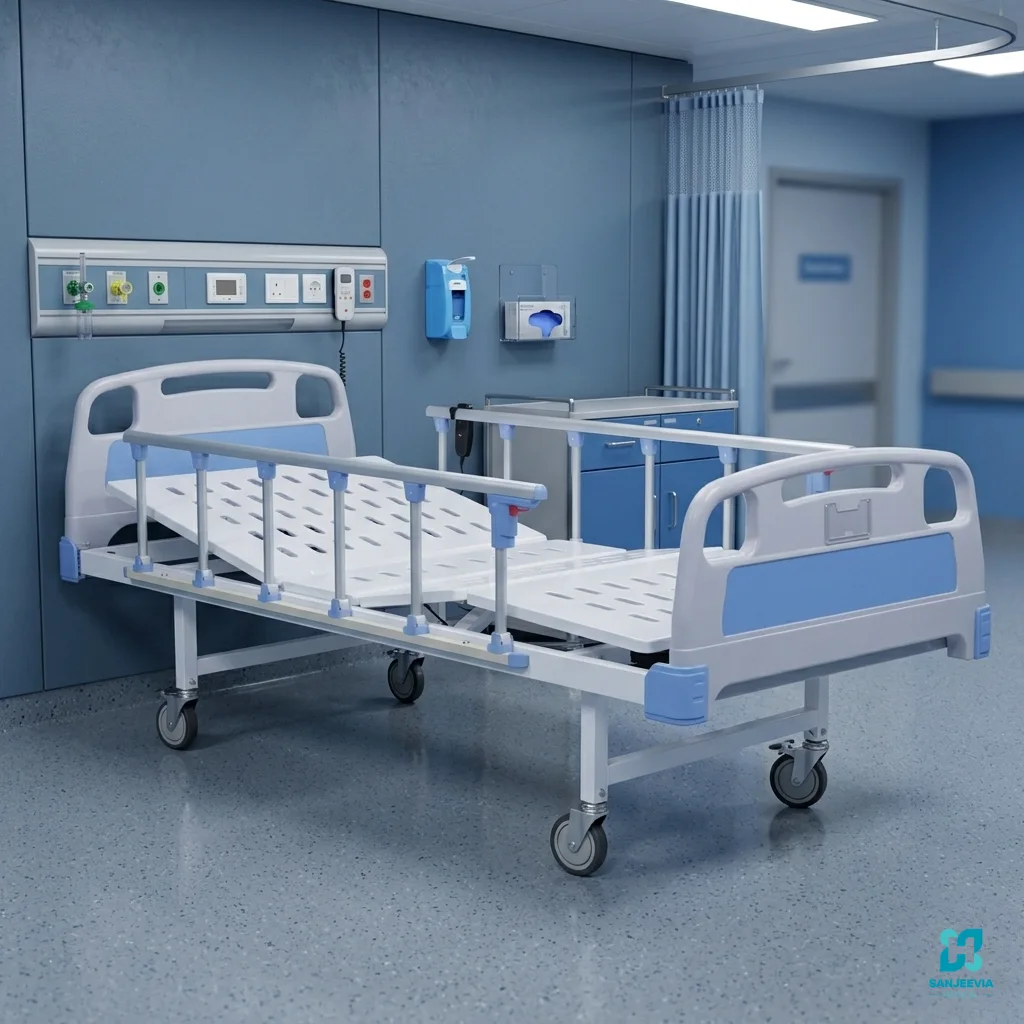
Measure before booking, especially when the patient already has a bed and several accessories. Begin with the Sanjeevia hospital-bed range so you can compare the planned bed style with the table base.
- Measure under-bed clearance. Record the available height from the floor to the lowest frame component.
- Check the path of the base. Make sure castors, brake pedals, cables and bed mechanisms do not block the H-shaped legs.
- Measure mattress height. Include the bed frame, mattress and any pressure-care surface.
- Test patient reach. The user should reach essential items without twisting, sliding or leaning over a rail.
- Allow for bed movement. An electric bed changes height and section angles. Move the table away before adjusting the bed if there is any risk of collision.
- Preserve caregiver access. Do not position the table where it blocks transfers, wound care, physiotherapy or emergency access.
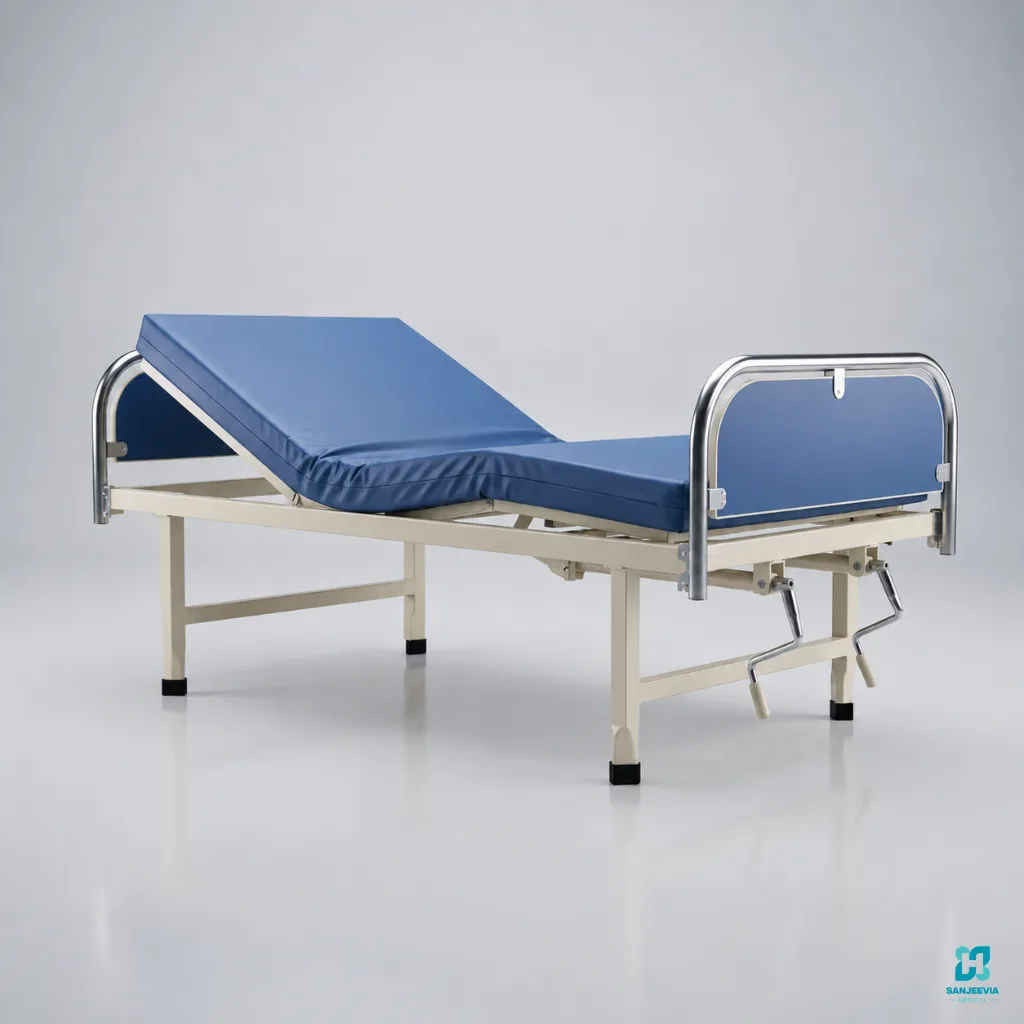
For a wider room check, follow Sanjeevia’s hospital-bed setup guide. Families comparing simpler beds can review the Manual Semi Fowler Bed and Manual Full Fowler Bed. If powered positioning is required, browse the 2 Function Electric Bed.
Safe ways to use an over-bed table
The table should support light everyday items within the manufacturer’s stated limits. It should never be used to pull the patient upright, support a standing transfer or carry body weight.
- Do not lean, sit or stand on the tabletop.
- Do not use the table as a walker, grab rail or transfer pole.
- Place hot drinks where they cannot spill onto the patient.
- Keep heavy objects away from the table edge.
- Move the table slowly and watch oxygen tubing, IV lines and power cables.
- Keep the castor path clear of rugs, footwear and loose cables.
- Follow the supplied instructions for height adjustment and castor use.
- Clean the surface with a product compatible with the table finish.
If the patient needs help sitting up or transferring, ask the treating physiotherapist about appropriate techniques and equipment. A table cannot replace bed rails, a walker or hands-on assistance.
How to arrange meals and medicines
The tabletop is useful because it creates one visible surface, but that surface still needs organisation. Use a stable meal tray, keep drinking water within the patient’s safe reach and remove unnecessary items after each use.
Do not treat the table as permanent medicine storage. Medicines should remain labelled and stored according to their instructions, away from heat, moisture and children. If a dose has been placed on the table for supervised use, clear the container promptly after the care task.
For devices with tubing or cables, place the table only after checking the route. A castor can trap an oxygen tube or pull an infusion line. The caregiver should be able to move the table away without disturbing prescribed equipment.
Who benefits most from an over-bed table?
- A person on temporary bed rest who can sit safely for meals or reading
- A patient using an adjustable hospital bed who needs a surface that follows the raised backrest position
- An older adult with limited reach who can use light items safely from bed
- A caregiver organising a compact room who needs movable surface space
- A family testing a home-care layout before committing to purchase
It may be unsuitable when the base cannot fit beneath the bed, when floor transitions prevent safe movement or when the patient is likely to use the table for weight-bearing. Resolve these points before delivery.
Delivery checklist
- Confirm the tabletop and height range match the listing.
- Check that the base fits beneath the intended bed.
- Move the table through its full safe height range.
- Check the castors and any available locking mechanism.
- Inspect the top, edges, column and base for damage.
- Ask for the safe load and cleaning instructions for the supplied model.
- Photograph the equipment condition at handover.
- Keep the rental terms and support contact available.
Sanjeevia’s guide to rental equipment checks before delivery explains the wider handover process.
How Sanjeevia can help
If you know the bed model and room measurements, Sanjeevia can help you assess whether the listed over-bed table is likely to fit. Share photos and measurements of the under-bed space when requesting guidance. You can also browse home-care essentials or contact Sanjeevia for a complete quotation.
Frequently asked questions
Can an over-bed table fit a normal household bed?
Only if the base has enough clearance to move beneath it. Storage beds, low frames and projecting supports frequently block mobile table bases.
Can the patient use it to stand up?
No. An over-bed table is not a weight-bearing transfer aid. Use only the transfer method and equipment recommended for the patient.
Does the table come with a meal tray?
The current Sanjeevia listing includes the assembled table and castors. Meal trays, cutlery and personal supplies are separate.
Should we rent the table with a hospital bed?
Renting both can simplify compatibility planning, but the table remains optional. Choose it when the patient’s reach, care routine and room layout show a clear benefit.
What is the difference between an over-bed table and bedside locker?
The over-bed table provides a movable surface above the mattress. A bedside locker provides storage beside the bed. Many rooms use both if there is enough safe space.
Next read
Once the tabletop is planned, the next storage question is likely: Bedside Locker for Home Patient Care: Size and Safe Placement.