
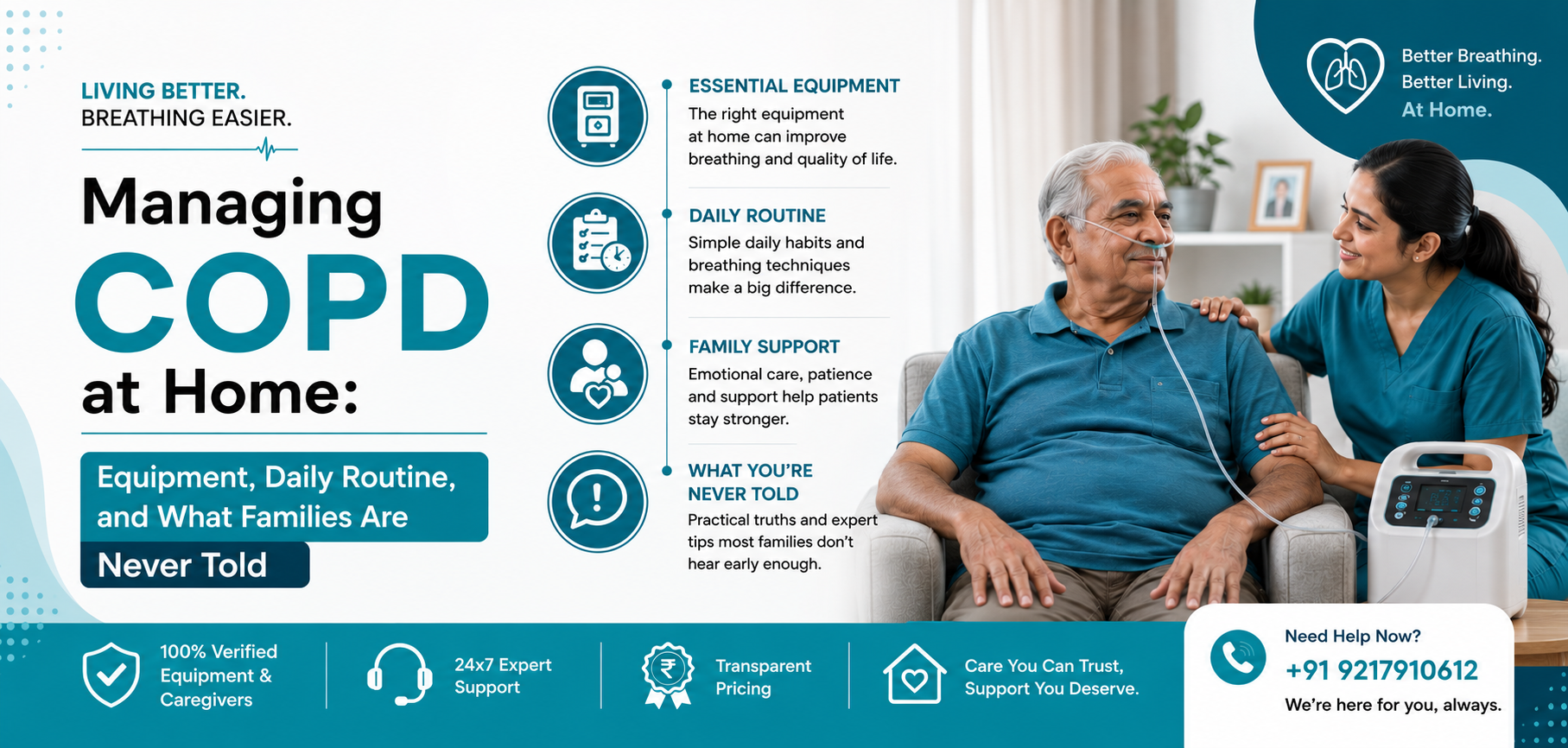
Home / Blog / Managing COPD at Home: Equipment, Daily Routine, and What Families Are Never Told
COPD Management. What Equipment to use for COPD. BiPAP Machine on rent. CPAP machine on rent

Managing COPD at Home: Equipment, Daily Routine, and What Families Are Never Told

Table of Contents

Your father was diagnosed with COPD three years ago. The last exacerbation landed him in the hospital for eight days. He has come home with a new prescription: oxygen 2 LPM for 16 hours daily, and a BiPAP machine for nighttime. The pulmonologist said to follow up in six weeks. You are the one managing everything in between.

This is the reality for most COPD families in Delhi NCR. The hospital manages the acute episode. Everything in between, the daily management, the equipment, the routine, the recognition of warning signs, falls on the family. This guide is for you.

COPD is Chronic Obstructive Pulmonary Disease, an umbrella term for progressive lung conditions, primarily chronic bronchitis and emphysema, that cause permanent airflow limitation. In Delhi NCR, where air quality is among the worst globally, COPD is disproportionately common. Decades of pollution exposure, combined with smoking in many patients, creates severe lung damage that cannot be reversed.

What can be managed: the rate of progression, the frequency of exacerbations (acute worsening episodes), and the quality of daily life. The right home setup significantly changes all three outcomes.

1. Oxygen Concentrator

Moderate to severe COPD causes resting hypoxemia, meaning the patient’s blood oxygen falls below safe levels even without exertion. Long-term oxygen therapy (LTOT) for 15 hours or more daily is prescribed when resting SpO2 consistently falls below 88 to 90%. This is the single most evidence-backed intervention for improving survival in severe COPD.

For most Delhi NCR COPD patients, a 5L concentrator is sufficient for prescriptions up to 5 LPM. If the prescription exceeds 5 LPM, a 10L concentrator is needed. Carry a 47L cylinder as power backup.

Browse oxygen concentrators on Sanjeevia with same-day delivery across Delhi NCR.

Oxygen Concentrator for rent in Delhi NCR. Oxygen Concentrator for rent

2. BiPAP Machine

BiPAP (Bi-level Positive Airway Pressure) delivers two pressure levels, higher on inhalation to push air into the lungs, lower on exhalation to reduce the effort of breathing out. It is prescribed for COPD patients with hypercapnia, meaning CO2 is building up in the blood because the patient cannot exhale fully.

Common BiPAP machines for COPD in India: the ResMed Lumis 100 VPAP ST is the physician-preferred device for home NIV in COPD. The Philips DreamStation COPD edition is an equivalent alternative. For patients with milder BiPAP needs, the Niscomed and BMC basic BiPAP models are effective and more affordable.

Browse BiPAP machines on Sanjeevia. All units delivered with full settings configuration per doctor’s prescription.

BiPAP machine on rent.BiPAP/CPAP machine on rent in Delhi

3. Pulse Oximeter

Non-negotiable. A pulse oximeter clips onto the finger and reads SpO2 (blood oxygen saturation) in seconds. Every COPD family needs one at home. Check SpO2 morning and night at minimum. Keep a log. Any reading consistently below 90% is a signal to contact the doctor.

4. Hospital Bed with Head Elevation

COPD patients sleep and rest better with the head of the bed elevated 30 to 45 degrees. This reduces the work of breathing by allowing the diaphragm to move more freely. A semi fowler hospital bed achieves this properly. Pillow stacking is inadequate for overnight positioning.

Browse hospital beds on Sanjeevia.

Hospital Bed on rent.ICU Bed for rent.Hospital Beds on rent in DELHI NCR
TimeActivityWhy It Matters
MorningCheck SpO2 before getting out of bedBaseline reading when fully rested
MorningTake all prescribed medicationsBronchodilators work best taken consistently at the same time
MorningPursed lip breathing exercises (10 minutes)Reduces air trapping, improves exhalation
Throughout dayOxygen as prescribed (if LTOT)Do not reduce hours even if patient feels fine
Before mealsRest for 15 minutesEating is physically demanding for COPD patients
EveningCheck SpO2 againCompare to morning reading, flag any consistent drop
BedtimeBiPAP on (if prescribed)Prevents CO2 build-up during sleep

An exacerbation is an acute worsening of COPD symptoms. Early recognition prevents hospitalisation. Contact the doctor immediately if:

  • Increased breathlessness worse than the patient’s usual baseline
  • Change in sputum colour from clear or white to yellow, green, or brown (indicates possible infection)
  • SpO2 dropping more than 3 to 4 points below the patient’s usual baseline
  • Increased use of rescue inhaler beyond the prescribed frequency
  • Confusion, drowsiness, or difficulty waking (can indicate CO2 retention, a medical emergency)
  • Blue tinge around lips or fingertips
  • Stopping oxygen when the patient says they do not feel they need it. COPD patients often cannot feel hypoxemia until it is severe. The prescription is based on measurements, not symptoms.
  • Not using BiPAP because the mask is uncomfortable. Mask discomfort is common initially and almost always solvable. Contact Sanjeevia and we will help troubleshoot.
  • Assuming pollution does not matter indoors. Delhi’s indoor air quality tracks outdoor AQI closely. On high pollution days, keep windows closed.
  • Not having a backup cylinder. A power cut during an acute episode without a backup cylinder is a genuine emergency.

Q: How long will my father need oxygen at home?

For moderate to severe COPD with persistent hypoxemia, oxygen therapy is typically a long-term or permanent requirement. Some post-exacerbation patients see SpO2 improve over weeks and may have the prescription reduced after a follow-up assessment. This must be a physician decision based on SpO2 measurements.

Q: Can my father use the BiPAP only some nights?

Follow the prescription. BiPAP for COPD with CO2 retention is prescribed nightly because CO2 builds up during sleep when breathing is naturally shallower. Skipping nights allows CO2 to accumulate, which can worsen the baseline over time.

Q: Is it safe to use oxygen with BiPAP simultaneously?

Yes, and this is a common combination for COPD patients. Supplemental oxygen is introduced into the BiPAP circuit via the oxygen inlet port. The flow rate and setup must be per the pulmonologist’s prescription. Sanjeevia’s team sets this up correctly at delivery.

Q: How do I manage the equipment if my father has a follow-up at the hospital?

For outings and hospital visits, a portable oxygen concentrator or a 10L cylinder provides oxygen away from home. A wheelchair for transport is also recommended for most moderate to severe COPD patients.

Browse oxygen concentrators
Browse BiPAP machines
Browse hospital beds
WhatsApp us for emergency delivery: +91 92179 10612
KEYWORD TAGS: COPD home care Delhi, COPD home care DelhiCOPD home management IndiaCOPD oxygen therapy homeBiPAP for COPD DelhiCOPD patient care at homeCOPD exacerbation warning signsmanaging COPD at home IndiaCOPD daily routine homeCOPD equipment at home Indialong term oxygen therapy COPD IndiaLTOT COPD Indiahome NIV COPD IndiaBiPAP COPD Delhi NCRResMed Lumis COPD DelhiPhilips DreamStation COPD rent Delhioxygen concentrator COPD homeCOPD SpO2 monitoring homepulse oximeter COPD IndiaCOPD exacerbation home managementCOPD caregiver guide IndiaCOPD pollution DelhiCOPD winter care DelhiCOPD Diwali pollution IndiaCOPD CO2 retention home treatmentCOPD hypercapnia home careCOPD pursed lip breathingCOPD breathing exercises homeCOPD hospital bed homesemi fowler bed COPDhead elevation COPD sleepoxygen cylinder backup COPDCOPD emergency home DelhiCOPD follow-up home IndiaCOPD portable oxygen IndiaCOPD severe management homeCOPD mild management homeSanjeevia COPD equipmentCOPD equipment rent Delhi NCRCOPD home oxygen delivery Delhisame day oxygen delivery COPD Delhirespiratory equipment rent DelhiCOPD family caregiver tips IndiaCOPD discharge home care IndiaCOPD ICU discharge homeCOPD elderly patient home careCOPD patient nutrition IndiaCOPD medication management homeCOPD BiPAP mask India, COPD home care Delhi

Related Guidance and Equipment

Respiratory equipment must match the written prescription; these links provide the relevant comparison and exact product specifications.

Continue Reading

Relevant Product Pages

Medical Disclaimer

This article is for general informational purposes only and does not constitute medical advice. Equipment selection and home care decisions should be guided by your treating physician. Consult your doctor for all clinical decisions.

Published by Sanjeevia Medical  |  sanjeevia.com  |  Delhi NCR