
Home / Blog / Bringing an Elderly Parent Home from ICU: What the First 30 Days Actually Look Like?
ICU discharge home care Delhi What is an Oxygen Concentrator and Does Your Patient Actually Need One? | Sanjeevia Meta Description: Confused about oxygen concentrators? This plain-language guide explains what they do, when they are medically needed, and how to rent one in Delhi NCR. oxygen concentrator rent Delhi NCR, oxygen machine for home, Philips EverFlo rent Delhi, oxygen concentrator vs cylinder, home oxygen therapy India, oxygen concentrator 5L rent

Bringing an Elderly Parent Home from ICU: What the First 30 Days Actually Look Like?

Table of Contents

Your father spent 12 days in the ICU. Sepsis, they said. He is 73. He came in walking on his own. He is leaving in a wheelchair, weak, confused about where he is, with oxygen at 2 LPM, a BiPAP prescription for nights, and a discharge summary that the resident doctor walked you through in seven minutes.

ICU discharge to home is a transition that the medical system handles poorly for families. The hospital is focused on the patient being stable enough to leave. What happens in the first 30 days at home, the period with the highest readmission risk, is almost entirely on the family.

This guide gives you a realistic, honest picture of what those 30 days look like, what you need, and what to watch for.

A patient who was in the ICU for any significant period comes home with a cluster of issues beyond the primary diagnosis:

  • ICU-acquired weakness: muscles deteriorate rapidly during bed rest in the ICU. An elderly patient who spent 10 or more days in intensive care may have lost significant muscle mass, affecting mobility, swallowing, and breathing.
  • Cognitive effects: ICU delirium affects a significant proportion of elderly ICU patients. The patient may be confused, disoriented, or have memory gaps. This usually improves over weeks to months but can be frightening for families not expecting it.
  • Respiratory compromise: most ICU patients have required some form of respiratory support. Coming home on oxygen or BiPAP is common, even if the primary diagnosis was not respiratory.
  • Skin breakdown: pressure sores from prolonged immobility are common in ICU patients. They may already exist at discharge and will worsen rapidly at home without proper management.
  • Swallowing difficulty: intubated patients often have temporary or lasting dysphagia. This is a serious risk factor for aspiration pneumonia at home.

Non-Negotiable

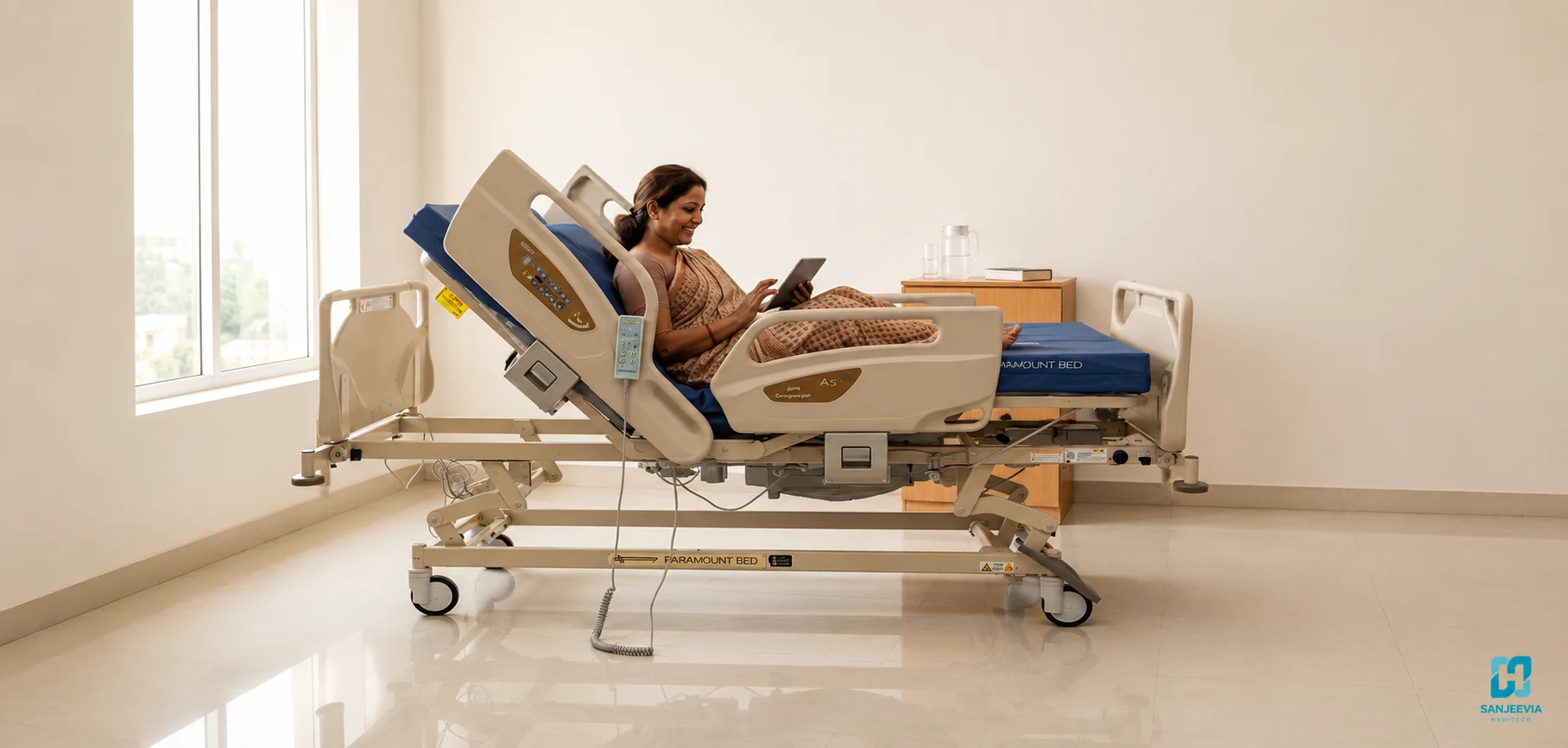
  • Hospital bed: a 3-function electric bed is strongly recommended for post-ICU patients. Repositioning needs are high, caregiver demands are significant, and manual cranking at this level of care frequency is not sustainable.
  • Oxygen concentrator: if the patient was on supplemental oxygen in the ICU and is leaving on a prescription, the concentrator must be set up before arrival. A 47L cylinder backup is mandatory.
  • Wheelchair: essential for any movement outside the bedroom in the first two weeks.
  • Commode chair: bathroom transfers for a post-ICU patient are high risk. A bedside commode eliminates this risk in the first critical weeks.
ICU discharge home care Delhi3 Function Electric Hospital Bed, Caregiver assisting a patient using a 3 Function Electric Hospital Bed during home recovery. Medical bed on rent in Delhi NCR Hospital bed on rent in Delhi NCR

Likely Required

  • BiPAP machine: if the patient required non-invasive ventilation in the ICU or is being sent home on BiPAP.
  • Anti-decubitus air mattress: if the patient already has pressure sores, or has been bed-bound for more than 7 days.
  • Multi-para monitor: if the patient has cardiac, respiratory, or metabolic conditions requiring SpO2, heart rate, and blood pressure monitoring at home.
WeekPatient StatusPrimary Caregiver FocusEquipment in Use
Week 1Maximum dependence. Confused, weak, potentially on oxygen and BiPAP.Positioning every 2 hours, medication schedule, swallowing assessment, daily skin check.Hospital bed, oxygen, BiPAP if prescribed, commode chair, wheelchair.
Week 2Slight improvement possible. Less confusion. Beginning to engage.Start supervised sitting at edge of bed. Physiotherapy if cleared. Nutrition focus.Same equipment. Add walker if physiotherapist clears supervised standing.
Week 3Progressive improvement in most patients. Less oxygen dependence possible.Increase supervised activity. SpO2 monitoring during activity. Wound care if pressure sores present.Reassess oxygen flow rate at physician follow-up. Walker increasingly in use.
Week 4Near-stabilised for many patients. Baseline established.Follow-up appointment. Medication review. Physiotherapy progression.Some equipment may be returned or downgraded at physician direction.
  • Not having equipment ready before the patient arrives. Setting up a hospital bed with your parent sitting in a chair is stressful, avoidable, and unsafe. Order everything 24 to 48 hours before discharge.
  • Under-managing medications. ICU discharge patients typically leave with multiple medications on precise schedules. Missing doses has direct consequences. Set phone alarms. Use a pill organiser.
  • Assuming confusion will resolve quickly. ICU delirium in elderly patients can last weeks to months. A calm, familiar environment, consistent routines, and familiar faces matter significantly for cognitive recovery.
  • Not tracking swallowing. If the patient coughs during eating, sounds wet after swallowing, or refuses food, report this immediately. Aspiration pneumonia is one of the most common post-ICU readmission causes.
  • Not having a physiotherapist at home from day one. ICU-acquired weakness does not resolve with rest alone. It resolves with structured, progressive exercise.
  • Oxygen saturation consistently below 90% despite prescribed oxygen therapy
  • Breathing rate above 25 to 30 breaths per minute at rest
  • Fever above 38.5 degrees Celsius
  • Sudden increased confusion or altered consciousness from the post-discharge baseline
  • Any new chest pain or pressure
  • Wound or surgical site that is red, warm, swelling, or has discharge
  • Complete refusal to eat or drink for more than 24 hours

Q: My father is confused and thinks he is still in the hospital. Is this normal?

Yes. ICU delirium with disorientation about location and time is common in elderly patients post-ICU. Familiar objects, photographs, consistent caregivers, and normal day-night light cycles help. This usually improves over weeks. If confusion is worsening rather than improving, contact the physician.

Q: How long will the oxygen be needed?

For post-infection or post-surgery patients, oxygen requirements often decrease as the underlying condition resolves. The physician will reassess at follow-up, typically two to four weeks post-discharge. Do not reduce oxygen flow rates without medical guidance.

Q: Should we hire a nurse or is family sufficient?

For the first two weeks of post-ICU home care, a trained home care nurse or attendant is strongly recommended, especially overnight. If a family member will be the sole caregiver, ensure they have been trained by the hospital discharge team on positioning, suctioning if required, and emergency response. Consult your physician for specific guidance.

Q: How do I order all the equipment urgently?

Please reach out to Sanjeevia via WhatsApp with the discharge date and equipment list. Same-day delivery is available for orders before 2 PM across Delhi NCR. For complex post-ICU setups, contact us directly, and we will coordinate the full setup before your parent arrives home.

Browse hospital beds for post-ICU patients
Browse oxygen concentrators and cylinders
Browse BiPAP machines
View current pricing on all equipment
WhatsApp us for urgent setup: +91 92179 10612
KEYWORD TAGS ICU discharge home care Delhi bringing parent home from ICU India elderly ICU discharge Delhi NCR post ICU home care equipment India ICU recovery at home Delhi ICU patient home care family guide ICU discharge checklist India ICU acquired weakness home care ICU delirium elderly home post ICU confusion elderly India ICU discharge oxygen home Delhi ICU discharge BiPAP home India post ICU pressure sore home care ICU discharge swallowing problem India aspiration pneumonia prevention home India post ICU physiotherapy home Delhi ICU patient hospital bed home3 function electric bed post ICU commode chair post ICU patient anti decubitus mattress ICU patientICU patient multi para monitor home home oxygen ICU discharge India ICU patient nursing home care Delhi post ICU nurse at home Delhi ICU discharge home readmission risk post ICU medication management India ICU discharge week by week recovery ICU patient 30 days home care Sanjeevia ICU discharge equipment same day ICU discharge equipment Delhi post ICU home setup Delhi NCR elderly patient ICU Delhi home care ICU discharge sepsis home care India ICU discharge pneumonia home care ICU discharge cardiac home care India ICU patient confusion disorientation ICU patient swallowing assessment IndiaICU discharge warning signs India ICU patient SpO2 monitoring home ICU patient blood pressure home monitoring post ICU oxygen concentrator rent Delhi post ICU BiPAP rent Delhi elderly home care after hospitalisation hospital discharge home care India family caregiver ICU patient guide ICU patient caregiver burnout India ICU discharge physiotherapy home ICU patient mobility aids Delhi