
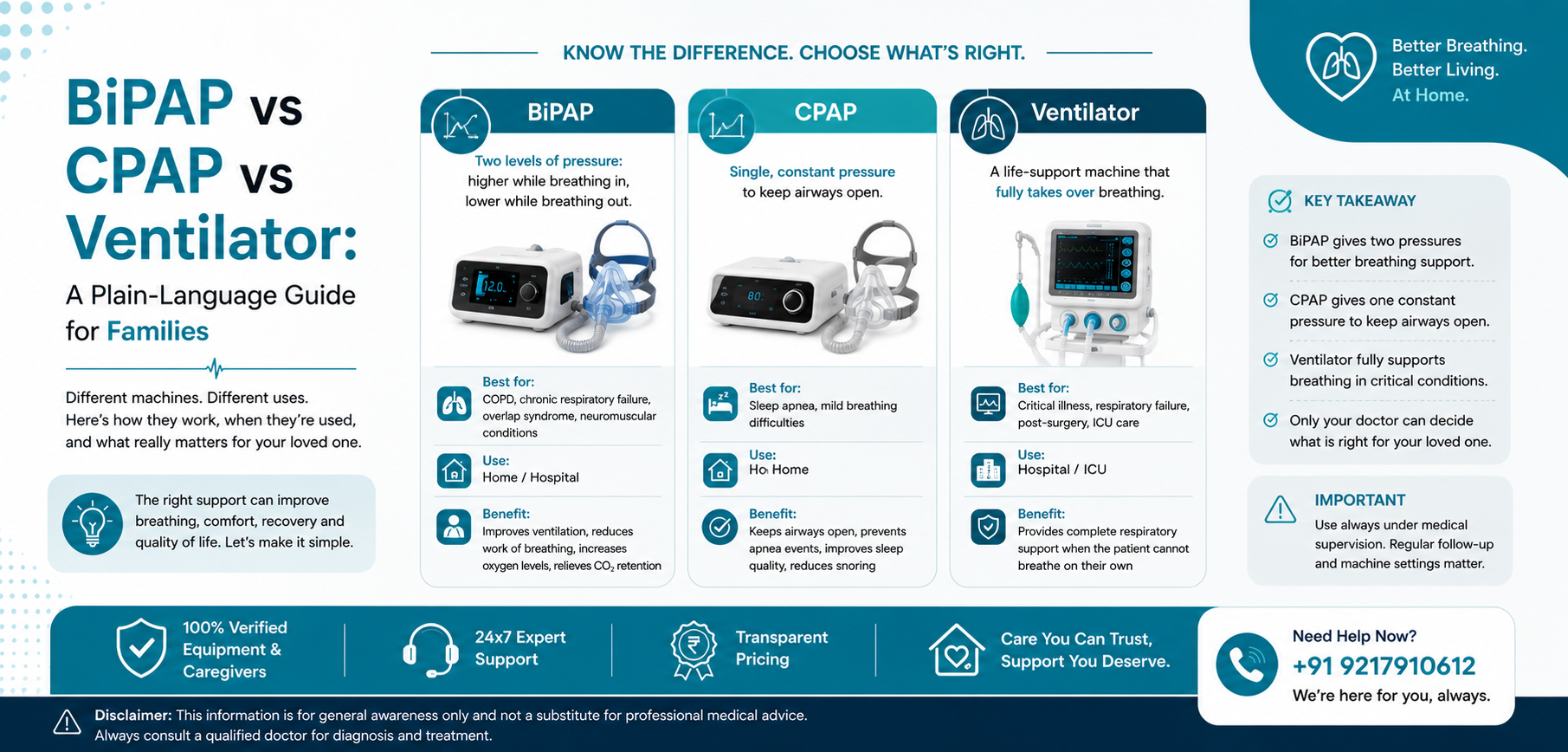
| The discharge summary says your mother needs a BiPAP machine. Your neighbour says his father used a CPAP machine. Your brother-in-law is asking why they did not give her a ventilator instead. You have no idea what any of these machines do or whether the doctor got it right. |
The doctor got it right. These are three different machines for three different medical situations. This guide explains each one in plain language.
The Simple Version: What Each Machine Does
| Machine | What It Does | Who Needs It |
| CPAP | Delivers one constant air pressure to keep the airway open during sleep | Obstructive sleep apnoea (OSA) |
| BiPAP | Delivers two pressures: higher when breathing in, lower when breathing out | COPD, respiratory failure, neuromuscular disease, severe OSA |
| Ventilator | Takes over or assists the entire breathing process | Severe respiratory failure, patients who cannot breathe adequately on their own |
CPAP: For Sleep Apnea
CPAP stands for Continuous Positive Airway Pressure. It delivers one fixed pressure of air continuously through a mask. This pressure acts as a pneumatic splint, keeping the throat open so the patient does not stop breathing repeatedly during sleep.
CPAP is prescribed almost exclusively for Obstructive Sleep Apnoea (OSA), where the airway physically collapses during sleep. Using CPAP for COPD is a common misconception and will not help the patient. The CPAP setting is determined by a sleep study and set by the physician. Common machines: ResMed AirSense, Philips DreamStation CPAP.

BiPAP: For COPD and Respiratory Support
BiPAP stands for Bi-level Positive Airway Pressure. It delivers two pressure levels: IPAP (inspiratory) when the patient breathes in, and EPAP (expiratory) when the patient breathes out. The gap between the two pressures reduces the effort of breathing.
BiPAP is prescribed for:
- COPD with CO2 retention (hypercapnia), the most common reason in Delhi NCR
- Restrictive lung disease (ILD, pulmonary fibrosis)
- Neuromuscular conditions (ALS, muscular dystrophy) where breathing muscles are weakening
- Severe OSA where CPAP pressure alone is insufficient
- Post-surgical respiratory support
BiPAP models at Sanjeevia: from the entry-level Niscomed and BMC basic BiPAP (for straightforward prescriptions) to the ResMed Lumis 100 VPAP ST and Lumis 150 ST (for complex COPD and volume-assured pressure support). The Philips DreamStation and Philips A40 are premium alternatives with equivalent clinical performance to ResMed.
Browse all BiPAP machines on Sanjeevia. Pricing is current and updated on the product page.

Ventilator: For When Breathing Itself Has Failed
A ventilator is prescribed when the patient cannot breathe adequately on their own, even with BiPAP support. It can be set to fully take over breathing (controlled ventilation) or to assist the patient’s own breathing effort.
Home ventilators are prescribed for:
- Advanced ALS or muscular dystrophy where respiratory muscle function is severely compromised
- High spinal cord injury (C3 and above) where breathing is not automatic
- Severe COPD where BiPAP is no longer sufficient
- Patients discharged from ICU who still require ventilatory support
Common home ventilators in India: the Philips Trilogy 100 and ResMed Astral 150 are the two most common life-support ventilators used in home NIV in India. Both support invasive and non-invasive ventilation and have internal battery backup. These are high-acuity devices requiring trained caregivers.

Full Comparison
| Factor | CPAP | BiPAP | Home Ventilator |
| Pressures delivered | One (fixed) | Two (IPAP + EPAP) | Multiple modes, volume and pressure |
| Backup breath rate | No | Yes (in ST mode) | Yes, mandatory in controlled modes |
| Primary condition treated | Obstructive sleep apnoea | COPD, respiratory failure, neuromuscular | Severe respiratory failure, ventilator dependence |
| Complexity of use | Low | Medium | High, trained caregiver required |
| Common brands (India) | ResMed AirSense, Philips DreamStation CPAP | ResMed Lumis, Philips DreamStation, Niscomed, BMC | Philips Trilogy 100, ResMed Astral 150 |
| Rental cost | View current pricing | View current pricing | View current pricing |
A Note on Masks
The mask is as important as the machine. All three devices connect to the patient via a mask interface. Wrong mask type or poor fit causes air leaks, discomfort, and poor therapy. Common mask types:
- Nasal mask: covers the nose only. Most common starting point.
- Full face mask: covers nose and mouth. Required for mouth breathers or patients on higher pressures.
- Nasal pillows: small inserts that fit into the nostrils. Good for claustrophobic patients.
Sanjeevia’s team guides mask selection at delivery and can arrange a different mask type if the first choice does not work. Do not stop BiPAP or CPAP because the mask is uncomfortable without first trying alternative mask types.
Frequently Asked Questions
Q: Can my family member use a CPAP instead of BiPAP to save cost?
No. CPAP and BiPAP address different physiological problems. Using CPAP for a patient who needs BiPAP will not provide the required pressure support for exhalation and will not manage CO2 retention in COPD. Follow the prescription.
Q: Does a BiPAP machine require a special electrical setup?
No. All BiPAP and CPAP machines run on standard Indian 220V household current. A UPS is recommended for patients on overnight BiPAP in areas with frequent power cuts.
Q: My father refuses to use the BiPAP. What do we do?
BiPAP refusal is very common in the first week. Start with the machine on low pressure for short periods while awake to acclimatise. Try a different mask type. Ensure the humidifier is on, as dry air significantly increases discomfort. Most patients who persist through the first two weeks adapt fully.
Q: Is oxygen with BiPAP a separate rental?
Yes. If your doctor has prescribed oxygen alongside BiPAP, the oxygen concentrator is a separate device. Both are delivered and set up together by Sanjeevia’s team, with the oxygen circuit connected to the BiPAP per the prescription.
Rent a BiPAP, CPAP, or Ventilator in Delhi NCR
| Browse all BiPAP and ventilator options Browse oxygen concentrators Read FAQ on BiPAP and CPAP WhatsApp us: +91 92179 10612 |
Keyword Tags
| KEYWORD TAGS: BiPAP on rent Delhi BiPAP on rent DelhiBiPAP vs CPAP difference Indiawhat is BiPAP machinewhat is CPAP machineBiPAP rent Delhi NCRCPAP rent Delhiventilator home rent Delhidifference BiPAP CPAP ventilatorBiPAP machine for COPDCPAP machine for sleep apnoea Indiahome ventilator rent DelhiBiPAP IPAP EPAP explainedResMed Lumis 100 rent DelhiResMed Lumis 150 rent DelhiPhilips DreamStation rent DelhiPhilips A40 rent DelhiNiscomed BiPAP rent DelhiBMC BiPAP rent DelhiResMed AirSense CPAP rentBiPAP for sleep apnoea IndiaBiPAP for neuromuscular disease Indiahome NIV Indianon invasive ventilation home IndiaPhilips Trilogy 100 rent IndiaResMed Astral 150 rent Indiahome ventilator COPD IndiaBiPAP mask Indiafull face mask BiPAPnasal mask BiPAP IndiaBiPAP mask discomfort solutionsBiPAP humidifier IndiaCPAP humidifier IndiaUPS for BiPAP IndiaBiPAP oxygen combination IndiaCPAP oxygen combination IndiaBiPAP CO2 retention COPDBiPAP ALS IndiaBiPAP muscular dystrophy IndiaSanjeevia BiPAP rent DelhiSanjeevia CPAP rentSanjeevia ventilator rentsame day BiPAP delivery Delhirespiratory equipment rent Delhi NCRBiPAP setup at home IndiaBiPAP prescription Indiasleep apnoea treatment IndiaBiPAP overnight therapy home |
Medical Disclaimer
This article is for general informational purposes only and does not constitute medical advice. Equipment selection and home care decisions should be guided by your treating physician. Consult your doctor for all clinical decisions.
Published by Sanjeevia Medical | sanjeevia.com | Delhi NCR