
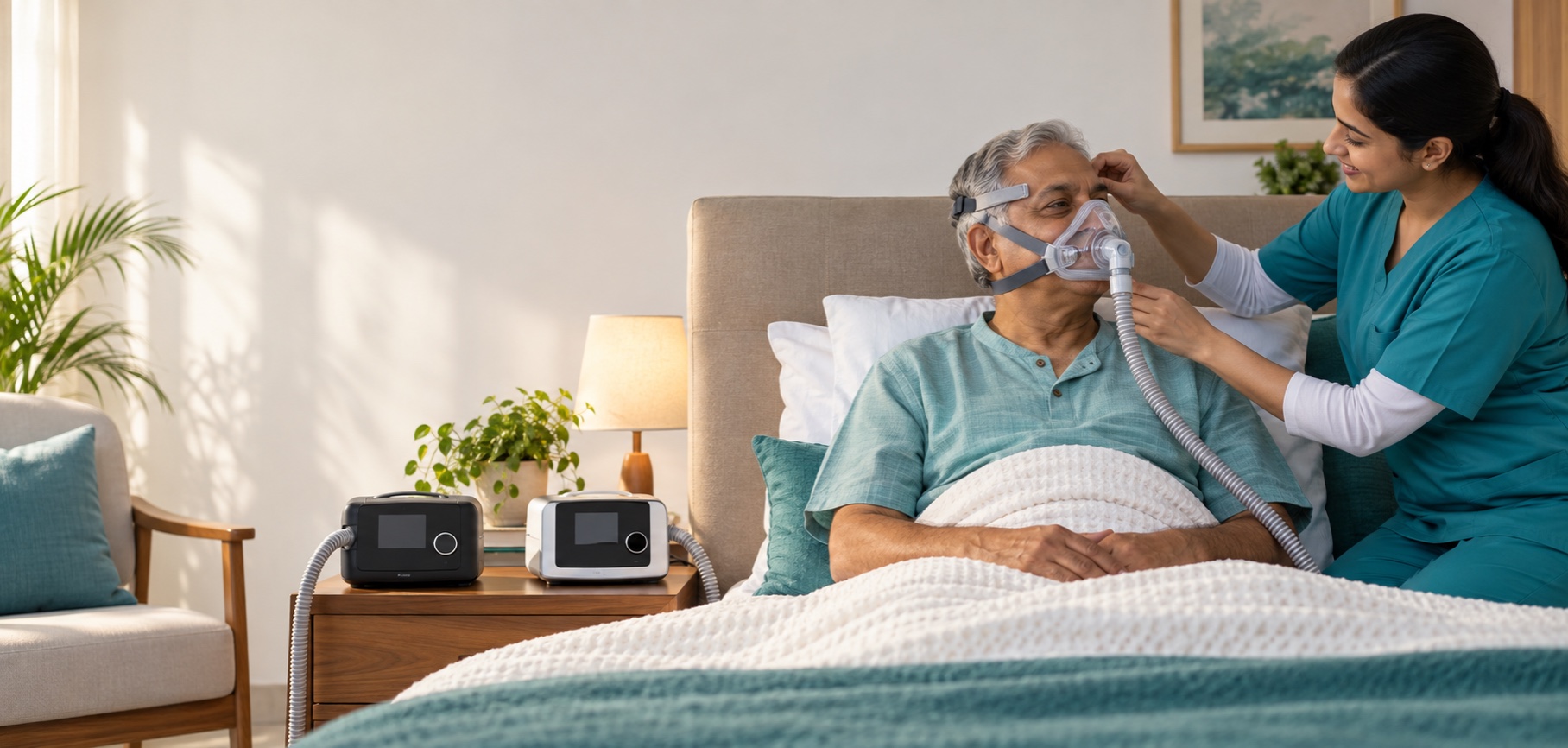
Quick answer: In BiPAP S mode, pressure support follows breaths initiated by the patient. In BiPAP ST mode, the device can also provide a timed breath when the patient’s breathing rate falls below the clinician-set backup rate. This difference can be clinically important. The treating respiratory or sleep specialist must choose the mode and settings from the patient’s diagnosis, test results and response to therapy.
Find the prescribed S or ST device
Compare BiPAP rental models and complete booking costs, including Basic S-mode BiPAP at ₹3,500 for one month and ST-mode rental at ₹4,100. Deck Mount VT60 ST and Deck Mount V90 ST are purchase-only listings; confirm the exact supported features before selecting either.
Families arranging a bilevel machine for home often receive a short discharge note that says “BiPAP,” “S,” “ST,” IPAP, EPAP or a respiratory rate. It is easy to focus on the machine name and miss the prescription details. Yet similar-looking devices can support different modes, and model titles do not prove which modes are enabled.
This guide explains the selection checks to complete before arranging a home unit. It does not provide therapy settings and should never be used to change a prescribed device.
What bilevel positive airway pressure does
Bilevel positive airway pressure provides one prescribed pressure during inhalation and another during exhalation. These are commonly described as IPAP and EPAP. The American Thoracic Society’s patient guide to CPAP and BPAP explains that BPAP can be used when a person needs different breathing support from standard continuous airway pressure, including some people who do not breathe enough on their own.
The therapy device, circuit and mask form one system. A correct machine with an unsuitable mask, a blocked vent or a poorly fitted circuit can still make therapy ineffective or unsafe.
BiPAP S and ST modes compared
| Feature | S mode | ST mode |
|---|---|---|
| How supported breaths begin | The patient initiates the breath and the machine responds | The patient can initiate a breath, and a timed breath is available if breathing falls below the set backup rate |
| Backup rate | Not the defining feature of spontaneous mode | Set by the clinician as part of the prescription |
| Who decides | Respiratory or sleep specialist after assessment | Respiratory or sleep specialist after assessment |
| What families must confirm | Exact enabled mode, IPAP, EPAP, mask and circuit | Exact enabled mode, IPAP, EPAP, backup rate, mask and circuit |
ResMed’s therapy handbook describes ST mode as providing additional breaths when the patient’s respiratory rate falls below the set backup rate. The document also makes clear that availability and indications vary by device. This is why an exact model and written mode confirmation matter.
Do not select from the model name alone
Sanjeevia lists several respiratory devices, including the Deck Mount V90 unit, Deck Mount VT60 unit, basic bilevel options, a BiPAP ST selection and the ResMed Lumis 150 ST. Treat these pages as starting points for discussion.
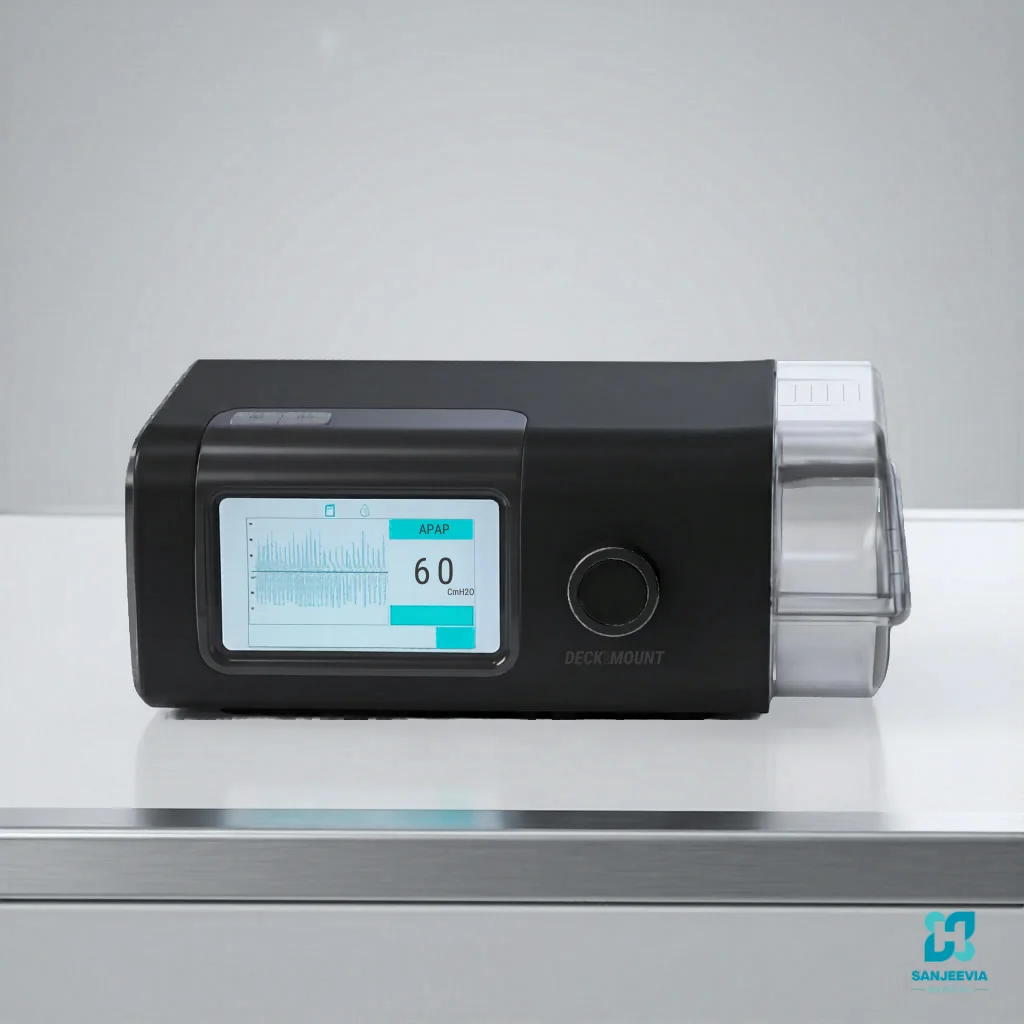
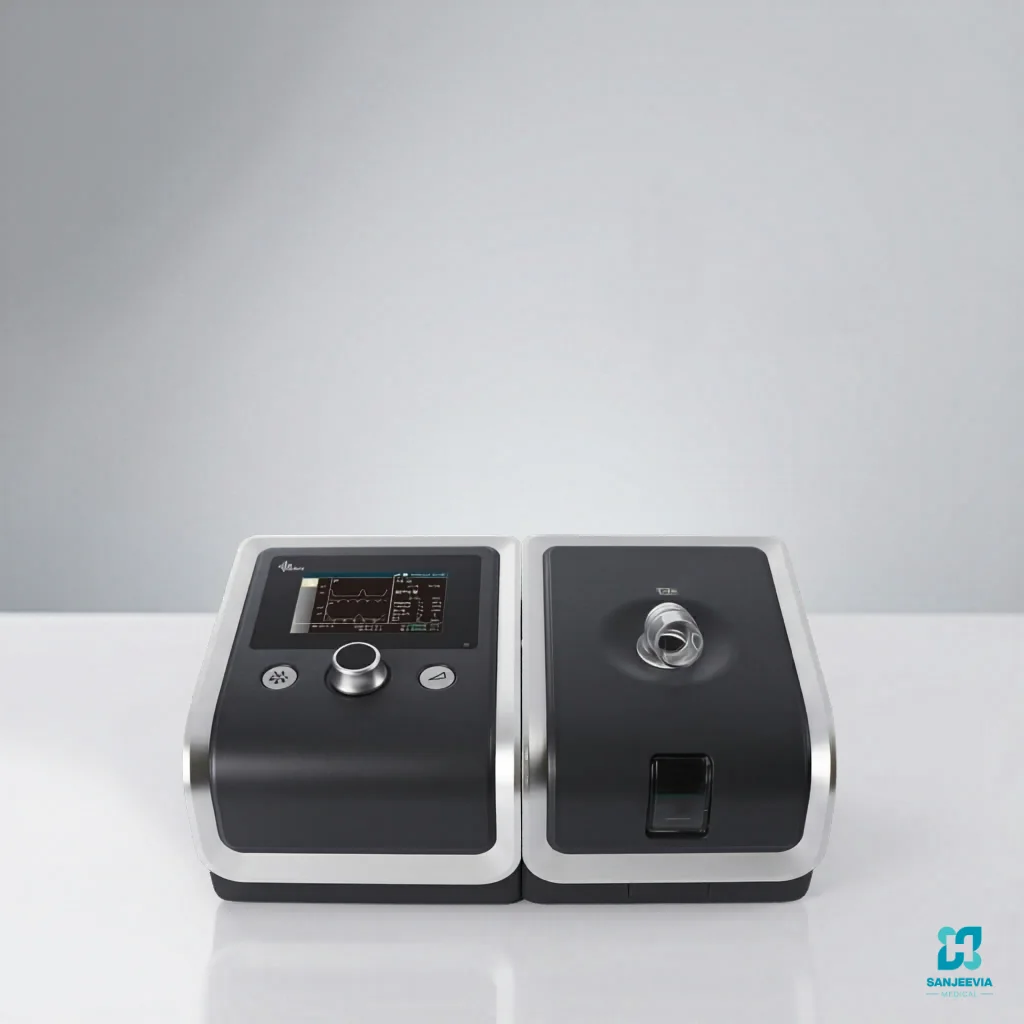
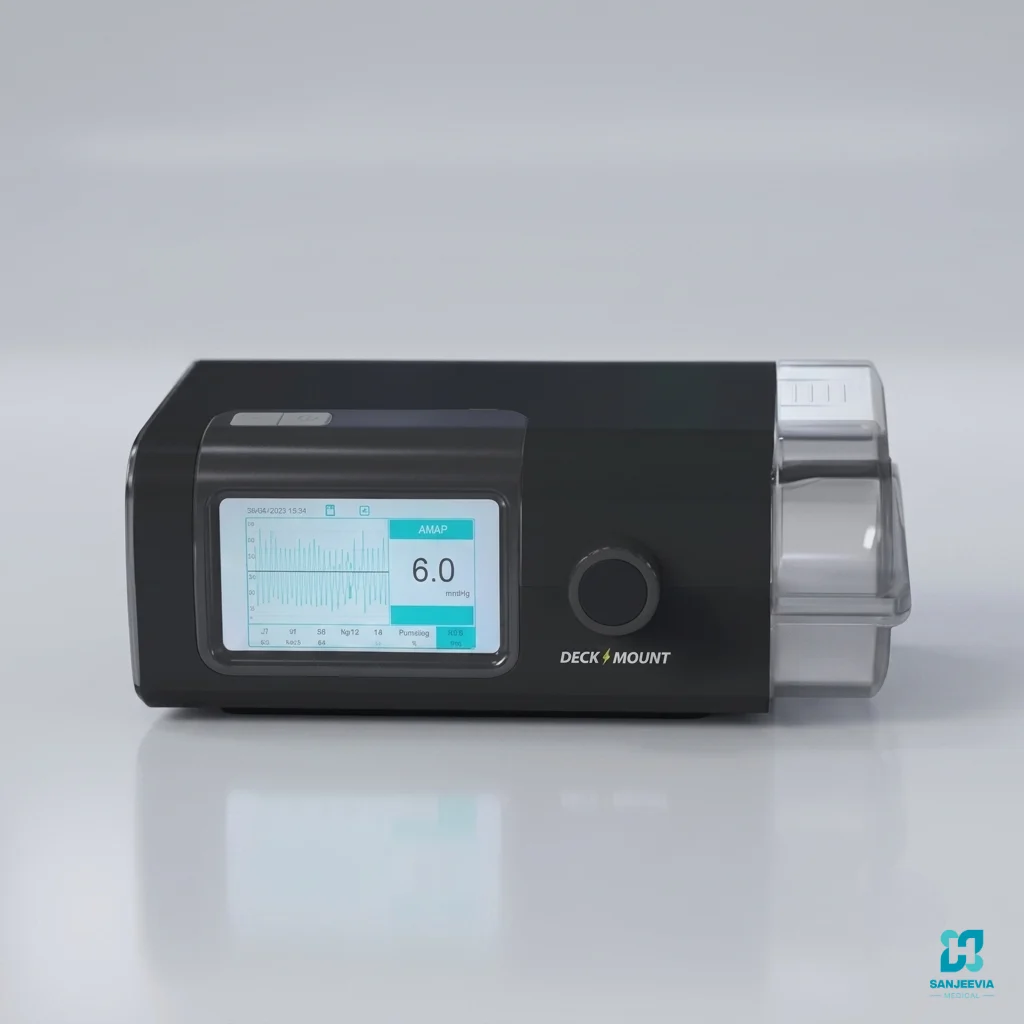
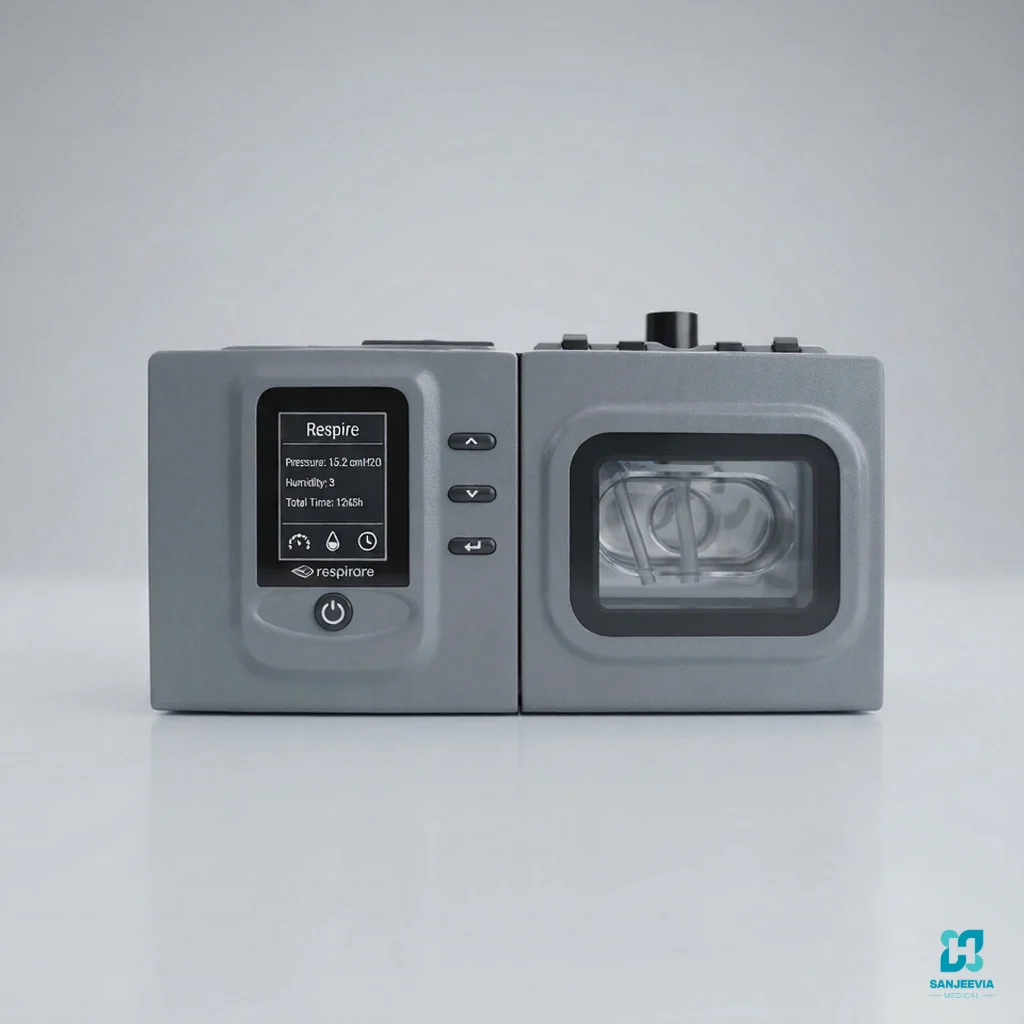
Before arranging any unit, ask the team to match the label on the physical device and its written specification with the prescription. Confirm that the requested mode is actually available and enabled. The letters in a listing title are not a substitute for that check.
The prescription details to copy exactly
Ask the treating clinician or respiratory therapist for a legible, current prescription. Depending on the case and device, it may include:
- therapy mode, such as S or ST;
- inspiratory and expiratory pressure settings;
- a backup respiratory rate if prescribed;
- inspiratory timing or rise-time instructions where relevant;
- the mask type and intended circuit;
- whether humidification is advised;
- hours of use and monitoring or review plan;
- instructions for supplemental oxygen, only when specifically prescribed.
Do not copy settings from a previous patient, an online video or a similar machine. Device menus and algorithms vary. If the discharge document and the machine label do not match, pause the setup and contact the treating team.
Mask, circuit and leak checks matter
A nasal, oronasal or full-face interface may be chosen according to the prescription, breathing pattern and tolerance. The mask should seal without excessive strap tension. A visible or audible leak, dry mouth, eye irritation or pressure marks needs review rather than repeated tightening.
Vented and non-vented masks are not interchangeable. The required exhalation path depends on the machine and circuit. Blocking a vent or assembling incompatible parts can cause rebreathing. Only use the mask, tubing, connectors and filters confirmed for that setup.
A home NIV service from University Hospitals Sussex advises that the device is individually set and that mask fit should minimise leak without over-tightening. Families should receive hands-on training and written support details.
Prepare the room before the device arrives
- Use a stable surface: keep the unit where it cannot be pulled down by the hose.
- Keep air vents open: leave the manufacturer-recommended space around the intake and exhaust.
- Plan reliable power: confirm the plug point, backup plan and what to do during an outage.
- Route tubing safely: avoid sharp bends, bed-rail traps and paths where someone can trip.
- Keep the area clean and dry: follow the maker’s instructions for filters, tubing, mask and humidifier chamber.
- Protect the prescribed settings: caregivers should know which controls they may use and which require clinical direction.
If a broader respiratory setup is needed, review Sanjeevia’s respiratory-care range. Oxygen is a separate therapy and should only be connected when the clinician has specified how it integrates with the circuit.
Handover checklist for the family
At handover, compare the physical model label with the booking and prescription. Ask the technician to demonstrate assembly, mask fitting, start and stop controls, humidifier use if applicable, filter care and alarm response. Make sure the caregiver can recognise a disconnected tube, excessive leak and loss of power.
Record the device serial number, prescribed mode and clinical support contact. Keep the user manual nearby. Arrange the clinician’s follow-up, especially if the patient has recently left hospital. Sanjeevia’s ICU discharge home-care checklist can help coordinate equipment, caregiver training and room readiness.
When to seek urgent medical help
Use the emergency plan provided by the treating team. Seek urgent medical help for severe breathlessness, blue or grey lips, new confusion, inability to stay awake, chest pain, rapidly worsening distress or any situation in which the device is not supporting the patient as expected. Do not spend time changing clinical settings unless a qualified professional directs you.
Frequently asked questions
Is ST mode simply a stronger version of S mode?
No. The key distinction is timed support through a clinician-set backup rate. The required mode depends on the person’s breathing problem and assessment, not on a simple strength scale.
Can a family member set the backup rate?
No. The treating respiratory or sleep specialist should prescribe it. A technician may enter prescribed settings during handover, but should not independently choose therapy parameters.
Can the same mask be used with every bilevel machine?
No. Mask venting and circuit design must be compatible with the exact device. Confirm all parts together.
Is a BiPAP machine the same as an oxygen concentrator?
No. A bilevel device provides pressure support for breathing. An oxygen concentrator supplies enriched oxygen. Some patients are prescribed both, but only the clinical team should specify that arrangement.
What should I send when asking about availability?
Send the prescription, diagnosis if available, requested mode, settings, mask type, expected duration and delivery location. Remove unrelated personal details from shared documents.
Arrange only after the mode is confirmed
For help matching an available model to a written prescription, contact Sanjeevia. Ask for confirmation of the exact machine, enabled mode, included circuit and mask requirements before finalising the setup.
This article is educational. BiPAP is prescribed respiratory support and must be selected, set and monitored by qualified clinicians.
Next read: Auto CPAP vs fixed CPAP for home use.