

A semi-Fowler bed has one main adjustment, but that does not make setup automatic. The crank, backrest hinge, mattress joint, rails and transfer height must work together; a single incompatible part can change how safely the bed is used.
Quick answer: A manual semi-Fowler bed uses one crank to raise or lower the backrest while the remaining platform stays fixed. It provides positioning support, not diagnosis or treatment, and the actual angle must follow the individual care plan.
Explore relevant equipment
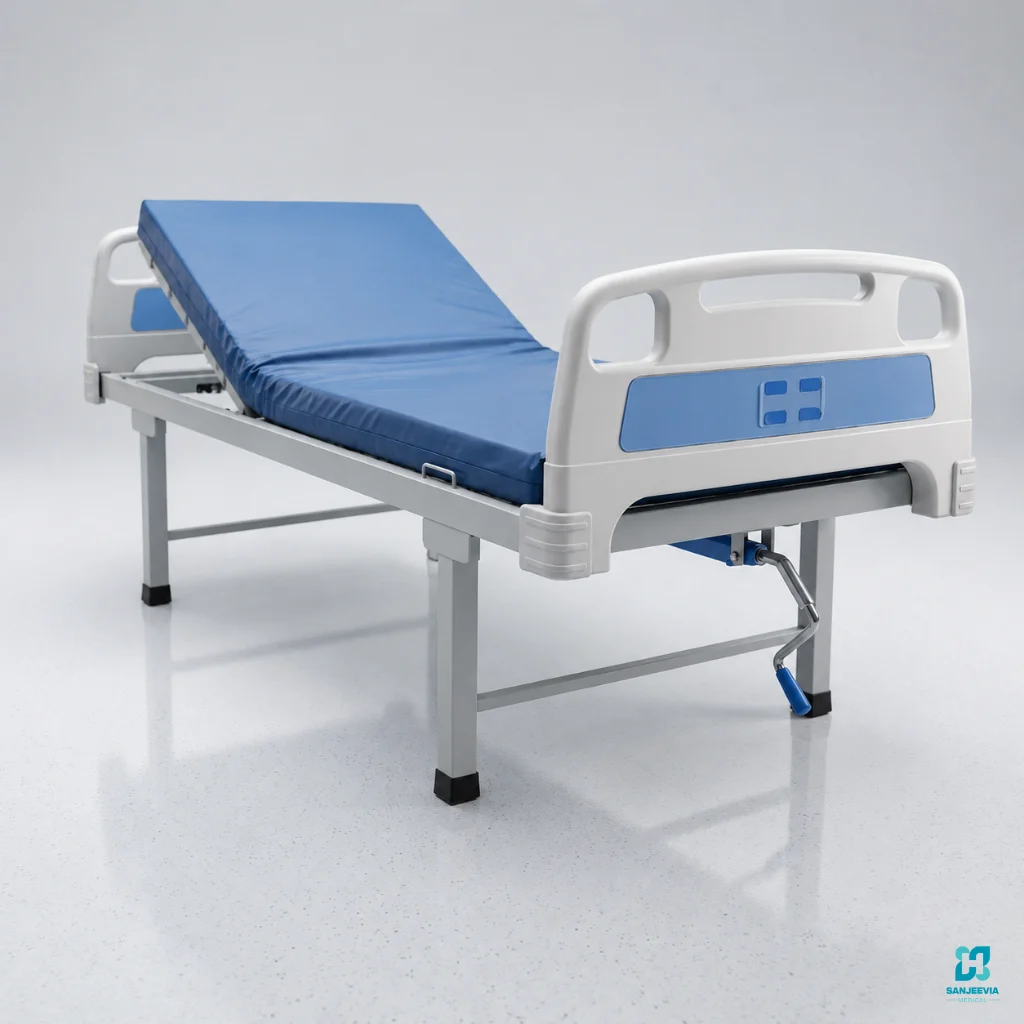
Manual Semi Fowler Bed – ABS Side Rails
Review the live listing for the confirmed configuration, included parts and current Delhi NCR rental or purchase options.

Manual Semi Fowler Bed – MS Rails
Review the live listing for the confirmed configuration, included parts and current Delhi NCR rental or purchase options.
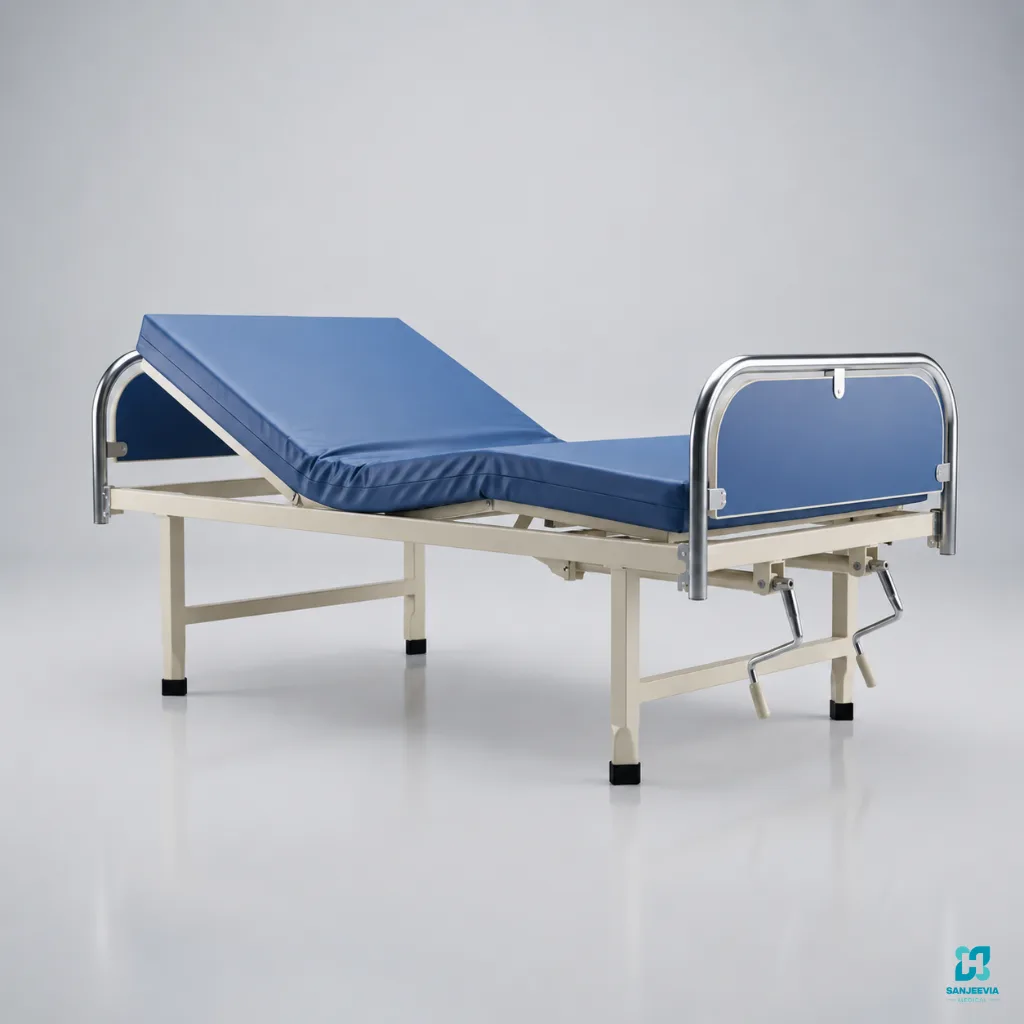
Manual Full Fowler Bed
Review the live listing for the confirmed configuration, included parts and current Delhi NCR rental or purchase options.
Confirm the exact bed, mattress, rails, accessories, room access and handover before booking.
Jump to equipment details
How a semi-Fowler bed works
Turning the single crank drives a screw mechanism that changes the backrest section. The seat and leg deck remain fixed on this one-function manual design. The two-section mattress bends at the backrest joint so the surface follows the platform.
“Semi-Fowler” describes a type of supported head-and-torso elevation, but listings often quote different angle ranges. Do not use an advertised number as a treatment setting. The responsible clinician decides whether elevation is required and the caregiver uses the actual bed within its instructions.
A manual mechanism does not need mains power, which can simplify power-cut planning. It still needs physical effort, clear crank access and a caregiver who can operate it without reaching under a loaded moving structure.
Parts, controls and ABS versus MS rails
| Part | Function | Check |
|---|---|---|
| Backrest deck | Raises the upper-body support. | Moves smoothly and supports the mattress without a hard gap. |
| Single crank | Manually drives the backrest. | Handle is secure, folds/stows correctly and does not bind. |
| Two-section mattress | Follows the backrest hinge. | Correct size, intact cover and aligned joint. |
| ABS or MS rails | Provide a bed-edge barrier when assessed. | Compatible latches, no deformation and safe gaps. |
| Castors and brakes | Allow positioning of the empty bed and stabilise it. | Each wheel rolls and each brake holds on the room floor. |
ABS panels and mild-steel grill rails differ in surfaces, openings, weight and cleaning detail. Neither is automatically best. The whole bed–rail–mattress combination and the user’s behaviour matter more than the material name.
Safe everyday operation
- Check the bed is stable, brakes are applied and the crank route is clear.
- Confirm linen, tubing and the mattress are not caught at the backrest hinge.
- Tell the patient before movement and observe their posture and attached devices.
- Turn the crank steadily in the demonstrated direction. Do not force it at the end of travel.
- Stop if the mechanism binds, the patient slides, tubing pulls or the mattress bunches.
- Stow the crank as demonstrated so it does not become a trip or impact hazard.
For transfers, use the position taught by the physiotherapist, nurse or occupational therapist. Do not ask a patient to pull on a rail unless that rail is specifically intended and assessed as a support handle.
Rails, mattress fit and room setup
Rails are not automatically required. They may reduce an assessed risk of rolling from bed, but can also create entrapment points between the rail, mattress, head/foot board and moving backrest. Reassess when the mattress, overlay, rail or patient condition changes.
Measure the complete bed and its turning route from building entrance to room. Leave space at the crank end and caregiver side. Keep castors on a level surface and do not block brakes with furniture. Confirm the mattress does not leave a large side gap or ride above the intended rail relationship.
Before the first patient use, raise and lower the empty backrest while watching rails, mattress, cable/tubing routes and wall clearance.
Common mistakes
- Forcing the crank instead of checking whether the mechanism is at its limit or obstructed.
- Using a one-piece household mattress that resists the hinge.
- Leaving one castor unlocked or assuming a wheel brake makes the bed safe on a slope.
- Adding an overlay that changes rail height and gaps without reassessment.
- Moving the bed with the patient aboard without model-specific permission and trained help.
- Sitting on the unsupported raised backrest edge.
- Using the same elevation for every condition or every meal without a care plan.
New pain, dizziness, breathlessness, skin redness, repeated sliding or near-falls require review of the person and care plan, not merely another crank adjustment.
Need help matching the bed?
Share the patient’s mobility, transfer method, required bed movements, mattress needs and delivery access. Sanjeevia can help confirm the configuration and current Delhi NCR options.
Cleaning and inspection
Clean bed rails, crank handle, boards and other high-touch areas with a compatible product. Remove visible soil first, follow the disinfectant’s contact time and dry the surfaces. Do not soak joints or leave wet floors around the castors.
Inspect the crank, screw drive, deck hinges, rail latches, fasteners, castors, brakes and mattress cover. Stop using the adjustment if parts are bent, loose, cracked or unusually noisy. After a collision or fall, inspect before continued use.
Rental handover should identify who reports a fault, what accessories belong with the bed and how exchange or pickup is arranged.
Questions before renting or buying in Delhi NCR
- Is one backrest adjustment sufficient for the written care plan?
- Which rail variant is being supplied, and has it been assessed for this user?
- Is the correctly sectioned mattress included?
- Can the caregiver reach and turn the crank comfortably?
- Do the lift, doorway, corridor and room accept the complete bed?
- Are all castors braked individually, and is the floor level?
- What are the delivery, setup, demonstration, service and return terms?
Compare the hospital bed overview, mattress guide and room-preparation checklist before delivery.
Frequently asked questions
Does semi-Fowler mean a fixed angle?
No. It describes an elevated position; use the setting prescribed and demonstrated for the individual.
What is the difference between ABS and MS rails?
They use different materials and openings. Safety depends on compatibility, condition, gaps and the user assessment.
Does the bed work during a power cut?
The manual crank does not rely on mains electricity, although attached medical devices may.
Can the crank be used while the patient is in bed?
Usually that is its purpose, but only after handover and while monitoring the patient and all attached lines.
Explore your equipment options
Manual Semi Fowler Bed – ABS Side Rails
Review the live listing for the confirmed configuration, included parts and current Delhi NCR rental or purchase options.
Manual Semi Fowler Bed – MS Rails
Review the live listing for the confirmed configuration, included parts and current Delhi NCR rental or purchase options.
Manual Full Fowler Bed
Review the live listing for the confirmed configuration, included parts and current Delhi NCR rental or purchase options.
Confirm the exact bed, mattress, rails, accessories, room access and handover before booking.
Sources and useful reading
- MHRA: Bed rails—management and safe use.
- FDA: Hospital bed system guidance to reduce entrapment.
- NHSRC India: Biomedical Equipment Management and Maintenance Programme.
- CDC: Environmental cleaning procedures and noncritical equipment.
- Sanjeevia Manual Semi Fowler Bed—ABS Rails listing.
- Sanjeevia Manual Semi Fowler Bed—MS Rails listing.
Prepared by Sanjeevia’s editorial team. Updated 10 November 2026. Equipment selection and positioning should follow the individual care plan and trained handover.
