
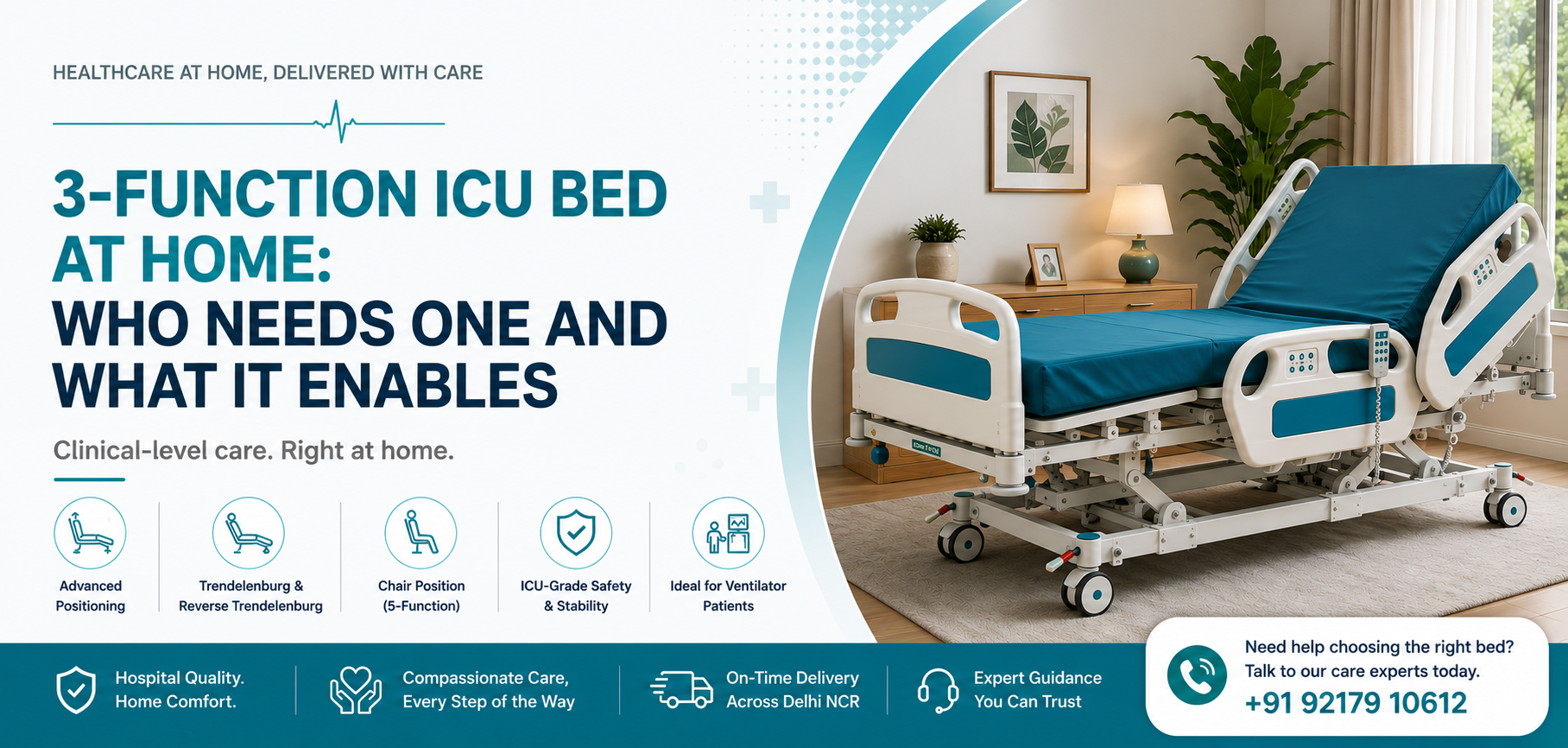
| Quick Answer Function counts and “ICU” labels vary by manufacturer. Confirm the exact model, listed functions, safe working load and accessories before ordering. A standard 3-function bed commonly provides backrest, knee-rest and height adjustment; Trendelenburg, reverse Trendelenburg and chair-position functions are additional features on selected models. Advanced functions should be selected and used only when the treating team has included them in the care plan. |
Your father was in the ICU for 18 days. He is coming home on a ventilator. The discharging intensivist has written in the notes that he needs an ICU-grade bed. You open the catalogue and see 3-function ICU beds and 5-function electric beds at a price point considerably above the standard electric beds. You are not sure what the difference is or whether you actually need it.
This guide explains what ICU-grade beds enable, when they are genuinely necessary, and what additional preparation the home setup requires for this level of care.
What Makes an ICU Bed Different from a Standard Electric Bed
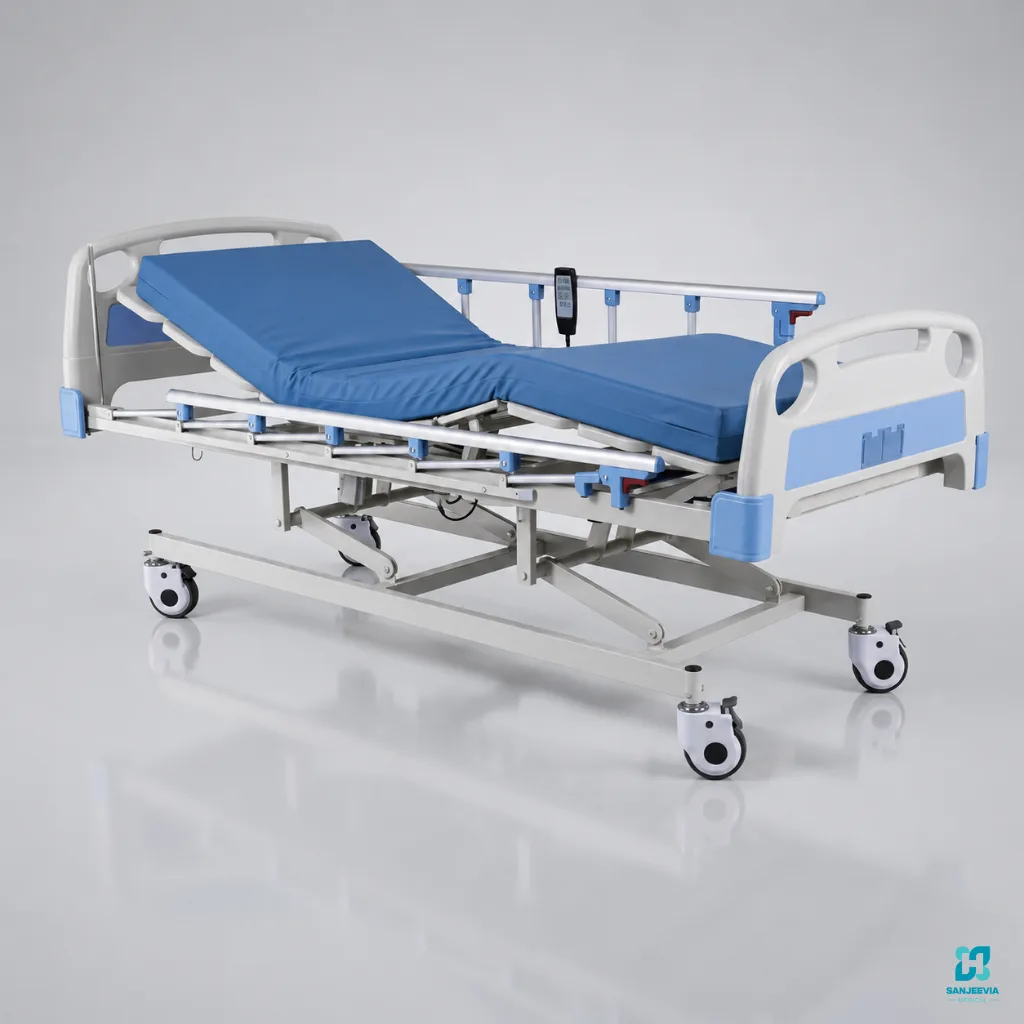
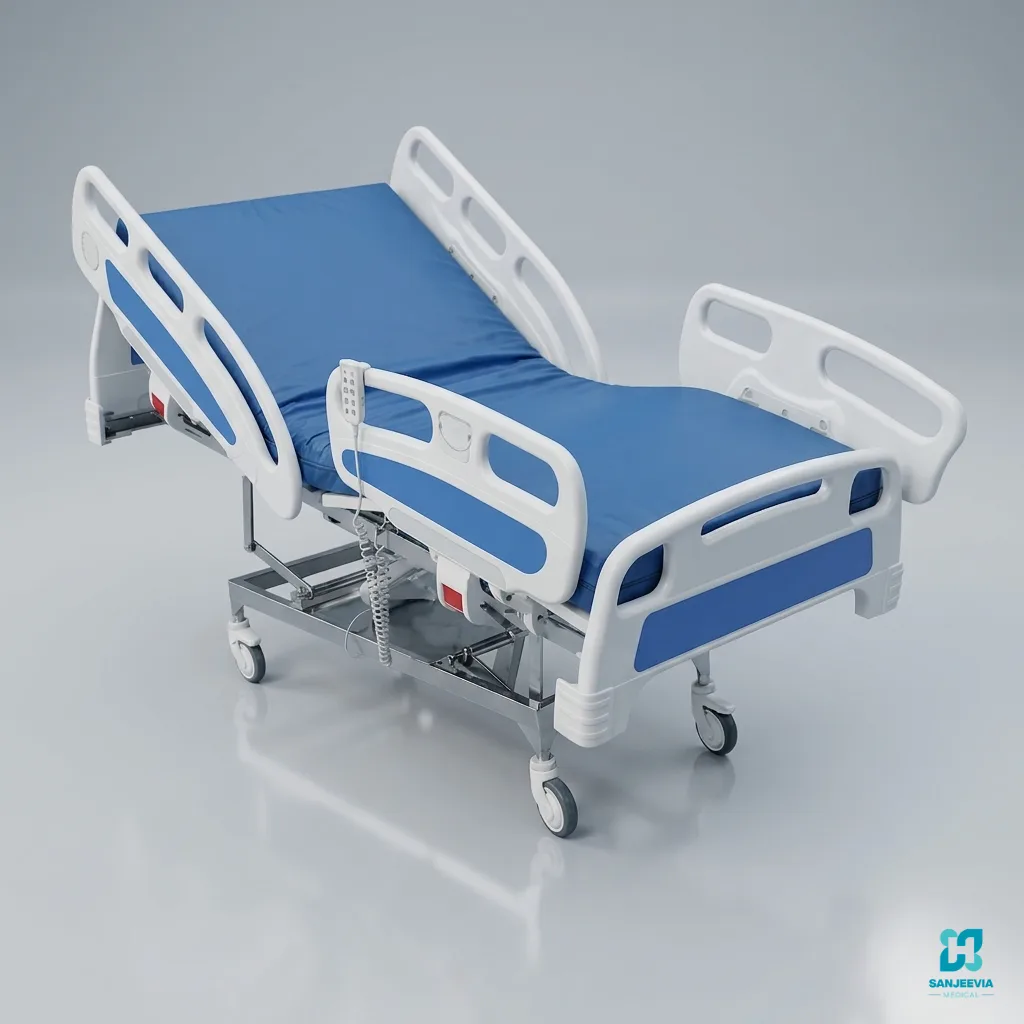
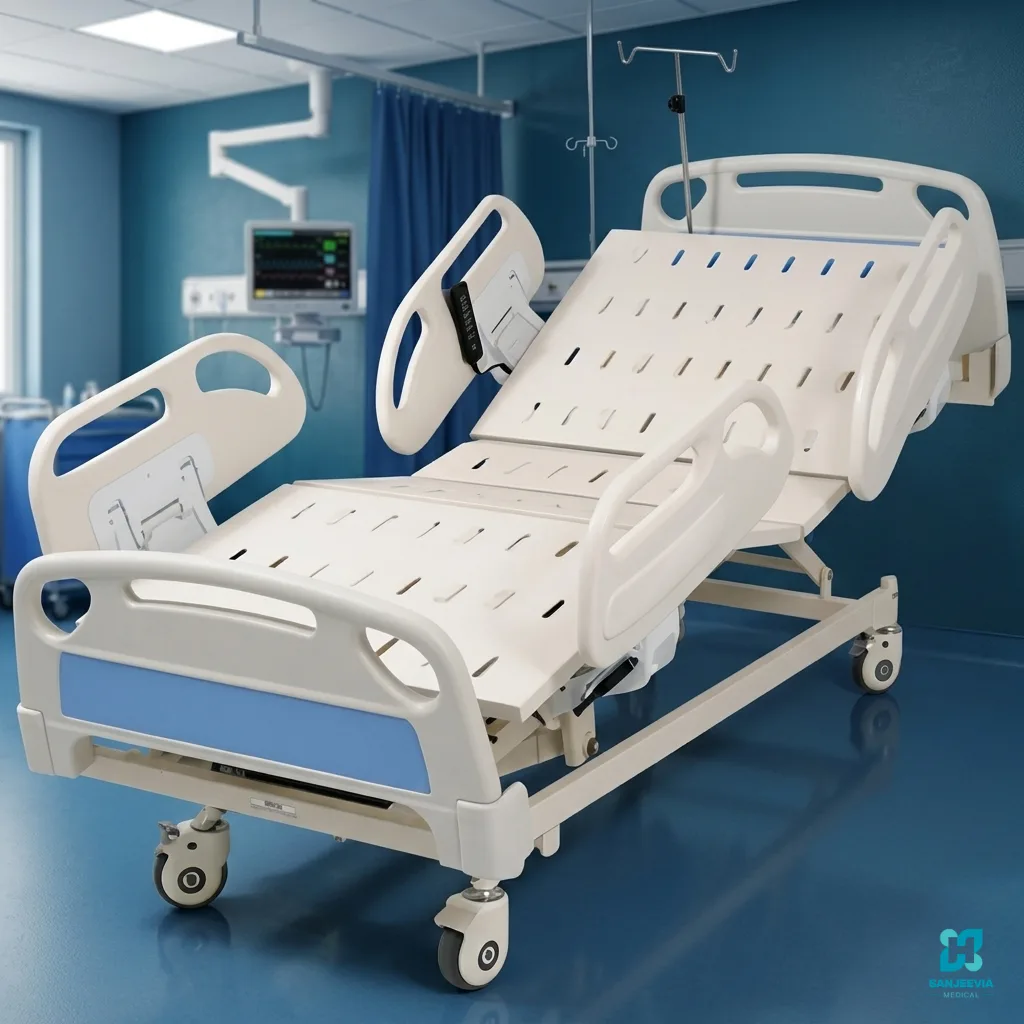
A standard 3-function electric bed controls backrest, knee section, and height. An ICU-grade bed adds positioning capabilities that are used in clinical settings for specific medical requirements:
| Positioning Function | Standard 3F Electric Bed | 3F ICU / 5F Electric Bed |
| Backrest elevation | Yes, electric | Yes, electric |
| Knee section elevation | Yes, electric | Yes, electric |
| Full bed height | Yes, electric | Yes, electric |
| Trendelenburg (feet higher than head) | Not normally included | Available only on selected advanced models; verify the exact model |
| Reverse Trendelenburg (head higher than feet) | Not normally included | Available only on selected advanced models; verify the exact model |
| Chair position | Varies by model | May be available on selected advanced models; verify the exact model |
| Load capacity | Verify product specification | Verify product specification |
| Frame construction | Verify product specification | Verify product specification |
| Accessories (IV pole, side tray, drainage bag hooks) | May be available | May be available; confirm compatibility and the care plan |
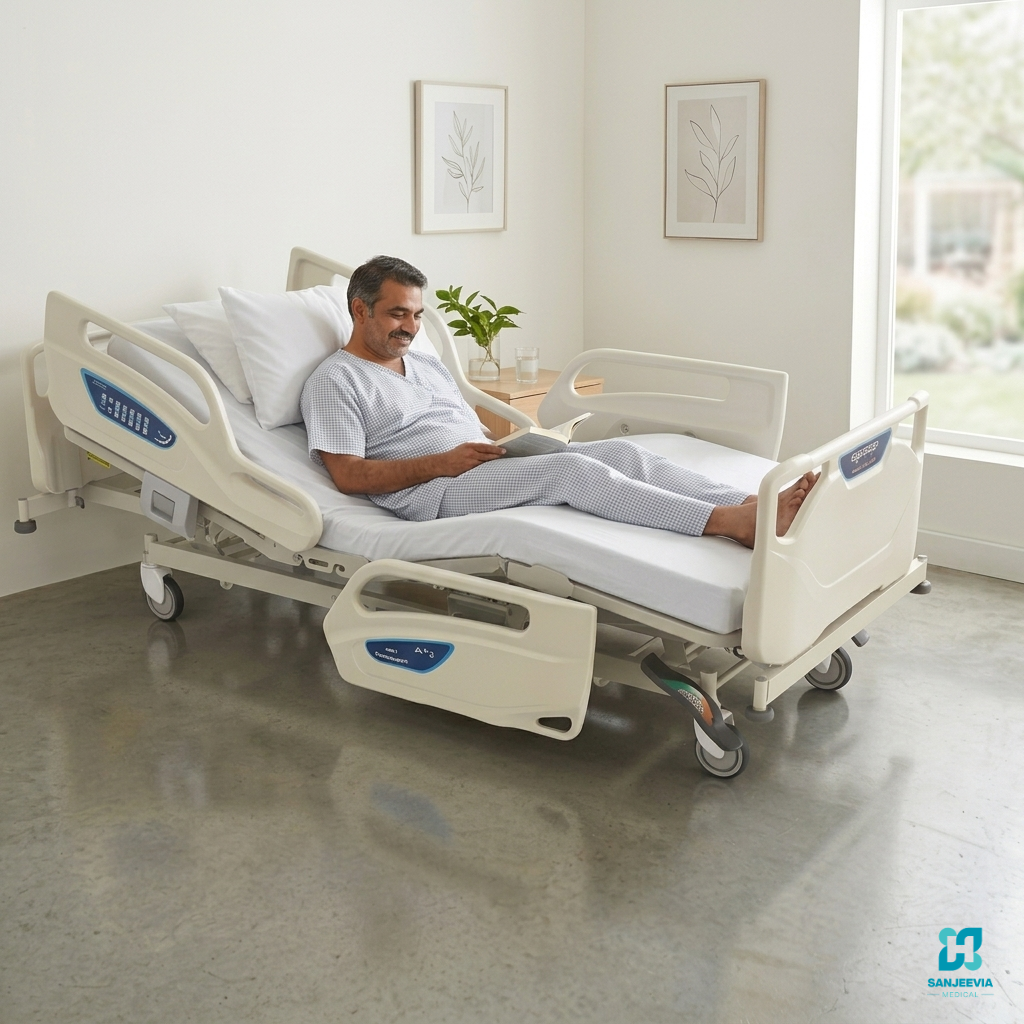
Trendelenburg Position: When Is It Prescribed?
Trendelenburg and reverse Trendelenburg are advanced tilt positions in which the entire mattress platform is angled. They are not routine comfort or respiratory settings. Use either position only when it is available on the confirmed model and specifically directed by the treating clinician.
Do not use these functions independently to manage low blood pressure, secretions, aspiration risk or wounds. The patient’s care team should prescribe the position, angle, duration and monitoring required.
If advanced tilt or chair functions are not specified in the care plan, do not assume they are required. Select the least complex bed that meets the prescribed positioning, transfer and caregiver-access needs.
The Ventilator-Dependent Patient at Home
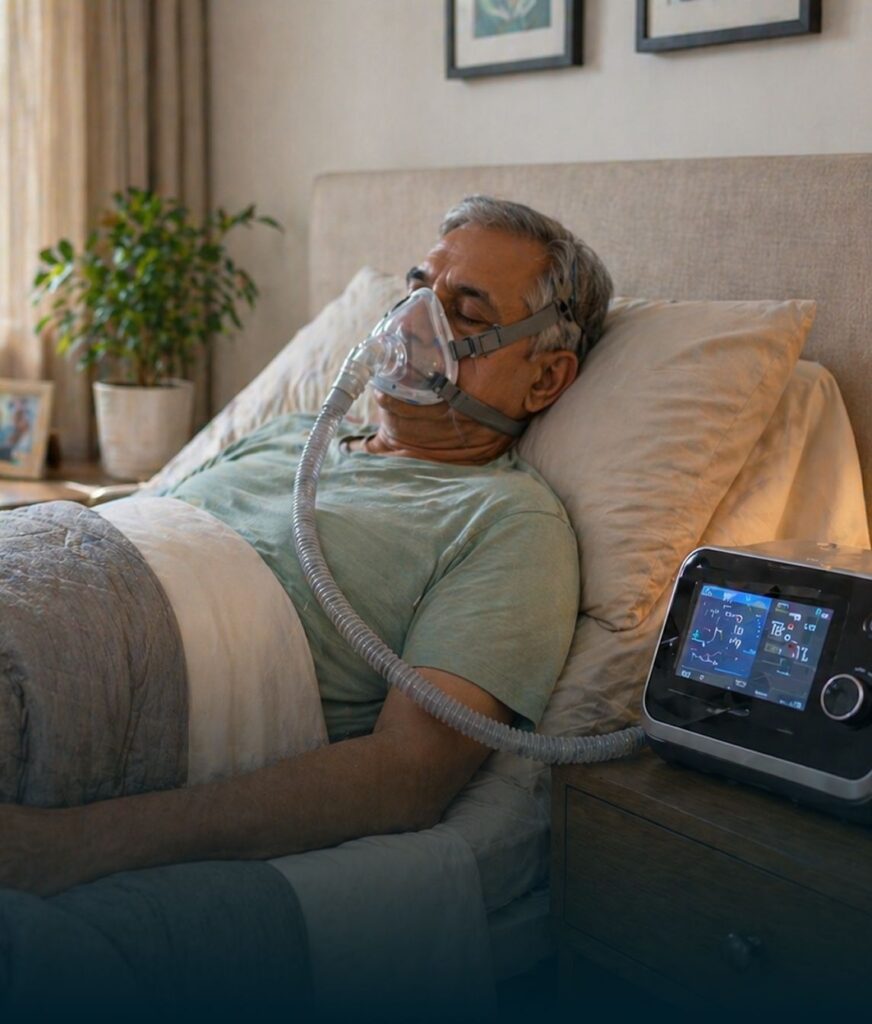
A patient discharged with home ventilation requires a written, clinician-led positioning and transfer plan. The bed should be chosen only after confirming the prescribed positions, the model’s documented functions, airway-device management requirements, caregiver capability and room setup.
- Use the head-of-bed angle, bed position and monitoring plan specified by the respiratory or critical-care team; do not substitute reverse Trendelenburg for backrest adjustment without their direction.
- Any secretion-management position should be prescribed for the individual patient and performed by trained carers where required.
- Transfers must protect tubing, lines and monitoring equipment and follow the method taught at discharge.
- Advanced functions may assist the prescribed care plan, but they do not replace trained handling, monitoring or clinical review.
Patients receiving home ventilation may require a prescribed ventilator, monitoring or oxygen equipment. Browse respiratory care equipment on Sanjeevia. For a complete post-ICU setup, WhatsApp us directly, and we will coordinate the full equipment list before discharge day.
Caregiver Training Requirements for ICU-Grade Home Care
This is the part most families are not told at discharge. Renting an ICU bed is the simpler part of the arrangement. Managing the care it enables is more demanding:
- Suctioning: ventilator-dependent and high-secretion patients require regular airway suctioning. This is a trained procedure. The family member or paid attendant managing this must be trained by the hospital nursing team before the patient is discharged.
- Ventilator alarm management: home ventilators have multiple alarms for disconnection, high pressure, low pressure, and apnoea events. The family must be trained to distinguish and respond to each alarm correctly. A false alarm muted and ignored can become a genuine emergency.
- Tracheostomy care (if applicable): patients with tracheostomy tubes require regular tube care, inner cannula cleaning, and tie changes. This is clinical nursing work. A paid trained nurse or respiratory therapist visiting daily is strongly recommended.
- Emergency plan: ICU-grade patients at home need a documented emergency protocol: what constitutes a call to the physician, what constitutes calling emergency services, and which hospital the patient returns to. This should be written and visible in the room.
An ICU-grade bed without the corresponding caregiver training and support network in place is not safe home care. The equipment enables the clinical management. It does not replace it.
Frequently Asked Questions
Q: My parent is post-ICU but not on a ventilator. Do they still need an ICU-grade bed?
Not necessarily. Review the written discharge plan with the discharging clinician. If advanced functions are not specified, a bed with the required basic functions may be appropriate. Confirm the exact model specification, transfer plan and load requirement before selection.
Q: What is the minimum ceiling height needed for an ICU bed with Trendelenburg function?
Confirm the current product dimensions, operating clearances and installation requirements before delivery. Check the room, doorway and transfer space against the model’s documented footprint rather than relying on a generic ceiling-height rule.
Q: Can the patient use a regular wheelchair for transfers from an ICU bed?
Only if the patient’s transfer plan permits it. Confirm the specific transfer technique with the physiotherapist or nursing team at discharge, because it depends on the patient’s condition, level of consciousness, mobility, and any lines or tubes in place.
Q: How quickly can Sanjeevia deliver an ICU-grade bed if discharge is sudden?
Same-day delivery is available for orders placed before 4 PM across Delhi NCR. For ICU-grade setups with multiple concurrent equipment needs, contact Sanjeevia directly as soon as a discharge date is known. We will coordinate the full setup, confirm the room layout, and plan delivery sequencing so everything is in place before the patient arrives.
| Set up ICU-grade home care in Delhi NCR: Browse all hospital beds including ICU-grade options Browse respiratory care and ventilator support equipment ICU discharge coordination: WhatsApp us immediately: +91 92179 10612. Give us the discharge date and we handle the rest. |
Related Guidance and Equipment
These links connect the patient’s positioning and transfer needs with the most relevant bed guidance and exact product specifications.
Continue Reading
- What Are the Three Functions in a Hospital Bed? — understand backrest, knee-rest and height adjustment.
- Hospital Bed Rental Checklist — confirm functions, mattress, rails and delivery details.
Relevant Product Pages
- 5-Function Electric Hospital Bed — review advanced positioning for clinician-led care.
- 3-Function ICU Bed — check ICU-style bed functions and included equipment.
Medical Disclaimer: This article is for general informational purposes only and does not constitute medical advice. All clinical and equipment decisions should be guided by your treating physician.
Published by Sanjeevia Medical | sanjeevia.com | Delhi NCR