
Quick answer: An oxygen concentrator and a medical oxygen cylinder can both supply prescribed oxygen, but they work differently. The appropriate source and backup arrangement must be based on the written prescription, the patient’s clinical dependence, mobility needs, available electricity and a documented contingency plan.
Do not choose between them only by diagnosis or by the number of daily hours. The treating team should define the oxygen requirement; the equipment provider should match that requirement to verified equipment specifications.
How the two oxygen sources work
Oxygen concentrator
A concentrator takes in room air and supplies oxygen while electricity is available and the unit is operating correctly. It does not need routine cylinder refilling, but it depends on power, maintenance and the performance limits of the exact model.
Medical oxygen cylinder
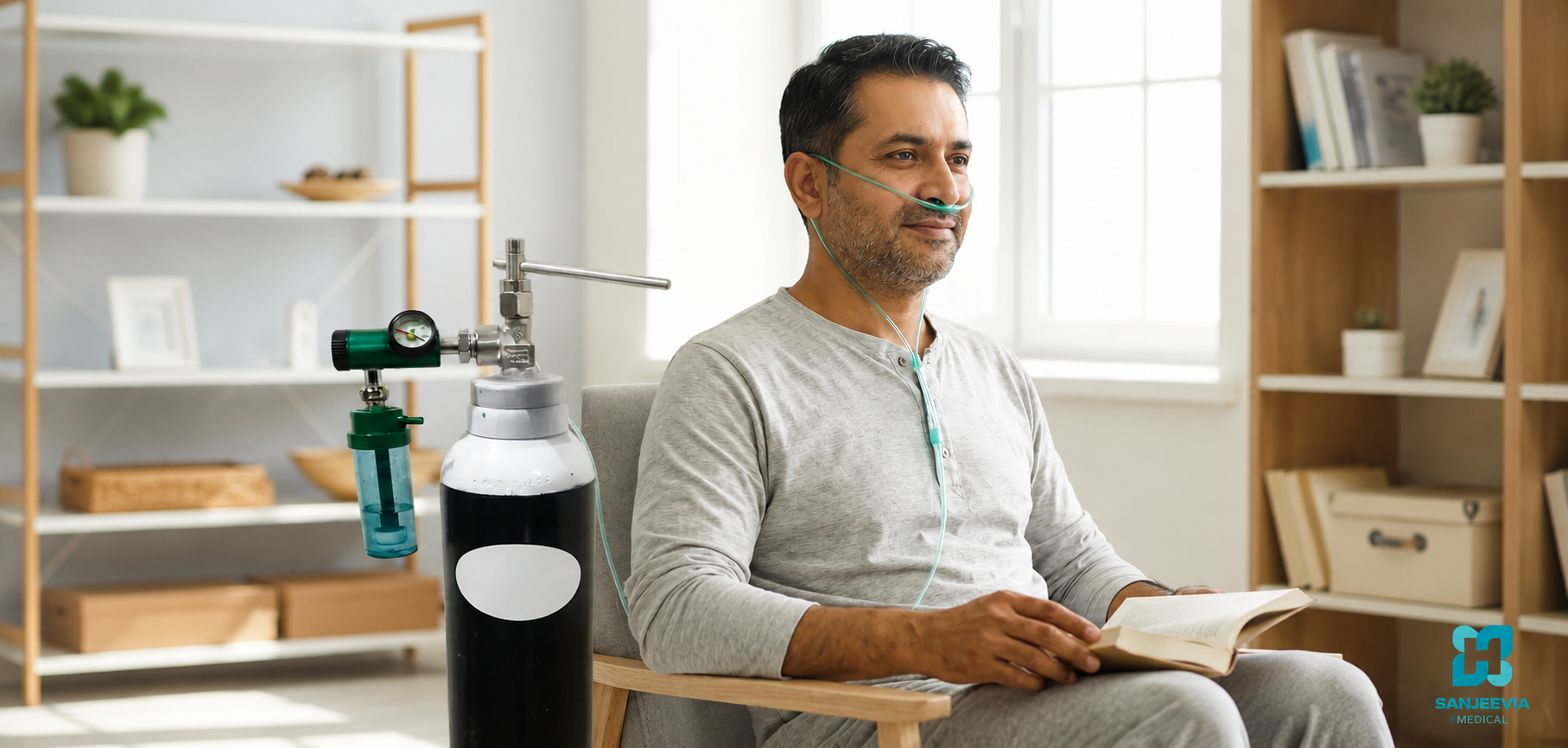
A cylinder stores compressed medical oxygen. It continues to supply oxygen without electricity, but its contents are finite. It must have the correct medical regulator and flow meter, be secured upright and be kept away from heat, flames and smoking.
How to estimate cylinder duration correctly
A cylinder’s “10 L” or “47 L” name usually refers to water capacity, not the amount of usable oxygen in litres. Indian government guidance lists approximately 1.5 cubic metres of oxygen for a 10-litre water-capacity cylinder and approximately 7 cubic metres for a 47-litre cylinder under the stated filling conditions.
The basic theoretical calculation is:
Estimated duration in minutes = available oxygen contents in litres ÷ prescribed flow in LPM
For illustration only:
- 1,500 litres at 2 LPM gives approximately 750 minutes, or 12.5 theoretical hours.
- 7,000 litres at 2 LPM gives approximately 3,500 minutes, or 58 theoretical hours.
Actual usable time can be shorter because of remaining pressure, reserve requirements, regulator accuracy, temperature, leaks, starting pressure and interruptions. Never promise a fixed duration from cylinder size alone. Check the cylinder label, current gauge/pressure, supplier information and the patient’s contingency plan.
Reference: Government of India National Guidelines on Medical Oxygen Management.
Comparison for home use
| Question | Concentrator | Cylinder |
|---|---|---|
| What supplies the oxygen? | Processes room air while powered | Stored compressed medical oxygen |
| Main limitation | Depends on electricity and exact model performance | Finite contents that require refill or exchange |
| Flow and concentration | Must be checked in the exact manufacturer specification | Flow is controlled by the prescribed setting and correct regulator |
| During a power cut | Stops unless supported by a compatible power solution | Does not require mains electricity |
| Mobility | Some models are portable; continuous- and pulse-flow devices differ | Size and trolley determine practicality |
| Fire safety | No smoking or open flames; follow oxygen-safety instructions | |
Questions that determine the home setup
- What continuous flow is prescribed during rest, sleep and activity?
- What target range and escalation instructions has the treating team documented?
- How clinically dependent is the patient on uninterrupted oxygen?
- Does the exact concentrator maintain its specified oxygen concentration at the prescribed flow?
- What outages are reasonably foreseeable at the home?
- What backup source or compatible power solution has the treating team/provider approved?
- How long must the backup cover, including a suitable reserve?
- Is oxygen needed during transport or outside the home?
There is no universal rule that every patient needs the same cylinder size. The backup plan should be documented for the individual situation.
When a concentrator is prescribed, compare the 5L, 10L and portable concentrator models by delivery mode and required flow; a cylinder backup is a separate part of the care plan.
Relevant Sanjeevia equipment pages
- Philips EverFlo 5L oxygen concentrator
- 10L oxygen concentrator options
- 10L medical oxygen cylinder
- 47L medical oxygen cylinder
- Medical oxygen cylinder regulator kit
Essential oxygen safety
- Do not smoke or use flames near oxygen equipment.
- Secure cylinders upright using a suitable stand, trolley or restraint.
- Use only medical oxygen and compatible medical regulators and accessories.
- Do not use oil or grease on oxygen fittings.
- Keep the manufacturer manual and support contact available.
- Do not change the prescribed flow without clinical instruction.
Frequently asked questions
Is a concentrator always better for long daily use?
It can be practical when its specifications meet the prescription and reliable power and contingency arrangements are available. The decision remains patient-specific.
Can a cylinder’s duration be calculated from “10 L” or “47 L” alone?
No. Use the stated oxygen contents or pressure-based supplier calculation, prescribed flow and a reserve. Actual duration can differ from the theoretical result.
Should every COPD patient keep a 47L cylinder?
No universal cylinder size applies to every COPD patient. Follow the treating team’s prescription and the documented interruption plan.
Medical note: This article explains equipment differences. It does not prescribe oxygen, set a target saturation or replace an emergency plan.