
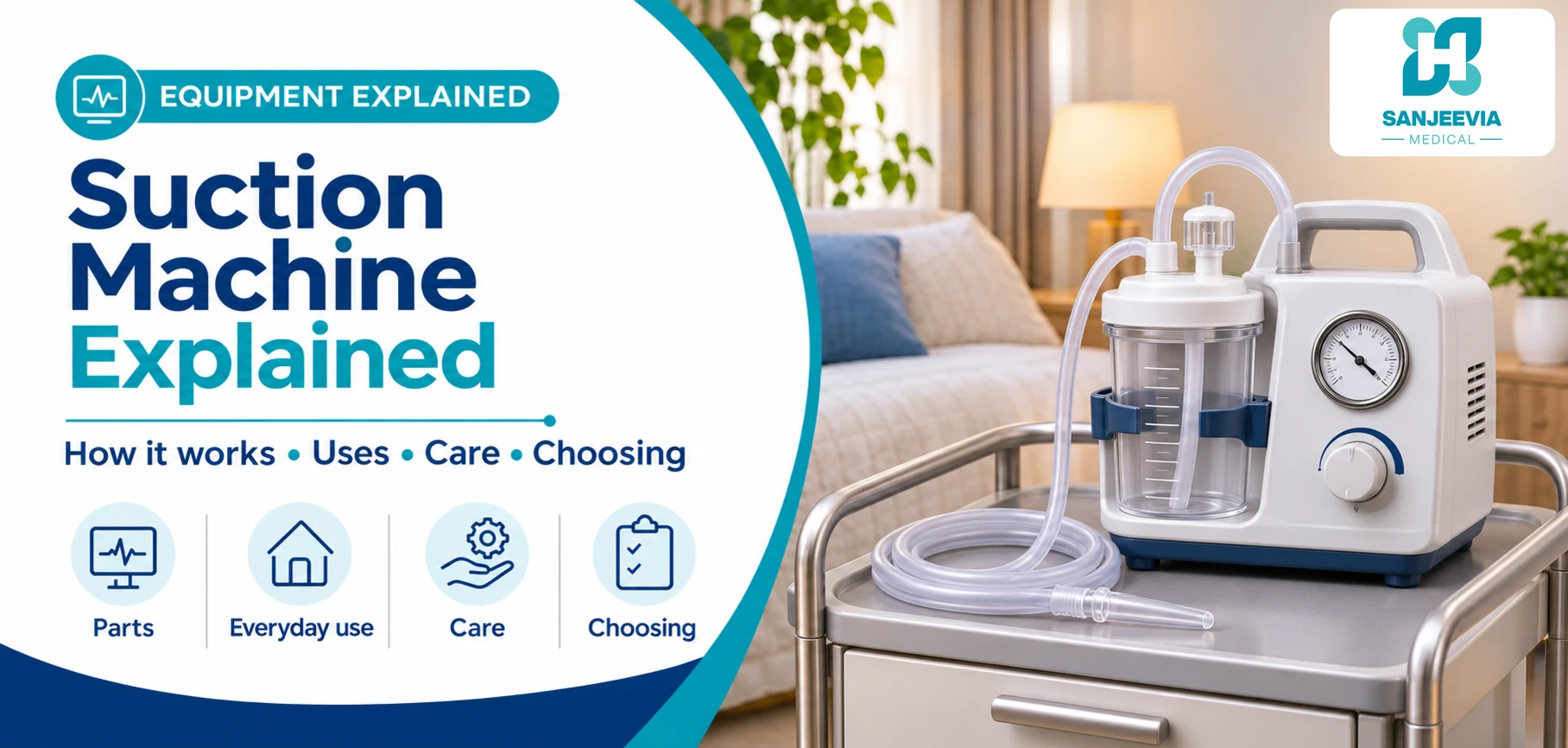
A suction machine is often described as something that “clears mucus”, but where the mucus is—and how the person is being cared for—changes what equipment and training are needed. The pump is only one part of that arrangement.
Quick answer: A suction machine creates negative pressure to draw secretions through an approved suction tip or catheter into a collection container. It may be used for prescribed oral or airway care by appropriately trained people. It does not supply oxygen, and oral suction is different from suction through a tracheostomy or other airway.
Explore relevant equipment
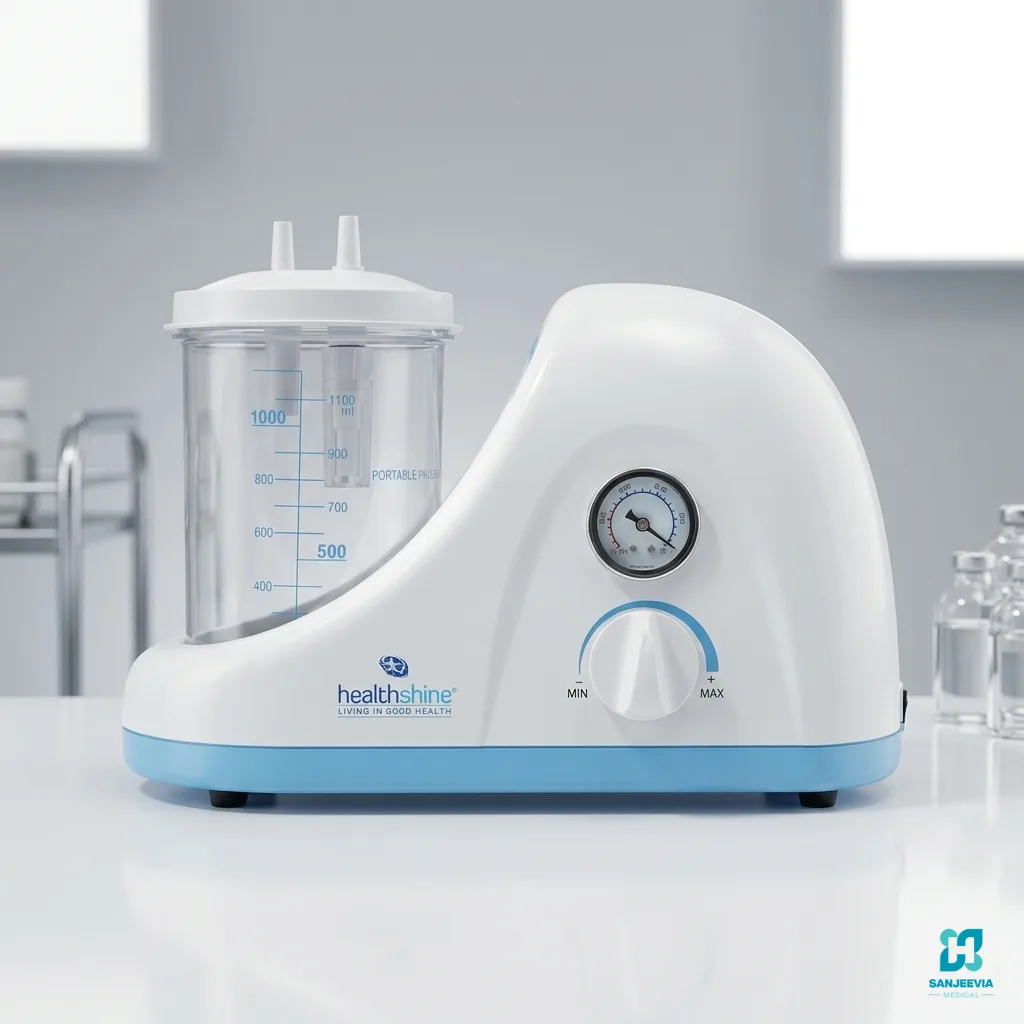
Suction Machine – Single Jar
Single-jar suction unit: check the vacuum specification, duty cycle, overflow protection and included tubing.
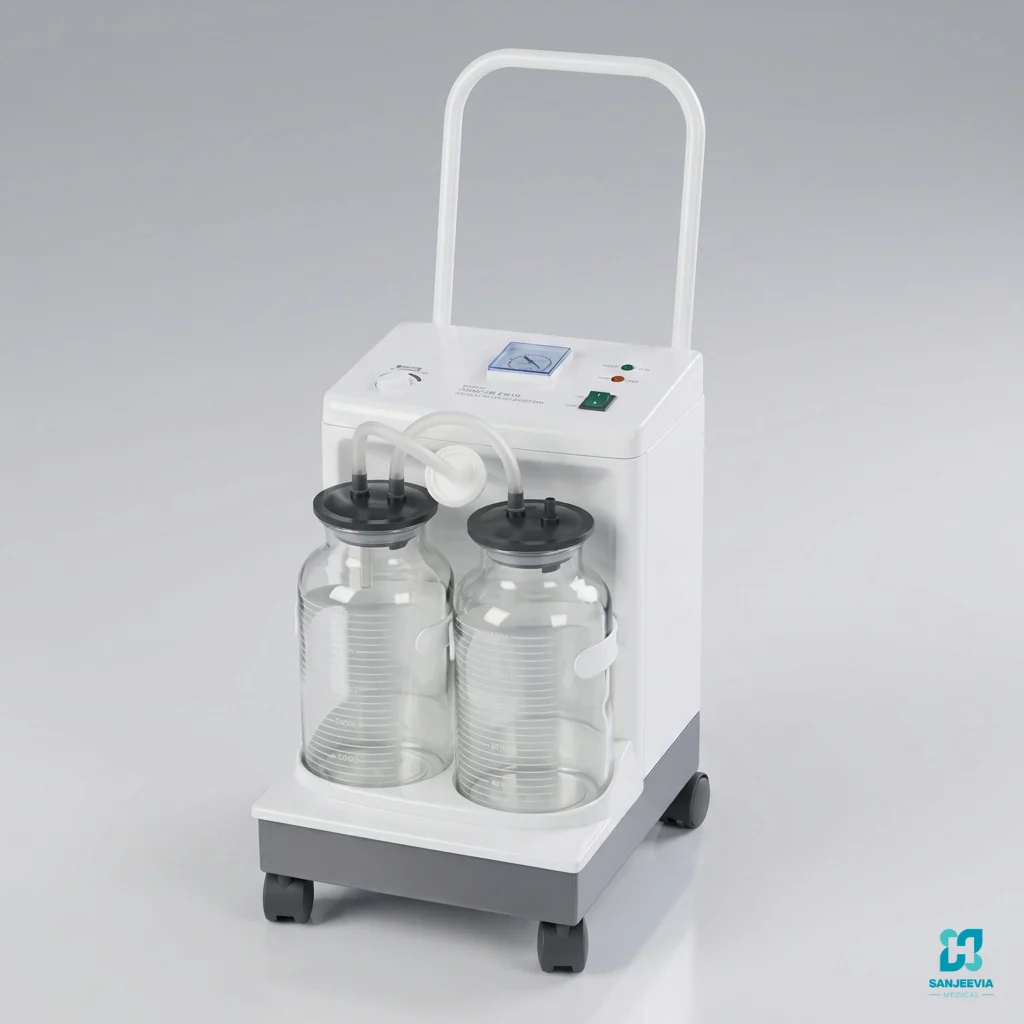
Suction Machine (Double Jar)
Double-jar suction unit: check each jar’s intended role and the complete configuration; jar count does not prove greater suction.
Open the product pages for current charges, rental or purchase options and package details. Confirm the exact supplied model, accessories and delivery availability for your PIN code.
Need a how-to-use demonstration? We could not find a matching suction machine demonstration on Sanjeevia’s YouTube channel at this update. Request a demonstration of the supplied model at handover, and use its written instructions. You can browse Sanjeevia’s available equipment videos.
Jump to equipment details
How does negative pressure remove secretions?
The pump lowers pressure in the collection system. That pressure difference draws secretions through patient tubing into the jar or canister. The liquid should stay in its approved collection path, while filters and overflow protection help protect the machine according to the model’s design.
The vacuum gauge may be marked in mmHg or kPa. It indicates suction pressure, not oxygen concentration. A flow specification, if supplied, describes another aspect of performance. Turning the regulator to maximum is not a safe general solution for thick secretions.
The required pressure, tip or catheter, route and technique come from a trained clinician. They vary by patient and procedure, so this equipment overview does not provide a universal suction setting or insertion instruction. A device’s advertised maximum tells you its capability, not what to use on a person.
Pump, regulator, jar and filter: what each part does
| Part | Purpose | What to identify at handover |
|---|---|---|
| Pump and power supply | Create vacuum. | Mains or battery operation, ventilation openings and operating limits. |
| Regulator and gauge | Adjust and display vacuum. | The prescribed setting and demonstrated pre-use function check. |
| Collection container | Collect secretions. | Fill limit, lid seal, patient port and pump port. |
| Overflow protection and filter | Help prevent liquid or contamination entering the pump, as designed. | Correct orientation, replacement criteria and response if wet. |
| Patient tubing and tip/catheter | Connect the collection path to the prescribed suction accessory. | Compatibility, size, personal-use status and replacement needs. |
Loose lids, damaged seals, kinked tubes and wet or blocked filters can reduce performance. The motor making a sound does not establish that useful suction is reaching the accessory. Ask someone trained to demonstrate the manufacturer’s test and safe checks. Do not open the pump casing or bypass a filter to restore suction.
Oral suction and airway suction need different training
Oral suction can help a person who cannot manage pooled saliva or secretions in the mouth. A rigid oral tip, often called a Yankauer, is one common accessory. Deeper suction, including suction via a tracheostomy, is a separate procedure requiring the correct catheter and specific training.
A general-purpose suction pump does not make every suction procedure suitable for an untrained family member. Route, positioning, protective equipment and the action plan must be demonstrated for the actual patient. An oral tip must not be improvised as a deep-airway device.
Suction is also not a general treatment for breathlessness or a method for draining fluid from the lungs at home. It does not replace cough-assistance assessment, oxygen, ventilation or medical treatment when those are required.
Do not attempt to pull a solid foreign object from the back of the mouth with routine oral suction. Choking or respiratory distress calls for the relevant trained emergency response. The before-discharge suction checklist helps families identify the training and supplies they need.
How to use the equipment: a trained-care overview
- Confirm the prescribed route, accessory, setting and care plan. Ensure the person performing suction has been trained for that procedure.
- Prepare hand hygiene and the protective equipment advised by the clinical team. Check the correct container, filter, tubing and power supply are in place.
- Perform the demonstrated function check and position the patient as instructed. Keep the unit stable and its collection container upright.
- Use only the taught patient-specific technique and limits. Observe the person throughout and stop for pain, bleeding, marked distress or other warning signs in the care plan.
- Afterwards, follow the instructions for clearing, cleaning or disposing of accessories, emptying the collection system and preparing the machine for the next use.
If the person has severe breathing difficulty or reduced responsiveness, seek urgent medical help and follow their emergency plan. Repeated suction attempts must not delay escalation. This article is an orientation to the equipment, not a substitute for airway-care training.
Single jar, double jar or battery-powered: what should you choose?
Jar count describes the collection arrangement. In some double-jar designs, containers have different collection or protective roles; in others the arrangement differs. Ask how that exact system is meant to be connected. Two jars do not automatically mean double the pressure, double the flow or twice the safe operating time.
Compare vacuum and flow capability, container capacity, overflow protection, filters, noise and the permitted duty cycle. Duty cycle means how long the unit may operate and what rest period is required. A machine intended for intermittent use should not be assumed suitable for continuous operation.
Battery operation is another separate feature. Sanjeevia’s listed single- and double-jar packages should not be assumed to include a battery. Confirm the actual model, compatible backup supply and tested runtime. If suction access is clinically critical, agree an immediately workable backup plan before discharge.
Read single-jar versus double-jar suction to compare the arrangement, then verify it against the supplied model’s manual.
Cleaning, consumables and rental checks in India
The collection jar, patient tubing, oral tip, suction catheter and pump filter have different care requirements. Follow the approved process for each. Do not assume that a disposable catheter can be cleaned and reused or that every reusable jar tolerates the same disinfectant.
Empty the collection container before the specified limit is reached. Keep the pump dry, use the instructed waste-disposal process and arrange a filter replacement if indicated by the manual or contamination. If liquid enters the machine, stop relying on it and obtain equipment support. Our suction cleaning guide explains what to confirm, while the maintenance guide covers servicing questions.
Before renting or buying, request a package list: pump, container or containers, lid assemblies, filter, connectors, tubing and power supply. Patient-use catheters or oral tips, protective supplies, batteries and professional care may need separate arrangements. Ask how many consumables are needed and how replacements will be obtained.
For Delhi NCR delivery, confirm the exact PIN code, charges, deposit and collection terms. Ask about the supplied unit’s cleaning, service checks, demonstration and fault response. An equipment rental does not itself provide suctioning by a nurse. Keep device details and the clinical contact close to the machine.
Frequently asked questions
Is a suction machine an oxygen machine?
No. Suction draws secretions into a collection system. An oxygen source supplies oxygen-enriched gas; the devices perform different jobs.
Does a double-jar machine suction more strongly?
Not necessarily. Compare the actual vacuum, flow, duty cycle and approved container arrangement rather than jar count.
Can I use it without training?
The pump can look simple, but patient suction can cause harm. Obtain training for the specific route, patient and accessory before use.
Are catheters and oral suction tips included?
Confirm the package. Personal-use accessories and protective supplies can be separate purchases, even when the pump, jars and connecting tubing are supplied.
Explore your equipment options
Suction Machine – Single Jar
Single-jar suction unit: check the vacuum specification, duty cycle, overflow protection and included tubing.
Suction Machine (Double Jar)
Double-jar suction unit: check each jar’s intended role and the complete configuration; jar count does not prove greater suction.
Open the product pages for current charges, rental or purchase options and package details. Confirm the exact supplied model, accessories and delivery availability for your PIN code.
Sources and useful reading
- Cambridge University Hospitals: Oral suction at home — Purpose and limits of prescribed oral suction, demonstrated by a professional.
- Hull University Teaching Hospitals: Oral suction — Oral suction equipment, cautions and care; local clinical instructions are not universal prescriptions.
- East Kent Hospitals: Oral suction caregiver guide — Training needs and potential adverse effects.
- Drive DeVilbiss: Vacu-Aide suction device — Manufacturer example showing model-specific features; not a specification for the Sanjeevia units.
- CDSCO: Medical devices and diagnostics — Official Indian medical-device information; this is not an endorsement of an individual listing.
- NHSRC: Materiovigilance Programme of India — Information about reporting suspected medical-device adverse events in India; urgent care comes first.
Prepared by Sanjeevia’s editorial team. Updated 7 November 2026. This guide explains equipment; individual treatment, settings and suitability must be confirmed with the treating clinical team.
