
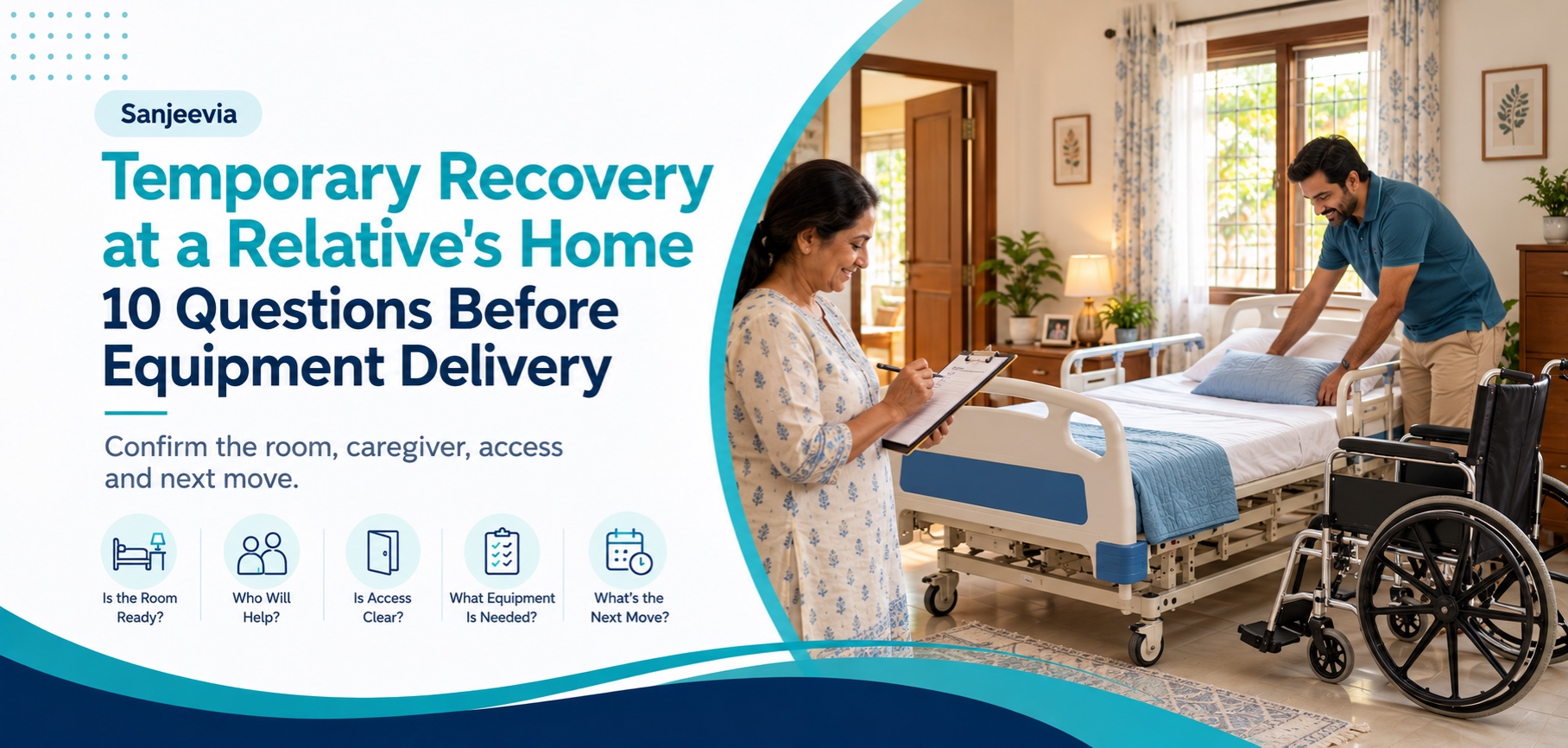
A relative may offer the most practical place for recovery after hospital discharge, especially when the patient’s usual home has stairs, no daytime caregiver or an unsuitable room. The change of address can solve one problem and create several others. Planning medical equipment for temporary home recovery means confirming the destination, the local caregiver, the delivery route and what will happen when the patient moves again.
Use these ten questions before equipment is sent to a relative’s home. This guide covers the temporary address and handover. It does not decide whether that home is clinically suitable for the patient.
Quick answer: what should families confirm first?
Ask the discharge team to approve the actual recovery address and provide a written equipment requirement. Choose one adult at that home to receive the delivery and attend every demonstration. Measure the complete route and room, confirm utilities and caregiver responsibilities, then document how equipment will be moved, exchanged or returned when the temporary stay ends.
The discharge team must approve the destination and requirements. Confirm the actual model, fit, room access and service address before booking.

Temporary recovery at a relative’s home
| Question | Why it matters | Evidence to keep |
|---|---|---|
| Is this the approved discharge destination? | The care plan must match the actual home and caregiver | Discharge instructions and address |
| Who receives the equipment? | Someone must inspect the model and learn its operation | Named adult and handover record |
| Can the home support the setup? | Access, room, power and toileting differ between properties | Measurements, photographs and room plan |
| How long is the stay? | Extensions, relocation and collection need planning | Review date, rental record and contacts |
Ten questions before delivery
1. Has the hospital team been given the temporary address?
Tell the discharge coordinator where the patient will actually stay, who will help and which floor and facilities are available. Do not let the care plan assume the usual home if recovery will happen elsewhere. Ask whether any home assessment, equipment demonstration or follow-up should use the temporary address.
The NHS discharge-planning guide states that discharge discussions should cover whether the patient is going home or somewhere else, the equipment required and the support available. Indian services differ, but the need to identify the real destination applies to every family.
2. What is the exact written equipment requirement?
Ask for the equipment type, essential functions, size or capacity information, accessories, prescribed settings and any restrictions. A message saying “arrange a bed and wheelchair” may be too broad to match the patient. Keep the requirement with the discharge summary and share only the relevant details with the provider.
Use the home medical equipment list to understand product categories, then return to the treating professional for the final decision. Do not add equipment because another family used it after a similar operation.
3. Who is the local recipient and daily caregiver?
Name the adult who will open the property, check the supplied model, attend the demonstration and sign the handover record. Ideally, this is the person who will help most often. If different relatives cover different shifts, decide who will pass on instructions and who can contact the equipment provider.
Equipment delivery does not supply a nurse or attendant. If the patient requires trained clinical care or two-person assistance, arrange that separately through the appropriate professionals. Do not quietly expect the host relative to perform tasks they have not agreed to or learned.
4. Can the equipment reach the chosen room?
Measure the vehicle stopping point, gate, steps, lift opening and cabin, corridor turns, room door and final setup space. Confirm whether large equipment arrives assembled or in sections. Share floor details and building rules before booking. A relative’s assurance that “there is enough space” is not a measurement.
Use Sanjeevia’s room-preparation checklist and keep photographs of the cleared route. The route for the patient may require separate planning by the discharge and transport professionals.
5. Will the room support sleeping, transfers and toileting?
Place the agreed bed position on a simple room sketch. Mark the caregiver side, wheelchair turning space, bathroom route and any bedside toileting arrangement. Remove loose rugs, unstable furniture and decorative clutter from the working path. Privacy also matters when the temporary room is a shared living area.
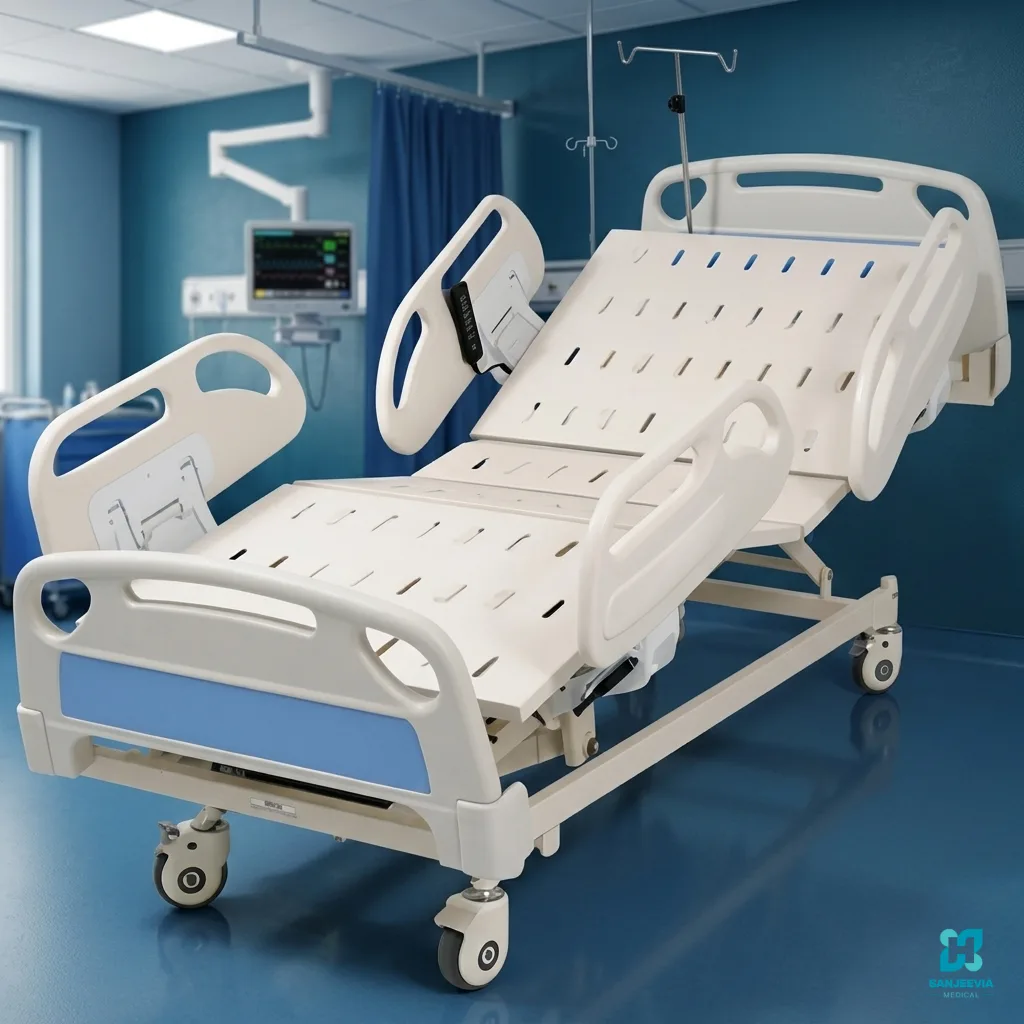
If an adjustable bed has been recommended, compare the required functions with the listed 3-function electric hospital bed. If mobility support is required, confirm wheelchair seat fit, transfer method and doorway clearance for the standard manual wheelchair or another assessed model.
6. Are power, ventilation and utilities suitable?
Check the actual sockets, circuit, ventilation, lighting and any water or communication requirements described in the device instructions. Do not route medical-device cables through doorways or rely on an unapproved adapter because the host room has too few outlets. Ask an appropriately qualified electrician if the home’s wiring needs assessment.
The US FDA home-device checklist recommends checking whether the home and any other place where the device will be used can support its operating needs. This is especially relevant when equipment moves away from the address where the first plan was made.
7. Can the caregiver demonstrate the permitted actions?
Ask the recipient to show back the normal startup, shutdown, brake, control and cleaning steps allowed for the device. Keep the manufacturer’s instructions beside the equipment. Record the numbers for equipment support and clinical escalation separately so a technical question does not get treated as a medical emergency, or the reverse.
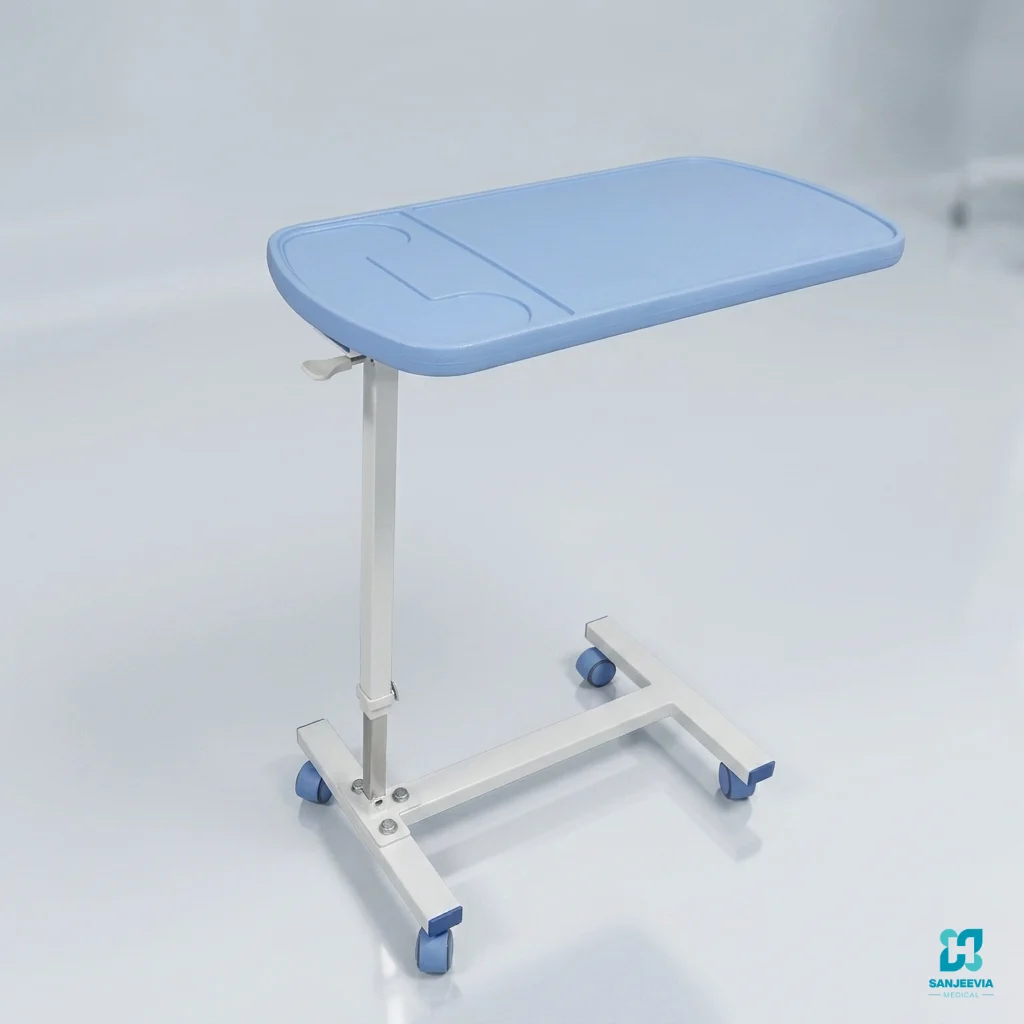
For an over-bed table, the handover should make clear that it is a surface for meals and light personal items. It is not a grab rail, walking aid or transfer support. Small accessories can be misused when a new caregiver has not seen the demonstration.
8. Which supplies and documents must travel with the patient?
Prepare one folder for the discharge summary, prescriptions, clinician instructions, device handover records and current contact list. Keep approved accessories and consumables with the correct device. Do not mix old tubing, sensors or components from another household unless compatibility and reuse have been confirmed.
Store clean supplies in a dry, labelled location away from waste, food and liquids. Ask how patient-contact items should be replaced and disposed of. If a supply is missing, obtain the correct item rather than adapting something available in the host home.
9. What does the rental record say about the temporary address?
Confirm the service address, responsible customer, rental period, supplied model, serial number, accessories, condition and support process in writing. Ask what notice and information are required for an extension, exchange, relocation or collection. Do not move rented equipment to another address without first confirming the provider’s process.
Review 15 terms to check in a medical equipment rental agreement. The blog explains the records families should expect without publishing changeable quotation amounts.
10. What is the exit plan for the second move?
Set a review date rather than assuming the temporary stay will end on a particular day. The care team should decide whether the patient is ready to return, needs different equipment or requires another destination. Re-measure the next property because a device that works at the relative’s home may not fit the patient’s usual home.
Before moving anything, confirm whether the provider must relocate, exchange or collect it and who will receive it at the next address. Update the caregiver handover and device instructions after any model change. The plan should follow the patient, not remain in a drawer at the first home.
Information to share with Sanjeevia
- The clinician-approved equipment requirement.
- The temporary address, PIN code, floor, lift and access measurements.
- The expected start date and a review date, without assuming a guaranteed recovery timeline.
- The name and phone number of the adult receiving the equipment.
- The room, caregiver and power details relevant to the chosen model.
For equipment enquiries in Delhi NCR, contact Sanjeevia with this information. The team can discuss listed equipment and the service process for the confirmed address. Medical decisions, nursing and the patient’s transfer between homes remain with the relevant professionals.
Frequently asked questions
Can rented medical equipment be delivered to a relative’s home?
Availability and service coverage must be confirmed for the exact address. Share the floor, access route, recipient and written equipment requirement before booking.
Can we later move the equipment to the patient’s usual home?
Do not move rented equipment without confirming the provider’s relocation process. The second property also needs its own access and room checks, and the patient may need reassessment.
Should the host relative sign the handover?
The responsible customer and recipient should be clearly recorded according to the rental agreement. The person who will use or assist with the equipment should attend the demonstration even if another family member handles payment.
What if the temporary room has only one socket?
Do not improvise with adapters or extension boards. Check the device instructions and ask an appropriately qualified electrician whether the home’s circuit and outlets are suitable.
Does Sanjeevia provide a caregiver with the equipment?
No caregiver or nursing service is promised by this article. Equipment rental and clinical or personal care are separate requirements and should be arranged accordingly.
Educational temporary-home equipment guide. Sources and linked catalogue pages checked on 18 October 2026. The treating team must approve the discharge destination and clinical plan. Cover image is illustrative.
Next Read
If several devices will share the temporary room, continue with Using Multiple Medical Devices in One Room: 11 Space, Power and Caregiver Checks.