
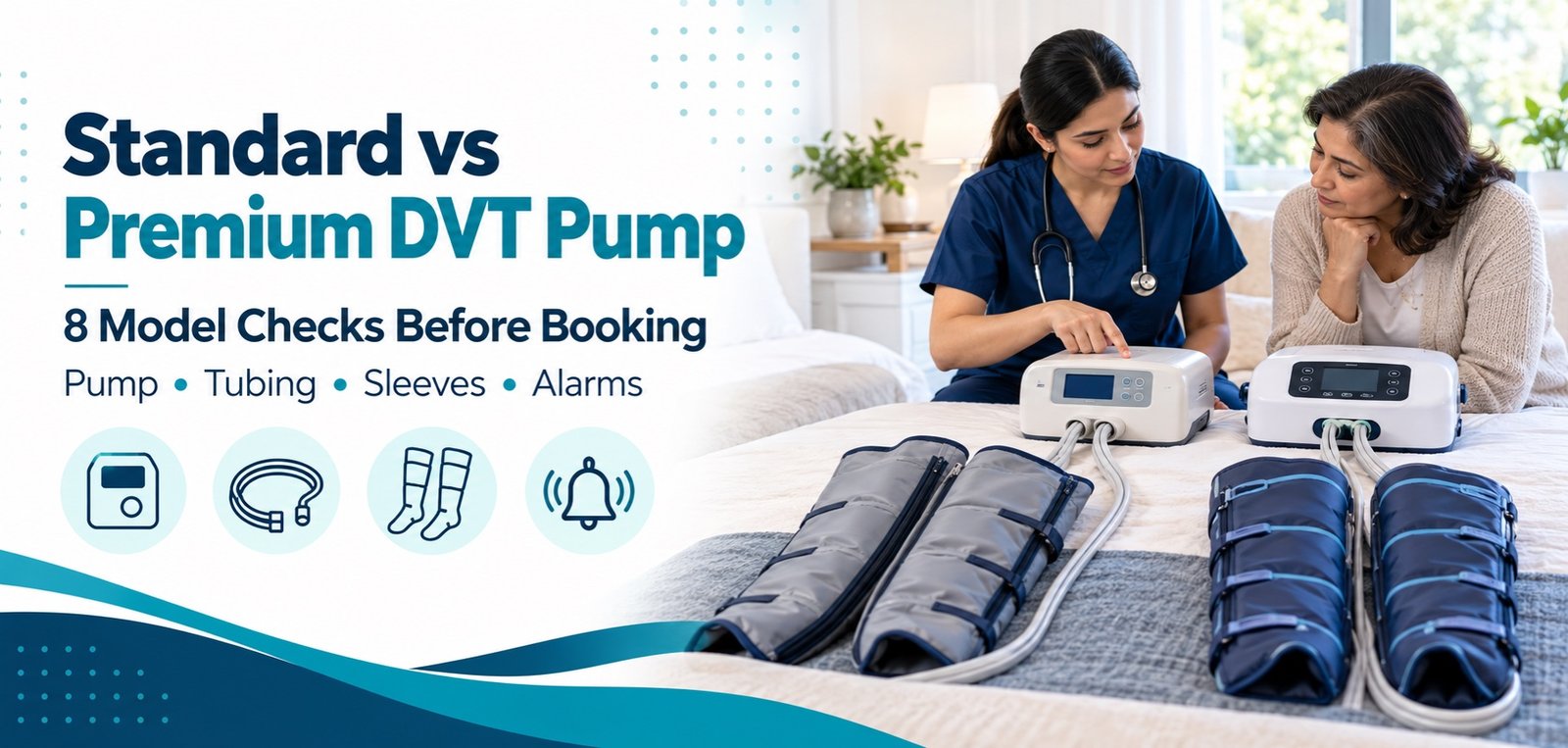
Compare the Sanjeevia listing categories
Sanjeevia’s standard listing may include Devon, Medflow, Zimmer or another verified manufacturer. The premium listing may include a Medtronic/Covidien Kendall SCD or an Arjo Flowtron system. Those brands and models are not interchangeable, and availability can change. The exact device must be confirmed before booking.
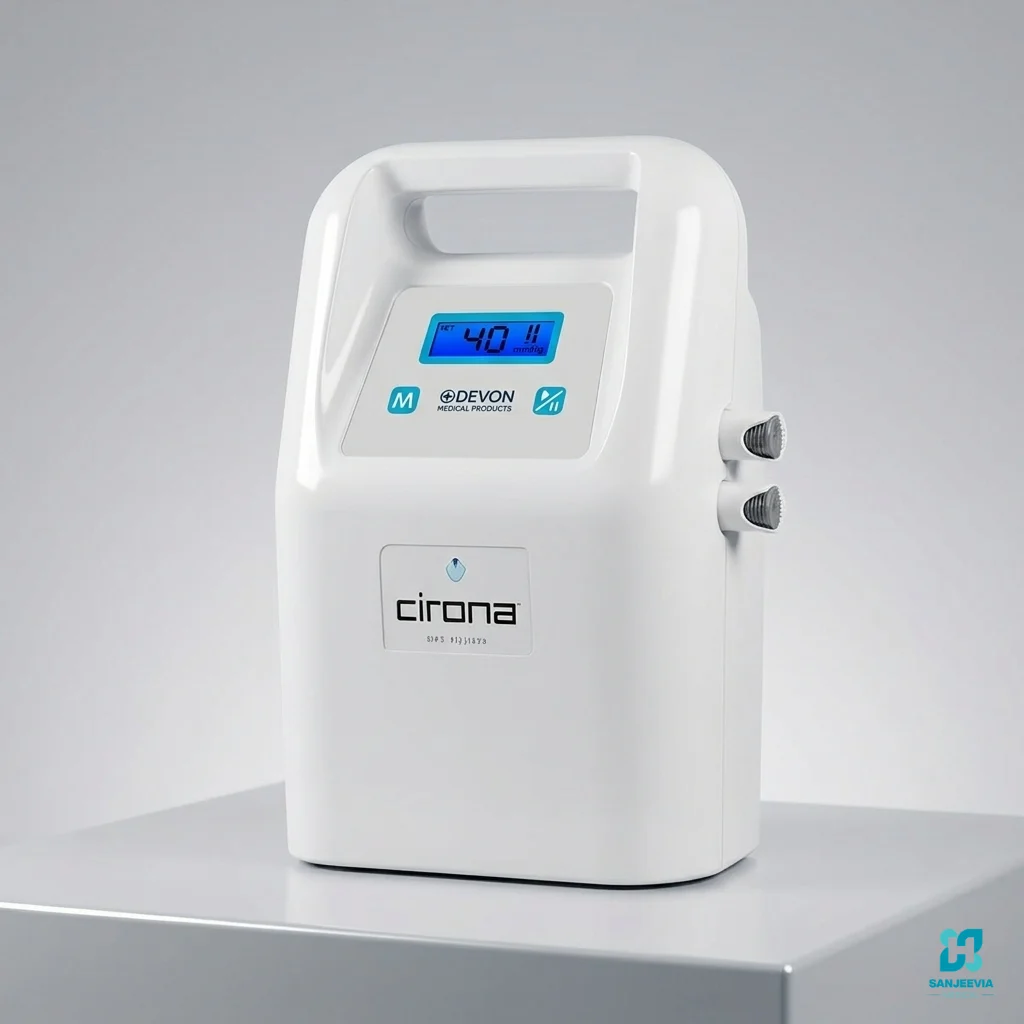
DVT Pump Standard Listing
Possible manufacturers vary. Confirm the exact pump, tubing and new compatible calf sleeves supplied.
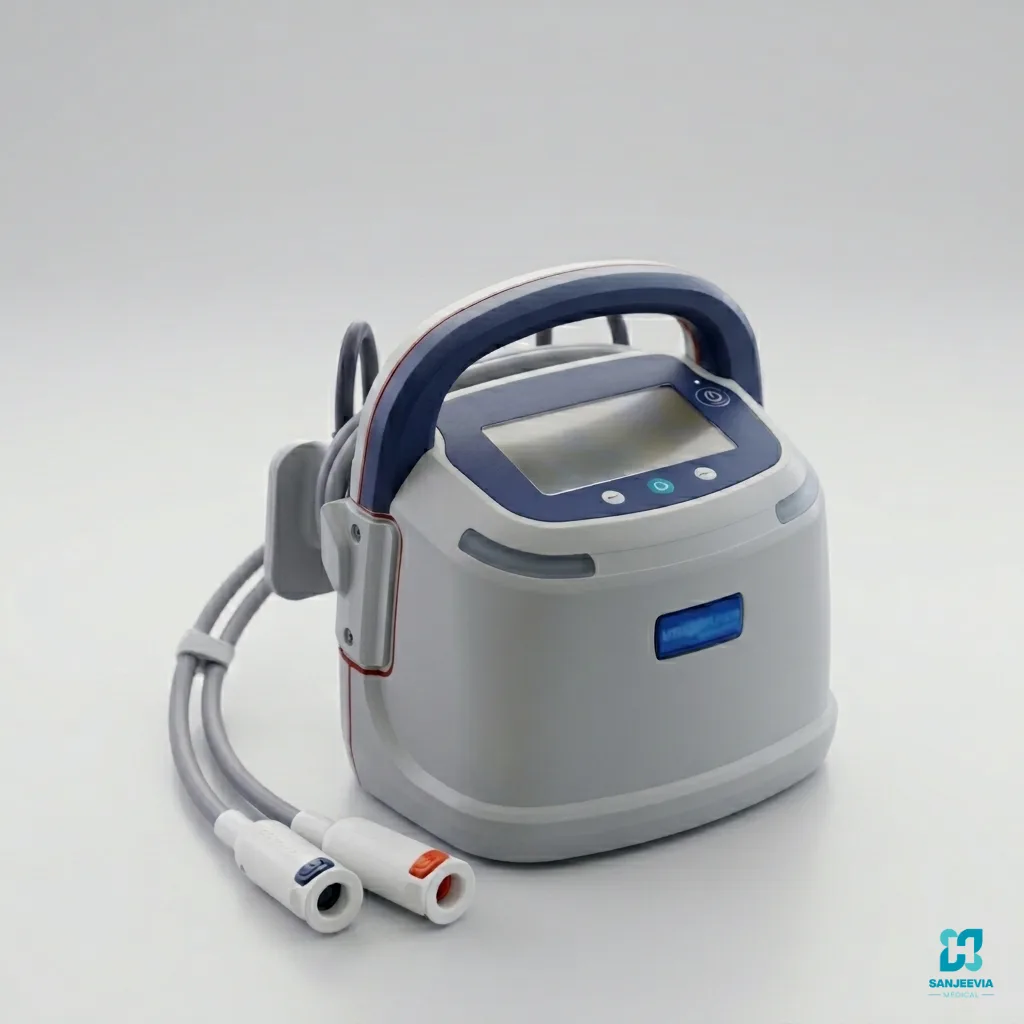
DVT Pump Premium Listing
May include a specific Medtronic/Covidien or Arjo system. Confirm model, application site and garment code.
What the category names do and do not tell you
| Question | Standard listing | Premium listing |
|---|---|---|
| Exact manufacturer | Can vary between verified models | Can vary between specified international-brand systems |
| Garment supplied | New compatible calf sleeves are listed; confirm size and code | Confirm calf, thigh or foot garment, size and code for the exact model |
| Clinical suitability | Cannot be inferred from category. Requires a clinician’s order and contraindication screening. | |
| Compatibility | Pump, tubing and sleeves must be approved for one another. Do not mix systems. | |
| Best reason to choose | Choose the exact system that fulfils the written requirement and can be supported reliably. | |
8 model checks before you book
1. Exact manufacturer and model number
Ask for a photo of the data label or a written model name. “DVT pump” alone is not enough. Models can differ in compression sequence, pressure control, ports, power source, alarms and approved garments.
2. Prescribed application site
Calf, thigh and foot compression are not interchangeable. The discharge instructions should identify the required site and whether one or both limbs are to be treated. Sanjeevia’s standard listing does not include thigh or foot garments unless specifically confirmed.
3. Sleeve type, size and condition
Ask for new, single-patient-use sleeves that match the exact pump and fit the patient according to the manufacturer’s sizing method. A sleeve that is too loose, too tight, damaged or connected to the wrong system can make the setup unsuitable.
4. Tubing and connector compatibility
Do not force a connector or use an adapter merely because two devices look similar. Confirm the approved tubing assembly, number of ports and any model-specific connector. Keep tubing free from kinks and trip hazards.
Need help checking the exact model?
Share the clinician’s requirement, city and intended use. A Sanjeevia coordinator can confirm the listed equipment and availability. Do not send medical records on WhatsApp.
5. Compression mode and monitoring features
Some systems provide uniform or sequential compression, garment recognition, compliance monitoring or different treatment modes. For example, Arjo describes these features for its Flowtron ACS900. Do not assume every Arjo pump or every premium listing has the same specification. Verify the exact model.
6. Power, battery and portability
Confirm whether the supplied pump operates only from mains power, has a battery, and how long any battery is expected to last under the manufacturer’s conditions. Plan cable routing, bedside placement and movement without interrupting the clinician’s schedule.
7. Alarms, display and caregiver handover
The caregiver should be shown the power-up check, sleeve connection, alarm indicators and actions permitted by the manual. An alarm should not be silenced repeatedly without finding the cause. If the family cannot restore normal operation, contact the provider and clinical team.
8. Service and replacement pathway
Record the provider’s support contact, model and accessory codes. Ask what happens if the pump fails, the tubing is damaged or a sleeve needs replacement. A well-supported suitable device is more useful than a feature-rich model with unavailable consumables.
Questions the prescription or discharge plan should answer
- Why is intermittent pneumatic compression being used?
- Which limb or limbs and which body site are prescribed?
- What garment size and wear schedule apply?
- Can the sleeves be removed for walking, bathing or skin checks, and when?
- What mobility plan and medicines are also prescribed?
- Which symptoms or skin changes require stopping and urgent clinical advice?
- When will the need for the device be reviewed?
NICE recommends assessing both VTE and bleeding risk and gives condition-specific guidance for mechanical prophylaxis. It also advises skin monitoring and stopping mechanical prophylaxis if marking, blistering, discolouration, pain or discomfort develops. Review the current NICE VTE recommendations with the treating team.
Red flags that are not equipment-selection questions
New leg swelling, chest pain, breathlessness, coughing blood, collapse or other sudden symptoms need urgent medical assessment according to the patient’s discharge and emergency plan. Do not use a rental enquiry, pump alarm or online article to diagnose the cause.
For a preparation-focused guide, use Sanjeevia’s DVT pump rental checklist before the device arrives.
Frequently asked questions
Is a premium DVT pump always clinically better?
No. Premium and standard are Sanjeevia listing categories, not universal clinical grades. The correct device is the exact model, garment and application site prescribed for the patient.
Can sleeves from one DVT pump be used with another brand?
Do not assume compatibility. Connectors, tubing, garment design and operating algorithms can differ. Use only the pump, tubing and sleeves approved for that exact system.
Can a DVT pump treat an existing blood clot?
These listings are for intermittent pneumatic compression used as part of a clinician-directed prevention plan. They do not diagnose or treat a suspected or confirmed clot.
What should be written in the order or discharge instructions?
Ask for the device type, body site, one or both limbs, garment size, wear schedule, skin-check instructions, mobility plan, medicines where prescribed, and when to stop and contact the clinical team.
Should the pump be stopped if it causes pain or skin changes?
Contact the clinical team and follow the discharge instructions. NICE advises monitoring skin and discontinuing mechanical prophylaxis if there is marking, blistering, discolouration, pain or discomfort.
This article is general equipment information only. It does not replace medical assessment, diagnosis, prescription or emergency care.