
Home / Blog / What is an Oxygen Concentrator and Does Your Patient Actually Need One?

What is an Oxygen Concentrator and Does Your Patient Actually Need One?

Table of Contents

Category: Oxygen Therapy  |  Reading time: 7-8 min  |  Published by Sanjeevia Medical

The pulmonologist walks out after rounds and tells you: your father needs supplemental oxygen at home. He hands you a prescription. It says 2 LPM, 16 hours daily. You have no idea what that means, what machine you need, or whether you can actually manage this at home.

You can. And this guide will tell you exactly how.

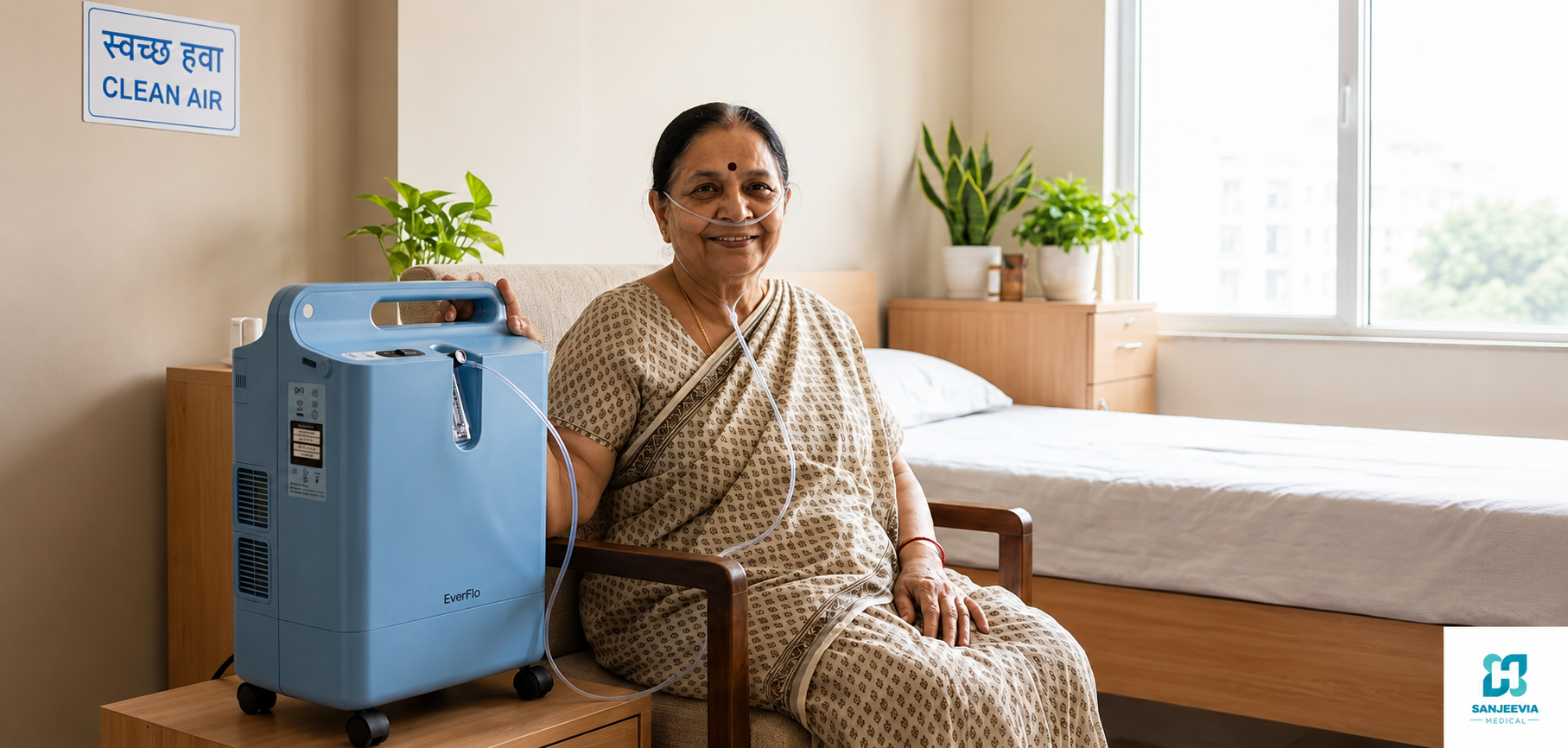
An oxygen concentrator is the most common home oxygen device prescribed in India today. It is not complicated to use, does not require medical training to operate, and is far more practical for home use than cylinders in most situations. Here is everything you need to understand before renting one.

Room air is approximately 21% oxygen. An oxygen concentrator pulls in room air, removes the nitrogen through a molecular sieve, and delivers oxygen at concentrations of 87 to 96 percent directly to the patient through a nasal cannula or mask.

It runs on standard household electricity. It does not store oxygen. It produces it continuously, on demand, as long as it is plugged in. This is its biggest practical advantage over cylinders: it never runs out as long as there is power.

The flow rate, measured in litres per minute (LPM), is set by your doctor based on the patient’s oxygen saturation levels and diagnosis. Common prescriptions range from 1 LPM for mild cases to 5 LPM for more significant respiratory conditions. Some patients with COPD or post-COVID lung damage need 10 LPM or higher, which requires a higher-capacity machine.

Oxygen therapy at home is prescribed by a doctor based on blood oxygen saturation (SpO2) measurements. It is not a self-diagnosis decision. If your doctor has prescribed it, the answer is yes. If you are trying to decide whether to call the doctor, here are the situations where home oxygen is commonly prescribed:

  • COPD (Chronic Obstructive Pulmonary Disease): the most common reason for home oxygen in Delhi NCR. Patients with moderate to severe COPD often have resting SpO2 below safe levels and need supplemental oxygen for 15 to 18 hours daily.
  • Post-COVID lung damage: many patients discharged after severe COVID-19 continue to need supplemental oxygen for weeks to months while lung function recovers.
  • Interstitial Lung Disease (ILD): a group of conditions causing progressive lung scarring, often requiring long-term oxygen therapy.
  • Post-cardiac surgery: some patients need supplemental oxygen during the first weeks of recovery at home.
  • Palliative care: oxygen therapy for comfort in terminal illness is a common home application.

If the patient is experiencing breathlessness at rest, SpO2 consistently below 94%, or has been discharged with a written oxygen prescription, a concentrator is needed. Do not delay getting one based on the assumption that the situation will improve on its own.

The most important specification on any concentrator is its maximum flow rate, measured in litres per minute.

Specification5 Litre Concentrator10 Litre Concentrator
Max flow rateUp to 5 LPMUp to 10 LPM
Oxygen purity at max flow90-95%90-95%
Typical patientCOPD mild-moderate, post-COVID recovery, ILD early stageSevere COPD, high-flow oxygen prescriptions, dual-patient use
Power consumptionLower (approx. 150-300W)Higher (approx. 350-500W)
Weight and sizeCompact, approx. 14-18 kgLarger, approx. 20-28 kg
Cost to rentView current pricingView current pricing

Rule: Always follow your doctor’s prescription. If the prescription says 3 LPM, a 5L concentrator is sufficient. If it says 6 LPM or above, you need a 10L machine.

Brand / ModelCountryKey StrengthBest For
Philips EverFlo 5LUSAIndustry benchmark. Quiet at 40dB. Continuous duty rated.Long-term use, noise-sensitive patients, doctor-specified Philips
Niscomed 5LIndiaReliable, widely serviced. Good value.Standard home use, cost-conscious families
Evox 5LIndiaCompact design, good portability within homePatients who need to move the unit between rooms
Medoxy 5LIndiaDependable performance. Good availability in NCR.Standard home use
Medoxy 10L / Niscomed 10LIndiaHigh-flow capabilityHigh-flow prescriptions above 5 LPM
Philips PortableUSABattery-powered, travel-readyPatients who need oxygen mobility outdoors

If your doctor has specified a brand, follow that. If no brand is specified, the Philips EverFlo is the gold standard for long-term home oxygen therapy. For shorter recovery periods, Indian brands provide reliable performance at lower cost.

FactorOxygen ConcentratorOxygen Cylinder
SupplyContinuous, unlimited (while powered)Finite, runs out and needs refilling
Power dependencyRequires electricityNo electricity needed
Best usePrimary home oxygen for daily therapyBackup during power cuts, short outings
Running costElectricity onlyRefill cost per cylinder use
SafetyNo high-pressure storagePressurised vessel, needs careful handling
Recommended setupConcentrator as primary plus cylinder as backupCylinder only for short-term or backup needs

For most home oxygen patients in Delhi NCR, the right setup is: a concentrator as the primary source, plus one 47L cylinder as a power backup. Delhi has frequent power cuts. A cylinder backup is not optional for any patient on 15 or more hours of daily oxygen therapy.

  • Place the concentrator in a ventilated area, at least 30 cm from walls and furniture. It draws in room air to function and needs airflow around it.
  • Clean the filters weekly. Every concentrator has an external foam filter. Rinse with water, let it dry completely, and reinsert. A clogged filter reduces oxygen output.
  • Do not use extension cords if possible. Concentrators draw significant power. Use the nearest wall socket.
  • Keep a pulse oximeter at home to monitor SpO2 while the patient is on oxygen.
  • Never smoke or allow open flames near the concentrator. Oxygen-enriched air accelerates combustion dramatically.

Q: How loud is an oxygen concentrator?

The Philips EverFlo runs at approximately 40 decibels, similar to a quiet refrigerator hum. Indian brand concentrators are slightly louder, typically 45 to 50 decibels. Placing the unit slightly away from the patient’s head reduces the perceived noise.

Q: How much electricity does it use?

A 5L concentrator uses approximately 150 to 300 watts. Running 16 hours daily at an average of 200 watts costs roughly 3.2 units of electricity per day. At Delhi residential rates, this is approximately Rs.20 to Rs.25 per day in additional electricity cost.

Q: What happens during a power cut?

The concentrator stops producing oxygen immediately when power goes. This is why a cylinder backup is essential. Keep your backup cylinder ready with regulator attached and the valve closed. When power goes, open the cylinder valve, set the flow rate on the regulator to match the prescription, and connect to the patient’s cannula.

Q: Does the concentrator need servicing during the rental?

Sanjeevia handles all servicing. If the concentrator is not performing correctly, contact us. We respond within 1 hour and resolve within 4 hours for critical equipment.

Q: What is the minimum rental period?

One month. Duration discounts apply: 5% off for two months, 10% off for three months, 20% off for six months. Most COPD patients rent for three to six months.

Browse all oxygen concentrators on Sanjeevia
View current pricing
Read our FAQ on oxygen equipment
WhatsApp us: +91 92179 10612

Keyword Tags

KEYWORD TAGS (47 tags): Copy into Yoast / WordPress Tags field oxygen concentrator on rent Delhioxygen concentrator rent Delhi NCRoxygen machine for home DelhiPhilips EverFlo rent DelhiPhilips oxygen concentrator rentNiscomed oxygen concentrator rent Delhi5L oxygen concentrator rent India10L oxygen concentrator rent Delhihome oxygen therapy Indiaoxygen concentrator vs cylinderoxygen cylinder vs concentrator Indiaoxygen concentrator for COPDoxygen concentrator for post-COVIDoxygen therapy at home Delhisupplemental oxygen at home Indiahow does oxygen concentrator workoxygen concentrator 2 LPMoxygen concentrator 5 LPMoxygen concentrator power consumption Indiaoxygen concentrator noise levelhome oxygen setup Indiaoxygen concentrator filter cleaningpulse oximeter home use IndiaSpO2 monitor home Delhioxygen cylinder backup home47L oxygen cylinder rent Delhioxygen cylinder refill DelhiCOPD home treatment DelhiCOPD oxygen therapy home IndiaILD home oxygen Indiapost COVID oxygen therapy homelung disease home care Delhirespiratory equipment rent Delhimedical oxygen concentrator IndiaEverFlo 5L DelhiMedoxy concentrator DelhiEvox concentrator rent Delhioxygen machine price per month Indiaoxygen rental service Delhi NCRhome oxygen equipment Delhi NCRSanjeevia oxygen concentratorsame day oxygen delivery Delhiemergency oxygen delivery Delhi NCRoxygen concentrator for elderlyoxygen concentrator for cancer patientpalliative care oxygen home Delhiportable oxygen concentrator rent Delhi

Medical Disclaimer

This article is for general informational purposes only and does not constitute medical advice. Equipment selection and home care decisions should be guided by your treating physician. Consult your doctor for all clinical decisions.

Published by Sanjeevia Medical  |  sanjeevia.com  |  Delhi NCR