
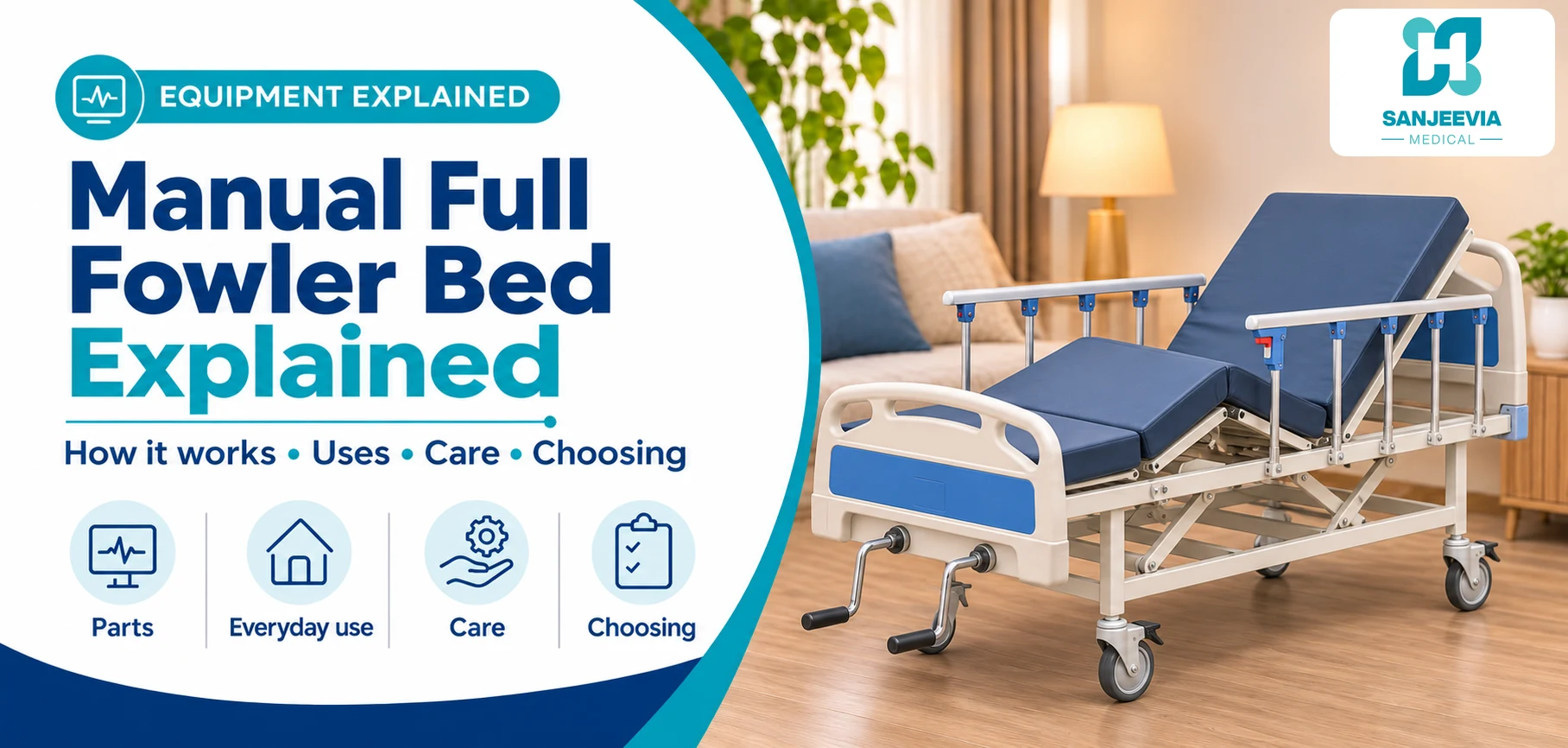
A two-crank bed can look only slightly different from a one-crank bed, but the second mechanism changes the way the lower body is supported. That extra movement is useful only when the caregiver understands which crank controls which section.
Quick answer: A manual full-Fowler bed independently adjusts the backrest and knee section using two cranks. It needs no mains power, but correct mattress articulation, rail assessment, transfer planning and trained operation remain essential.
Explore relevant equipment
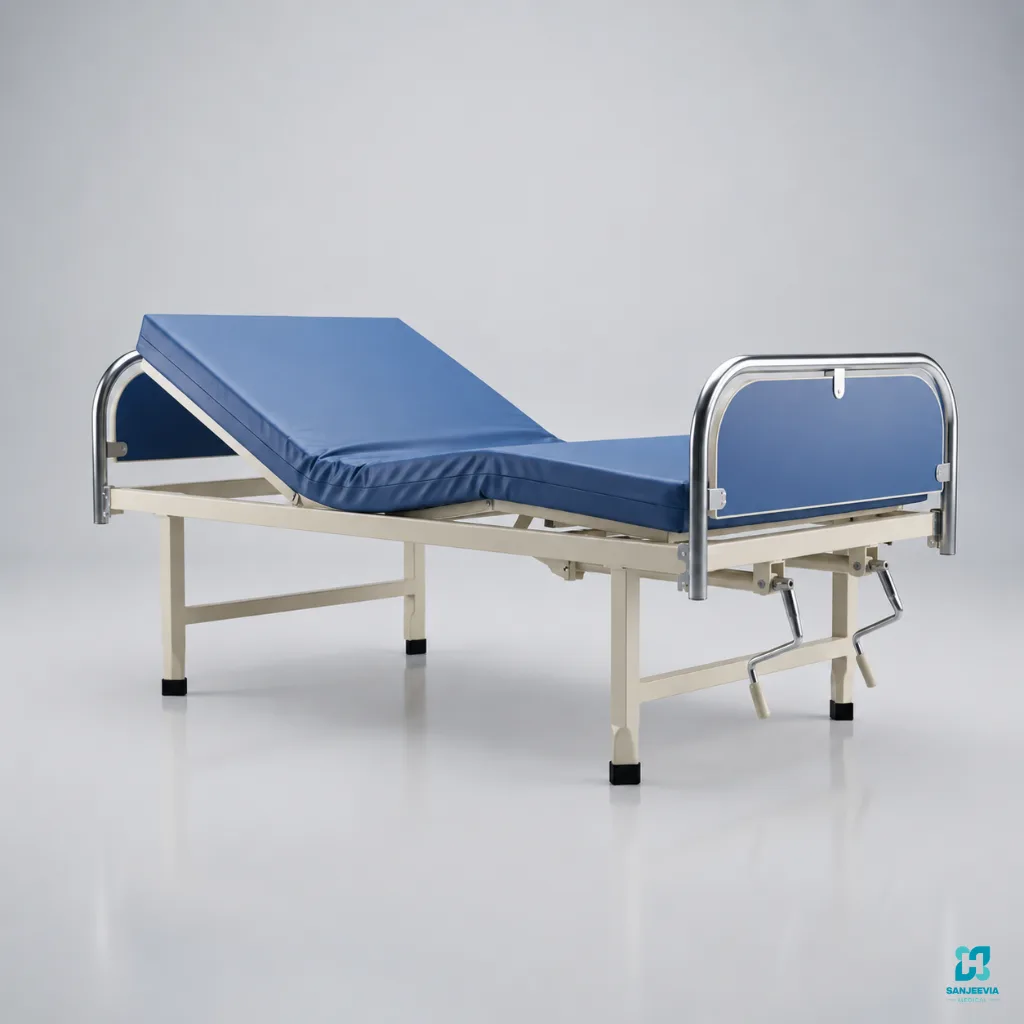
Manual Full Fowler Bed
Review the live listing for the confirmed configuration, included parts and current Delhi NCR rental or purchase options.
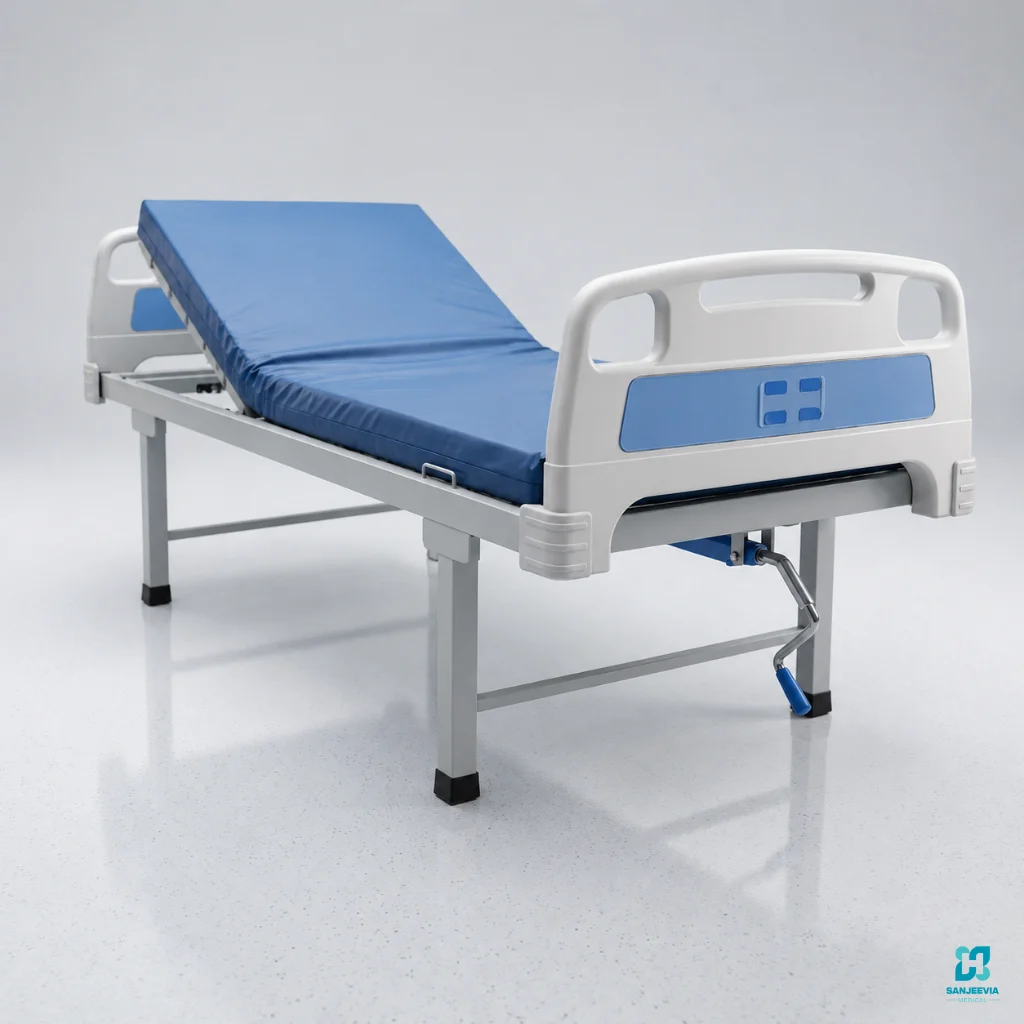
Manual Semi Fowler Bed – ABS Side Rails
Review the live listing for the confirmed configuration, included parts and current Delhi NCR rental or purchase options.
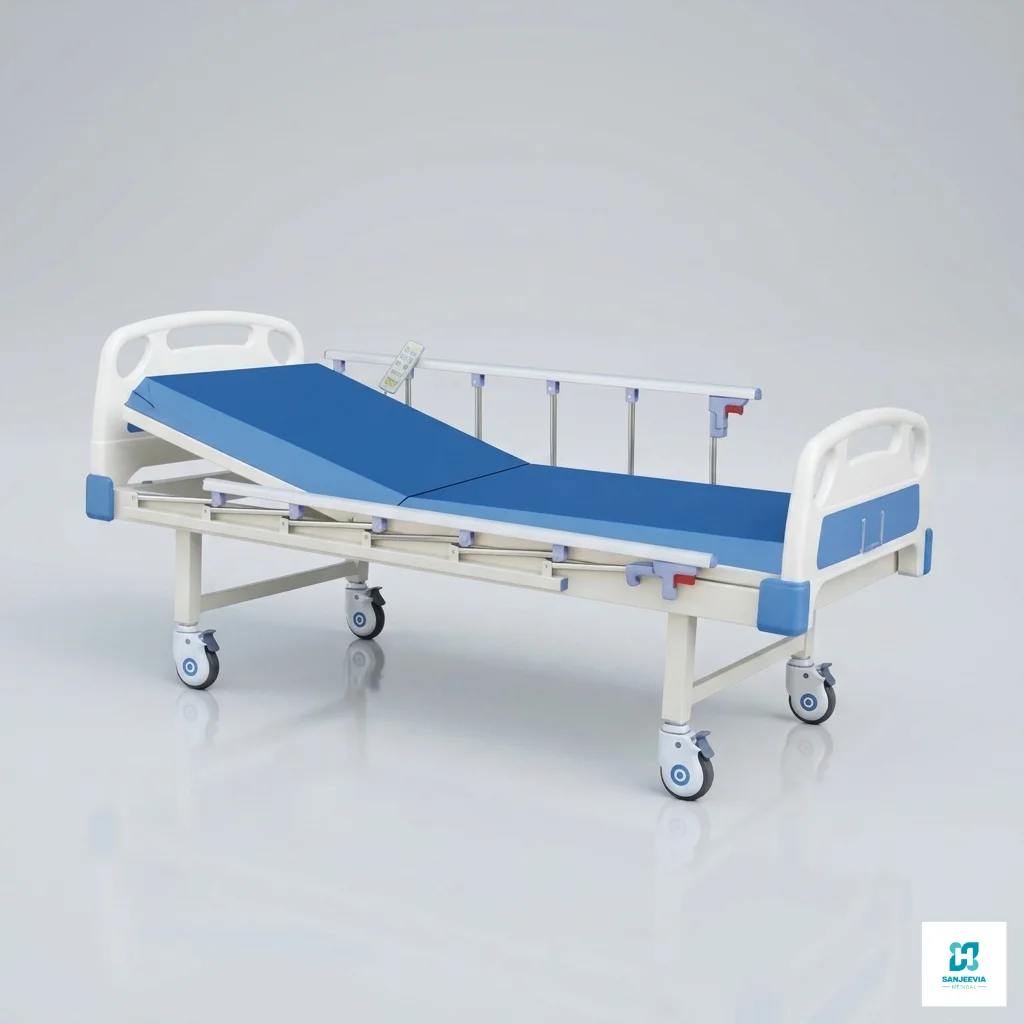
1 Function Electric Bed
Review the live listing for the confirmed configuration, included parts and current Delhi NCR rental or purchase options.
Confirm the exact bed, mattress, rails, accessories, room access and handover before booking.
Jump to equipment details
What “full Fowler” means on this bed
The product has one manual crank for the backrest and another for the knee-break section. Each screw drive changes a separate deck segment. A sectioned mattress bends with those joints and helps keep the surface aligned.
The label “full Fowler” is often used as shorthand for a bed with both upper-body and knee positioning. It does not mean the user should be placed at a universal angle. Positioning can affect comfort, breathing, skin pressure, circulation, feeding and transfers, so the responsible clinician’s instruction takes priority.
Manual operation avoids dependence on electricity. It also transfers the workload to the caregiver, who needs enough strength, reach and space to turn the correct crank without forcing it.
Parts and controls
| Part | Purpose | Before use |
|---|---|---|
| Backrest crank | Raises or lowers the upper deck. | Identify it during handover; confirm smooth movement. |
| Knee crank | Changes the knee-break support. | Confirm direction and end limits; never guess from appearance. |
| Four-section mattress | Follows the articulated deck. | Align each hinge and keep the cover unwrinkled. |
| Rails | Provide a barrier when individually assessed. | Latches secure; gaps compatible with user and mattress. |
| Castors and brakes | Position and stabilise the bed. | All wheels intact and brakes hold on the actual floor. |
| IV pole, if supplied | Supports prescribed fluids or accessories. | Correct socket, stable pole and no overload or improvised items. |
Marking the crank handles “back” and “knee” may help caregivers if the supplier permits it. Never modify the mechanism or add an extension handle.
Practical operating sequence
- Apply the brakes and remove obstacles from both crank paths.
- Check the patient, mattress, linen, rails, tubing and drains before movement.
- Explain the movement and use one crank at a time.
- Turn steadily while observing the corresponding deck section.
- Stop at the prescribed position or earlier if there is pain, resistance, sliding or line tension.
- Do not force a crank at the mechanical limit.
- Stow both handles safely after adjustment.
When returning the bed flatter, monitor heels, knees, hips and the patient’s tendency to slide. A caregiver should never reach into a moving linkage or place hands beneath a loaded deck.
Who may need it—and when another bed may be better
A manual full-Fowler bed may suit a care plan requiring independent upper-body and knee positioning when a capable caregiver is available. It can be useful where power reliability is a concern or the user does not need to self-adjust frequently.
A powered bed may be more practical if the caregiver cannot operate cranks, the patient needs frequent changes or independent control is appropriate. A height-adjustable bed may be needed for safer transfers or caregiver ergonomics. A two-crank bed does not provide height movement unless the exact configuration states otherwise.
The bed is not a substitute for manual-handling equipment, pressure care, nursing assessment or clinical monitoring.
Common errors and warning signs
- Turning the wrong crank while attached tubing or the patient’s posture is not ready.
- Raising the backrest without adequate knee support and allowing repeated sliding.
- Using a mattress whose joints do not match the deck.
- Forcing a crank, using tools on it or continuing after a grinding sound.
- Leaving one or more castors unlocked.
- Assuming rails can be used as lifting or transfer handles.
- Adding a pressure overlay without checking rail and entrapment gaps.
Stop using the adjustment if the deck drops, moves unevenly, fails to hold position or shows a bent linkage. Arrange inspection instead of improvising a repair.
Need help matching the bed?
Share the patient’s mobility, transfer method, required bed movements, mattress needs and delivery access. Sanjeevia can help confirm the configuration and current Delhi NCR options.
Cleaning, maintenance and fault planning
Clean visible soil from rails, boards, crank handles and frame before applying a compatible disinfectant. Follow the product label and dry surfaces. Mattress cleaning must follow the cover instructions; fluid inside foam or a torn cover needs prompt review.
Regularly check fasteners, drive screws, crank pins, hinges, rail latches, castors, brakes and the mattress retainers. Listen for a new sound and compare left and right deck alignment. Preventive inspection is safer than waiting for a complete failure.
Keep the supplier’s support number and bed identity available. Record which accessories arrived so exchange and return do not separate incompatible parts.
Questions before renting or buying
- Does the care plan require both backrest and knee adjustment?
- Can the caregiver operate both cranks comfortably and correctly?
- Is a four-section mattress supplied and compatible?
- Which rails and castors are fitted, and have they been assessed?
- What is the bed’s overall size and delivery route?
- Is height adjustment needed for transfers or caregiver tasks?
- What inspection, breakdown, exchange and pickup support is included?
For a single manual backrest function, read the semi-Fowler guide. For powered movement and power-cut planning, see the electric-bed power guide.
Frequently asked questions
What is the second crank for?
It changes the knee-break section independently of the backrest on this bed type.
Does a full-Fowler bed raise the entire bed height?
Not necessarily. This listing describes backrest and knee adjustment; confirm any height function separately.
Can both cranks be turned together?
Use one control at a time while observing the patient and moving section.
Does it need electricity?
The manual cranks do not, although other attached care equipment may require power.
Explore your equipment options
Manual Full Fowler Bed
Review the live listing for the confirmed configuration, included parts and current Delhi NCR rental or purchase options.
Manual Semi Fowler Bed – ABS Side Rails
Review the live listing for the confirmed configuration, included parts and current Delhi NCR rental or purchase options.
1 Function Electric Bed
Review the live listing for the confirmed configuration, included parts and current Delhi NCR rental or purchase options.
Confirm the exact bed, mattress, rails, accessories, room access and handover before booking.
Sources and useful reading
- MHRA: Bed rails—management and safe use.
- FDA: Hospital bed system guidance to reduce entrapment.
- NHSRC India: Biomedical Equipment Management and Maintenance Programme.
- CDC: Environmental cleaning procedures and noncritical equipment.
- Sanjeevia Manual Full Fowler Bed listing.
- NHSRC India: Medical-device technical specification resources.
Prepared by Sanjeevia’s editorial team. Updated 10 November 2026. Use only patient-specific positions and transfer methods taught by the responsible professional.
