
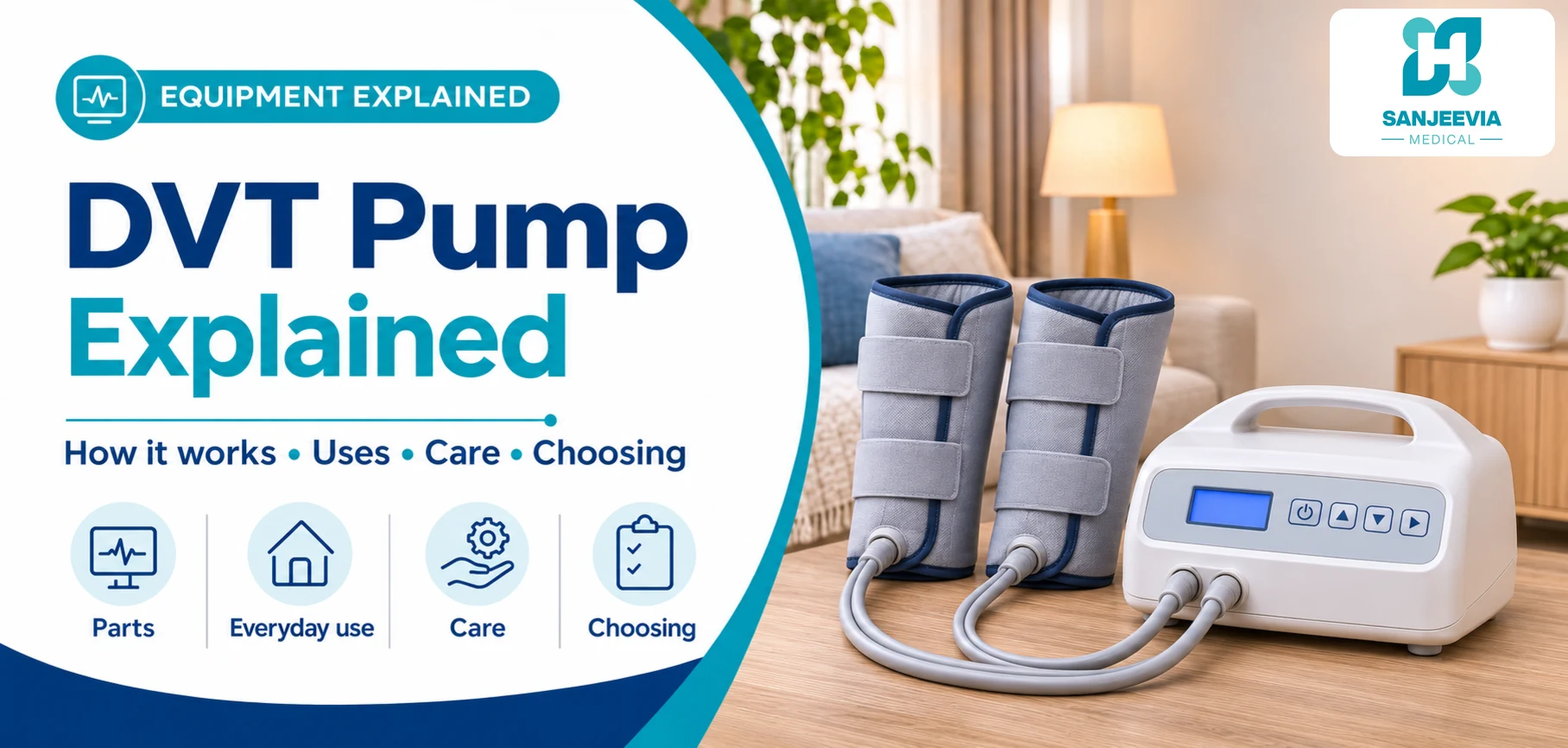
A DVT pump does not dissolve an existing clot. Its usual job is preventive: inflatable sleeves repeatedly compress the limb while a person is less mobile, supporting venous blood flow during a period of increased clot risk.
Quick answer: A DVT pump is an intermittent pneumatic compression system. A pump inflates and deflates compatible sleeves around the leg, usually according to a preset cycle, to help reduce venous stasis. It is used only after clinical assessment and is one part of a wider clot-prevention plan.
Explore relevant equipment
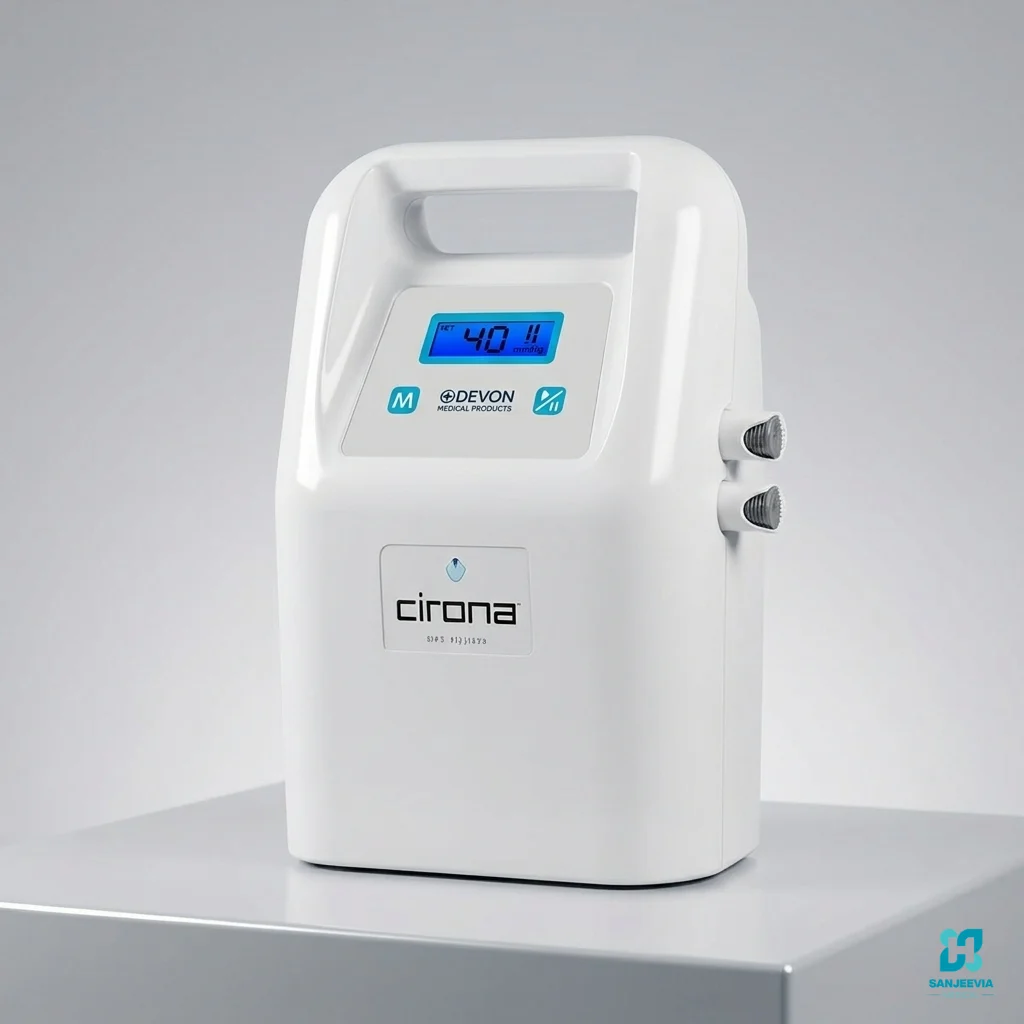
DVT Pump – Standard
Standard IPC rental category. The exact Devon, Medflow, Zimmer or other verified model and compatible sleeves are confirmed before payment.
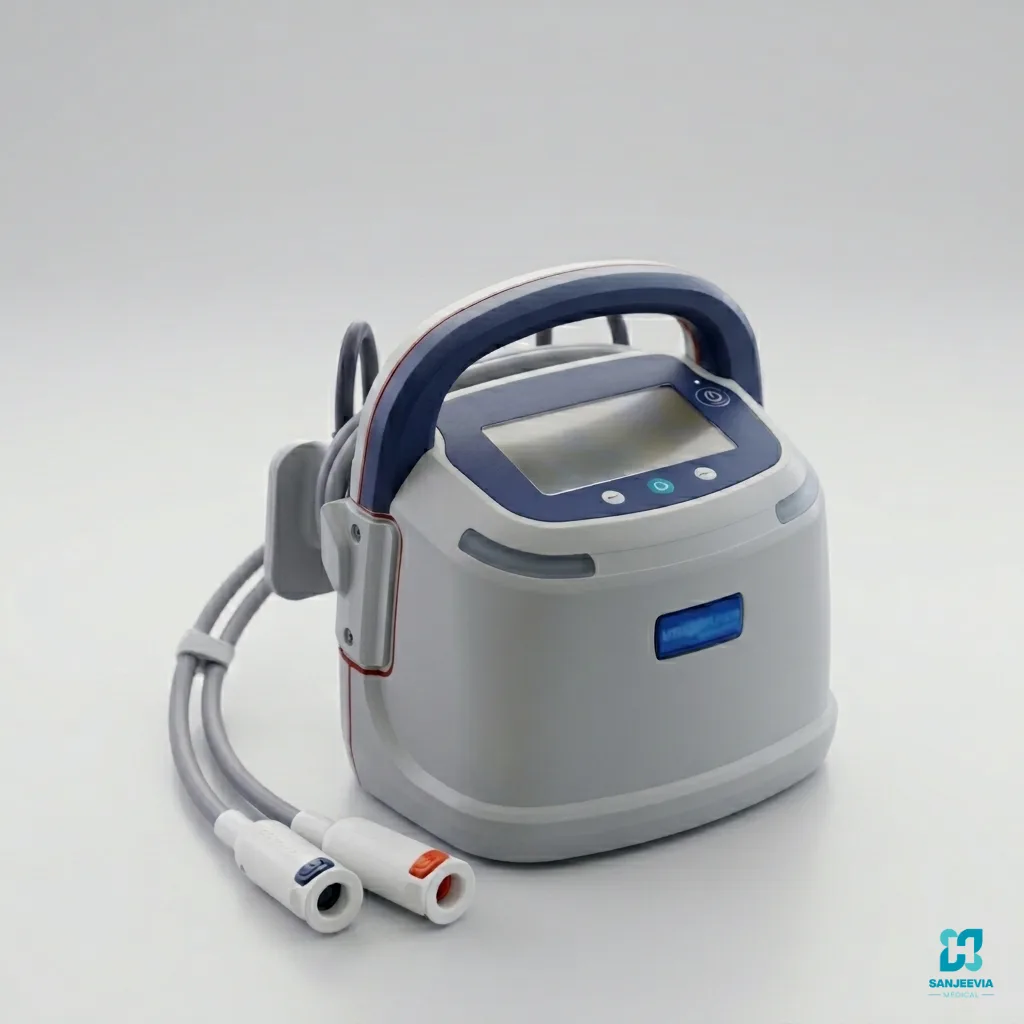
DVT Pump – Premium
Premium IPC rental category. Covidien/Medtronic and Arjo systems use different pumps, tubing, sleeves and instructions; parts are not interchangeable.
Open each product page for the current rental or purchase options and package details. Confirm the exact supplied model, compatible accessories and delivery availability for your PIN code.
Need a DVT pump demonstration? No matching demonstration was available on Sanjeevia’s YouTube channel at this update. Request a hands-on demonstration of the supplied model from the responsible trained professional and use the manufacturer’s instructions. You can browse Sanjeevia’s current equipment videos.
Jump to equipment details
How does intermittent pneumatic compression work?
The pump sends air through tubing into one or more chambers in a sleeve. The chambers inflate and then release in a repeating pattern. This external pressure helps move blood through the leg veins when normal calf-muscle activity is reduced.
IPC is mechanical thromboprophylaxis: a method used to reduce clot risk. It is not an anticoagulant medicine and does not diagnose DVT. A person may need IPC, medication, early mobilisation or another combination according to their clinician’s risk and bleeding assessment.
Pressure, cycle timing, sleeve location and duration are device- and patient-specific. They must not be copied from another patient or set from a generic online chart.
Pump, tubing and sleeves: one system
| Part | Role | Check before use |
|---|---|---|
| Pump | Creates the programmed inflation cycle. | Exact model, power supply, controls and alarm indicators. |
| Tubing | Carries air between pump and garment. | Correct connector, no kinks, splits or loose fittings. |
| Sleeves or cuffs | Apply pressure to the prescribed site. | Correct manufacturer, product code, limb site and size. |
| Power or battery | Keeps the cycle operating as intended. | Whether battery operation exists and tested runtime for the assigned unit. |
A sleeve that physically connects is not necessarily compatible. Different systems use different pressure patterns, connectors and detection features. Sanjeevia’s listings state that the exact pump, tubing and single-patient-use sleeves are confirmed together.
Who might be prescribed a DVT pump?
IPC may be used when a person has reduced mobility after surgery, illness or stroke and the clinical team judges it appropriate. NICE recommends condition- and procedure-specific VTE risk assessment; it does not make a pump a routine purchase for every postoperative patient.
The plan should state the limb or limbs, sleeve site, size, expected wearing period, allowed breaks, skin-check routine and when IPC can stop. The team should also explain mobility, medicines and hydration advice relevant to the patient.
Read DVT pump questions after knee replacement if the equipment is being considered after orthopaedic surgery.
When should compression be reviewed or avoided?
Known or suspected DVT, severe peripheral arterial disease, acute skin infection, significant wounds, severe swelling, heart failure and other conditions can change whether and how compression is used. This is why a prescription or clinical instruction is more than a pressure number.
Check the skin and comfort as instructed. Stop and obtain clinical advice for new pain, numbness, coldness, marked swelling, skin discolouration, blistering or pressure injury. Sudden breathlessness, chest pain, coughing blood or collapse requires urgent medical attention.
A pump can reduce risk but cannot guarantee that a clot will not occur. Do not use it to explain away symptoms or delay assessment.
Everyday operation and alarm response
- Confirm the prescribed site, sleeve size, model and schedule. Inspect the skin, garment, tubing and pump before applying it.
- Apply the sleeves exactly as demonstrated, smooth and correctly oriented. Connect only the matching tubing and keep it free from kinks.
- Place the pump securely, connect power and start the approved programme. Observe the first cycles and confirm inflation is occurring as expected.
- Remove the sleeves only for the breaks specified by the care team, including skin care, hygiene or physiotherapy. Recheck fit after repositioning.
- If an alarm occurs, assess the patient and read the message. Check permitted causes such as a loose connection or kink; do not bypass an alarm or alter clinical settings.
Ask how mobility or walking affects the wearing schedule and how the patient can transfer safely. Sleeves and tubing can create a trip or entanglement risk if the setup is poorly arranged.
Keep a simple daily record of application time, removal time, skin findings, comfort and interruptions. This helps the treating team judge whether the plan is practical and whether sleeve fit needs review. Do not interpret the record as proof that clot risk has ended; only the clinical team should decide when prophylaxis can stop.
Standard versus premium: what actually matters?
“Standard” and “premium” are Sanjeevia listing categories, not medical classifications. The clinically relevant details are the exact manufacturer and model, prescribed compression site, garment type and size, compatible tubing, enabled alarms and operating instructions.
Request a written package: pump, power cable, tubing, new compatible sleeves, demonstration, cleaning status and fault support. Confirm whether the device is mains-only or has a verified battery, and establish a plan for an interruption when continuous use is clinically important.
For Delhi NCR delivery, confirm the PIN code, current charge, deposit, extension and collection terms. Use the standard versus premium DVT pump checklist before booking.
Frequently asked questions
Does a DVT pump treat an existing clot?
Do not use it as treatment for a suspected clot. An existing or suspected DVT needs urgent clinical assessment and a specific treatment plan.
Is the pump needed after every knee replacement?
No. The surgeon or treating team determines the clot-prevention plan after assessing risk and contraindications.
Can sleeves from another pump be used?
Do not assume so. Confirm the manufacturer, model and compatible sleeve product code.
Can it replace walking or prescribed blood-thinning medicine?
No. It is one possible part of a wider plan. Follow the separate mobility and medicine instructions.
Explore your equipment options
DVT Pump – Standard
Standard IPC rental category. The exact Devon, Medflow, Zimmer or other verified model and compatible sleeves are confirmed before payment.
DVT Pump – Premium
Premium IPC rental category. Covidien/Medtronic and Arjo systems use different pumps, tubing, sleeves and instructions; parts are not interchangeable.
Open each product page for the current rental or purchase options and package details. Confirm the exact supplied model, compatible accessories and delivery availability for your PIN code.
Sources and useful reading
- NICE: Reducing hospital-acquired VTE risk — Risk assessment and condition-specific use of intermittent pneumatic compression.
- Chelsea and Westminster NHS: IPC patient guide — Plain-language explanation of sleeves, cycles and clot prevention.
- Sanjeevia: Standard DVT pump listing — Exact-model and compatibility checks for the standard rental category.
- Sanjeevia: Premium DVT pump listing — Exact-model and compatibility checks for the premium rental category.
- CDSCO: Medical devices and diagnostics — Official Indian medical-device information; this is not an endorsement of an individual listing.
- NHSRC: Materiovigilance Programme of India — Information about reporting suspected medical-device adverse events in India; urgent care comes first.
Prepared by Sanjeevia’s editorial team. Updated 7 November 2026. This guide explains equipment; diagnosis, treatment, settings and patient-specific suitability must come from the responsible clinical team.
