
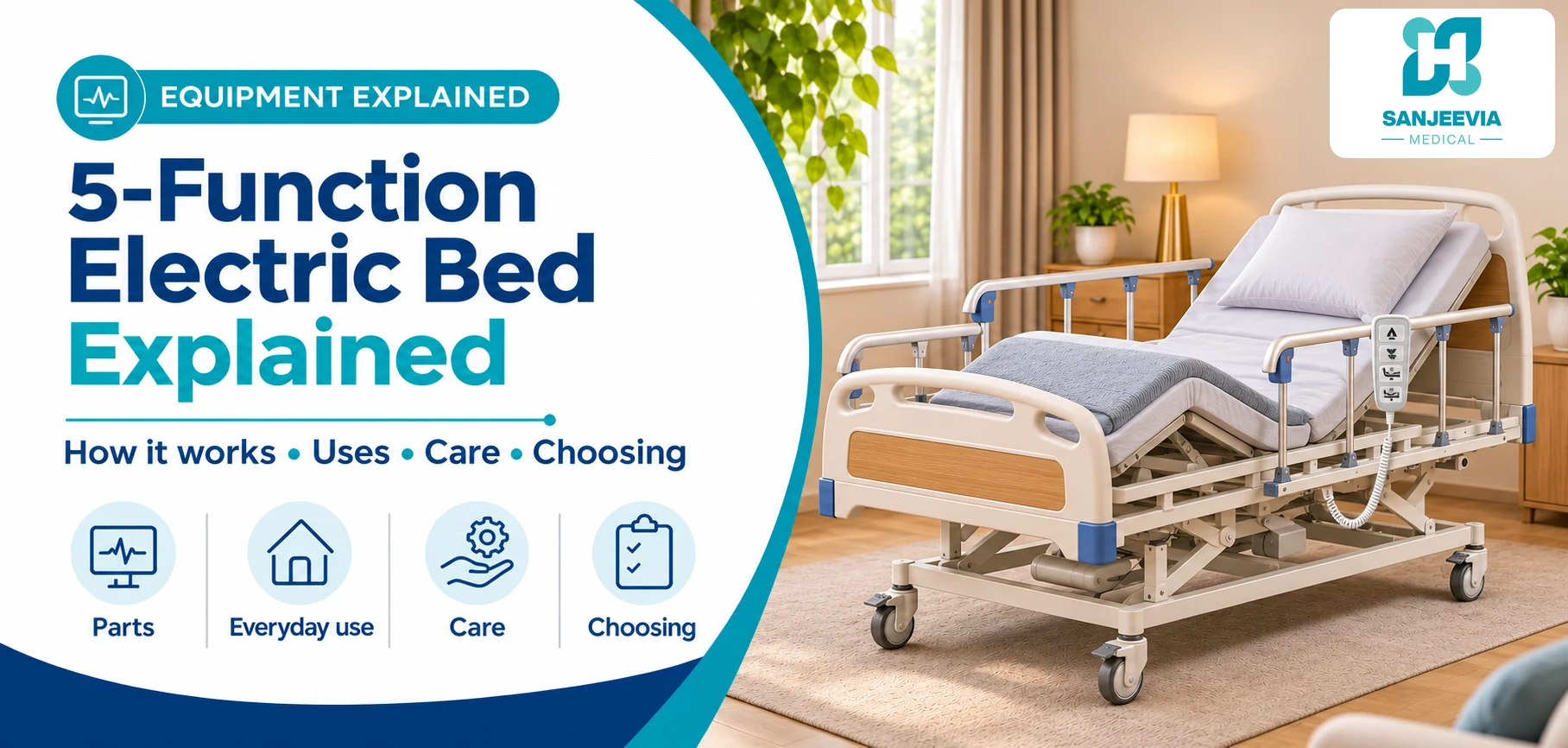
Raising the backrest and tilting the whole bed are very different movements—even when they look similar from the doorway. A 5-function electric bed commonly adjusts the backrest, knees and platform height, plus head-down and head-up platform tilt. Sanjeevia’s listed bed follows this five-movement description. Those extra tilt positions require patient-specific clinical direction; they are not everyday treatments to try at home. Understanding that distinction helps families choose a bed for the actual care plan rather than the largest number on the label.
Explore relevant equipment
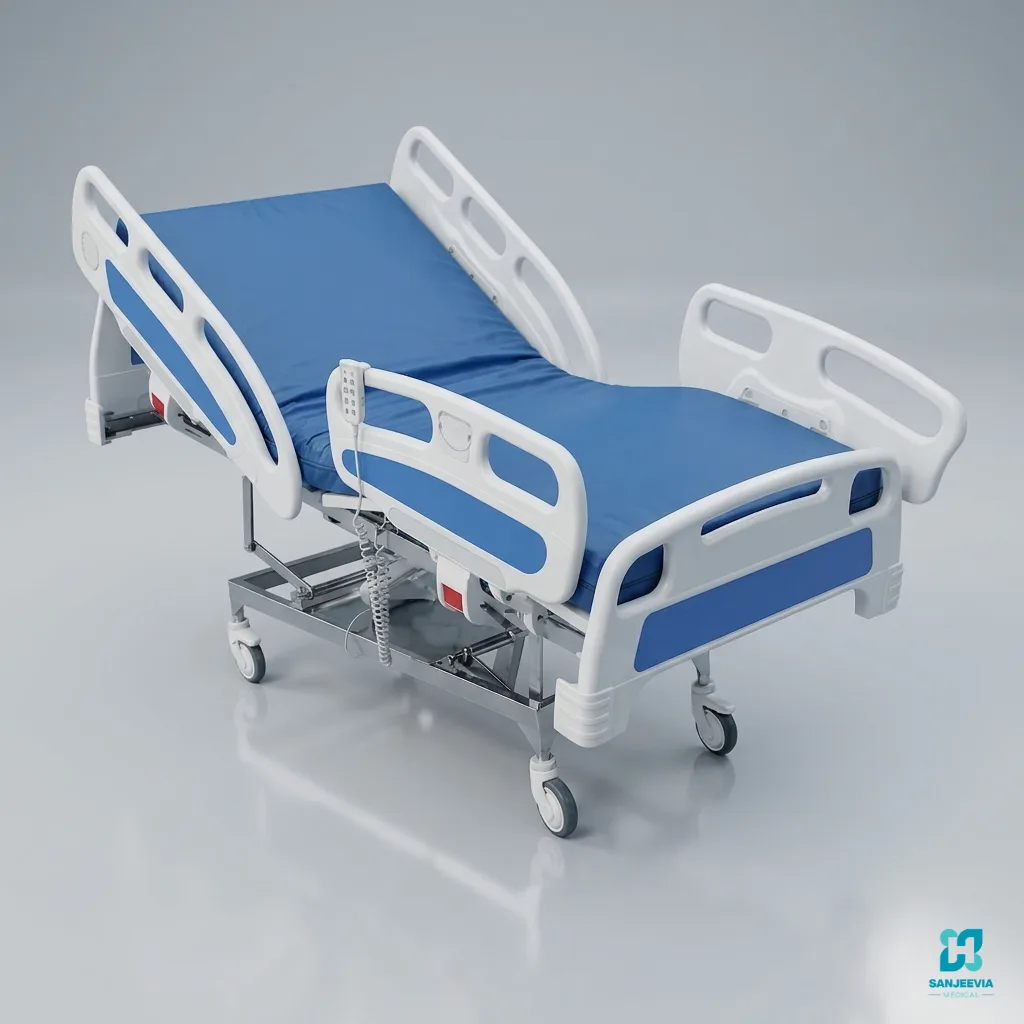
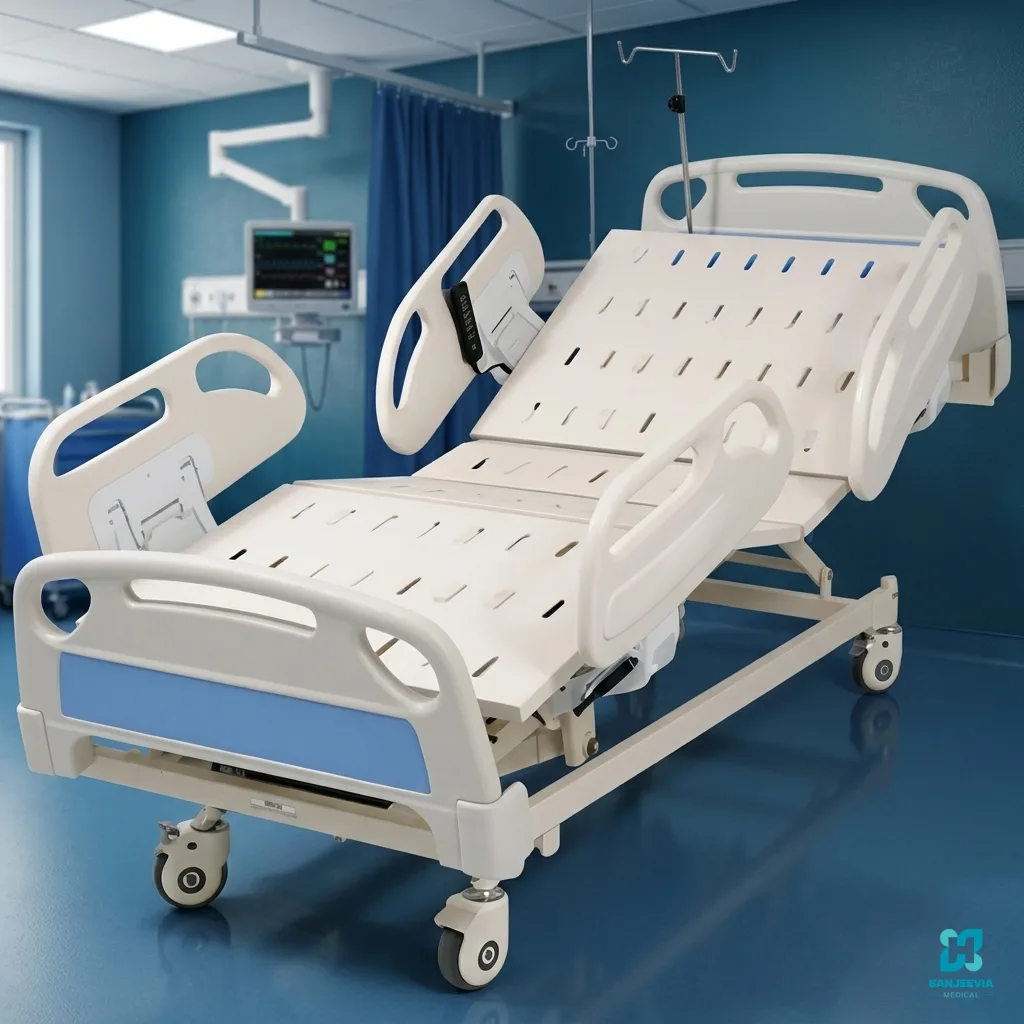
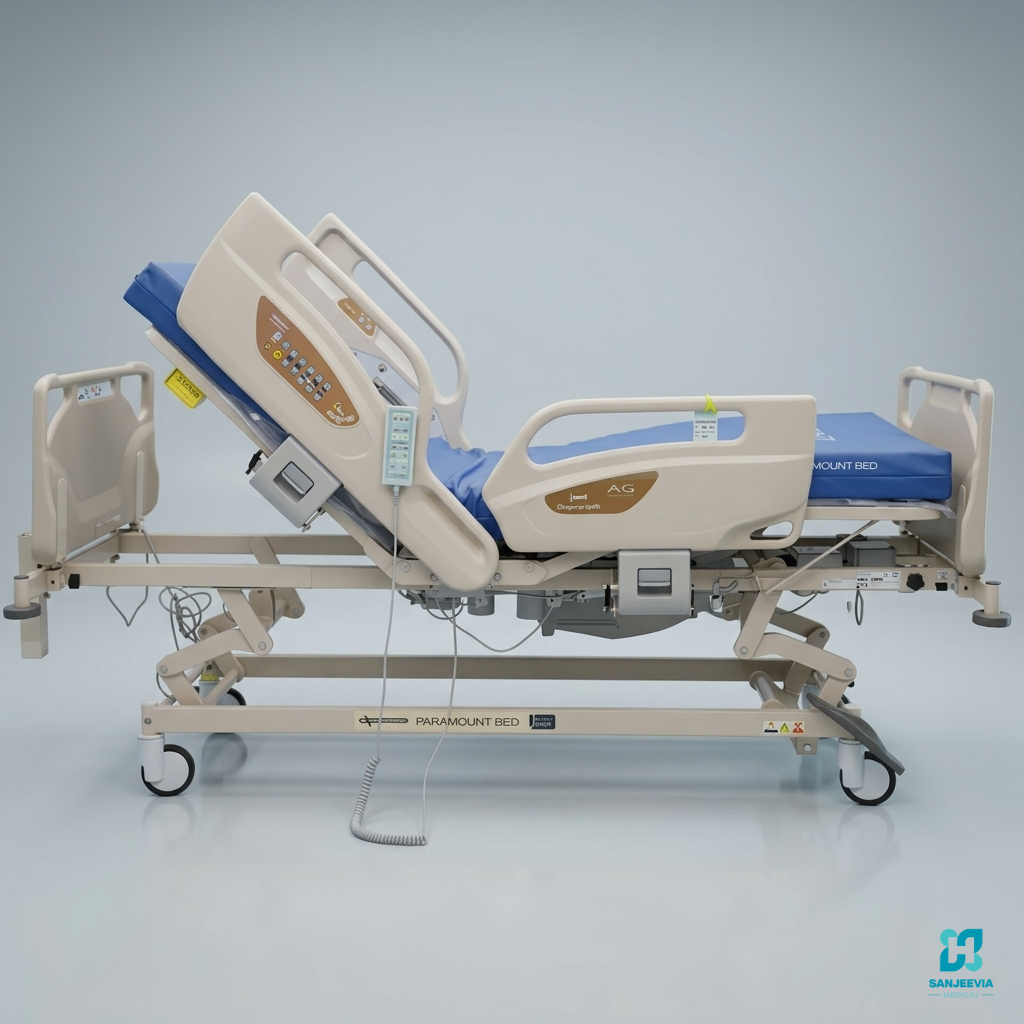
Watch Sanjeevia’s equipment demonstration
See the 5-function electric bed example and its controls. Confirm the exact supplied configuration at handover; this video does not prescribe patient positions.
Jump to equipment details
- What counts as five functions?
- Controls, mechanical parts and important units
- Who needs the additional tilt—and who decides?
- Mattress, rails and room clearance form one system
- Everyday operation without guessing settings
- Cleaning, faults and a realistic power-cut plan
- Choosing a package for home care
- Frequently asked questions
What counts as five functions?
Backrest movement raises the upper-body section. Knee adjustment bends the platform near the knees. Height adjustment lifts or lowers the entire platform. Trendelenburg tilts the platform with the head end lower than the foot end; reverse Trendelenburg tilts it the other way. The last two are whole-platform movements, not simply a raised pillow or backrest.
These are the movements described for the listed 5-function electric hospital bed. Naming varies across suppliers. Ask for each movement to be identified on the exact delivered bed. Five functions do not prove five motors, five independent controls or any particular angle range.
More controls bring more possibilities for selecting the wrong movement. Get the patient’s permitted positions and any restrictions from the treating team before the bed is used.
Controls, mechanical parts and important units
Expect a sectional mattress platform, lifting and tilting frame, powered actuators, a control box, handset, power lead, boards, rails, castors and mattress retainers. The supplied control system may differ from a brochure. Ask which buttons are patient controls, which are caregiver controls and whether specific functions can be locked.
Angles are measured in degrees; dimensions may use millimetres or centimetres. External width affects doorway access, while mattress-platform width affects surface compatibility. Safe working load includes the load defined by the manufacturer, not necessarily only the patient. Confirm the separate maximum patient weight.
Do not infer a CPR release, weighing scale, integrated monitor, battery or nurse panel from the function count. Each is a separate feature that must be verified. A castor brake holds the bed in place; it does not prevent every movement of the patient.
Who needs the additional tilt—and who decides?
A five-function bed may be appropriate when an assessed care plan specifically calls for whole-platform tilt alongside powered positioning and adjustable height. Some people need only the first three movements. A 3-function bed can therefore be the more suitable option when tilt is unnecessary.
Do not use head-down tilt to treat fainting, low blood pressure or any new symptom without clinical direction. Nor should head-up tilt be presented as a universal treatment for reflux or breathing problems. The appropriate position, duration and monitoring depend on the person’s condition and devices.
A bed described commercially as “ICU-style” does not create an ICU at home. Clinical assessment, staffing, monitoring, prescribed treatment and an emergency plan remain separate requirements. This guide explains equipment rather than prescribing therapy.
Mattress, rails and room clearance form one system
A moving platform requires an approved flexible mattress of the correct dimensions. Adding an overlay or thicker mattress changes effective rail height and may introduce gaps. Ask the provider to assess the complete bed, mattress and rail combination, particularly for someone small, frail, confused or prone to sliding.
Rails can cause entrapment, climbing and fall risks when used inappropriately. They are not automatically a safe pull-up handle or a replacement for supervision. Check rail latches at handover and after adjustment. Read the mattress guide before changing the surface.
Allow clearance for the bed’s entire approved movement range. Tilting can change the space needed at each end and the relationship to nearby equipment. Keep walls, furniture, tubing, cables and under-bed storage clear. Measure lift and doorway access before delivery.
Everyday operation without guessing settings
- Confirm the planned position and who is permitted to operate the controls.
- Secure the brakes according to the manual. Explain the movement to the patient.
- Move the over-bed table away. Check all sides and underneath for obstructions, limbs, bedding and lines.
- Select only the demonstrated control. Observe the patient throughout and stop on distress, pain or unexpected movement.
- Recheck alignment, line slack and the agreed resting arrangement. Store or lock controls as instructed.
Need help choosing suitable equipment?
Share your care requirements, room measurements and expected duration. Ask Sanjeevia about compatible options and current rental or purchase terms in Delhi NCR.
Do not trial tilt just to see whether it improves a symptom. Do not bypass control locks, force a stalled platform or place hands in the mechanism. If an urgent medical problem develops, follow the emergency plan and seek help rather than experimenting with the bed.
The Sanjeevia video shows a five-function example. It introduces the equipment and controls, but does not establish safe positions for a particular patient or the exact specification of every supplied unit.
Cleaning, faults and a realistic power-cut plan
Keep the handset and rail contact areas clean using the frame manufacturer’s approved products. Follow separate mattress cleaning instructions. Isolate electrical power as instructed before cleaning, keep housings dry and remove spilled liquid promptly. Avoid unapproved solvents, soaking or pressure washing.
Check visible cables, brakes, latches, mattress retainers and covers. Stop and contact the provider for damaged wiring, loose rails, unusual smell or heat, unexpected motion or a function that will not stop normally. Do not open motors or the control box. Professional maintenance is separate from daily cleaning.
Ask whether the actual bed has a charged, serviceable battery and which movements it supports. A battery can be optional and is not unlimited. Have the provider demonstrate the approved outage procedure and any manual emergency feature; never improvise one. The power-cut guide helps record a workable plan.
Choosing a package for home care
Give the provider the required movements, patient dimensions, mattress needs, transfer method and room measurements. Ask for a written specification, compatible accessories, power requirements, delivery and installation plan, caregiver handover and maintenance contact. Clarify rental extension, exchange, pickup and deposit terms, or long-term servicing when buying.
Compare the Paramount A5 and 3-function discussion only after establishing required functions; a brand or feature count alone cannot establish fit. Reassess when the patient, mattress, room or caregivers change. No bed replaces a personalised pressure-care and repositioning plan.
Frequently asked questions
Does five-function mean five motors?
No. Function labels and motor arrangements vary. Verify the movement list and specification of the exact unit.
Can we use Trendelenburg for low blood pressure?
Do not self-prescribe head-down positioning. Seek clinical advice and follow the emergency plan for symptoms.
Does it include CPR and battery backup?
These are separate model-specific features. Have the provider confirm and demonstrate what is fitted.
Does an ICU-style bed include medical care?
No. The bed is equipment. Staffing, monitoring, treatment and emergency support need their own arrangements.
Explore your equipment options
Sources and further reading
Manufacturer instructions apply to the exact supplied model. International safety resources below support general equipment principles; they are not Indian prescribing rules.
- Paramount Bed: A5 family, model groups and official manuals (manufacturer example for electric-bed terminology, not the manual for an unbranded Sanjeevia listing).
- Paramount A5 electric-bed instruction manual: controls, precautions, cleaning and model-dependent features.
- MHRA: bed rails, compatibility, individual assessment and safe use
- NHSRC, India: Biomedical Equipment Management and Maintenance Programme and technical resources
- Sanjeevia catalogue: 5 Function Electric Hospital Bed — current listing; verify the assigned unit at handover.
Educational information: Follow the person’s clinical care, transfer and emergency plan and the exact equipment instructions. Equipment does not replace professional assessment or required care staff. Sources and catalogue checked November 2026.
