
Home / Blog / Hospital Bed After Spinal Surgery: Positioning Considerations at Home
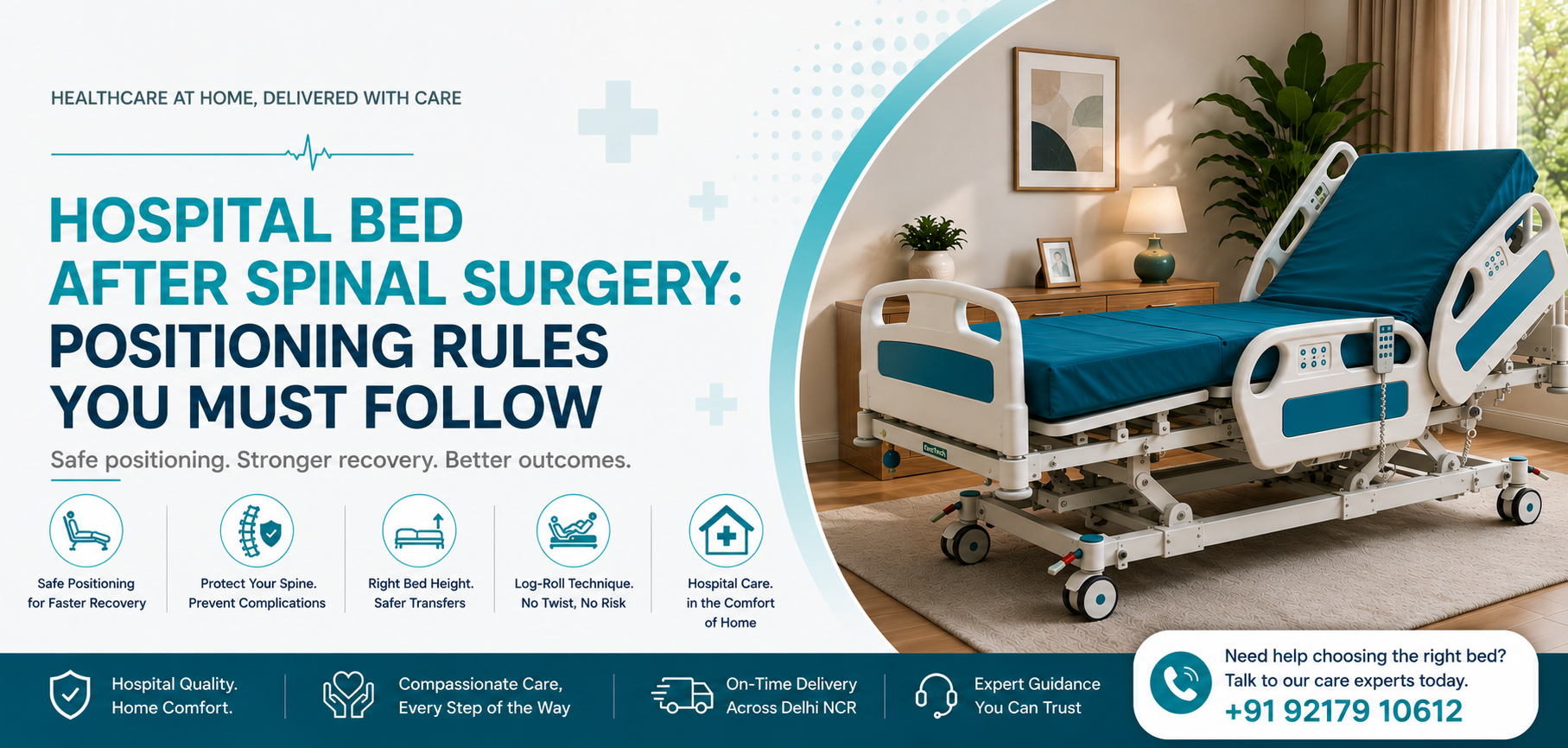
Hospital Bed After Spinal Surgery: Positioning Rules You Must Follow log roll technique spinal surgery India, hospital bed spine surgery home India, spinal surgery positioning rules, no twist spinal surgery home care, laminectomy discectomy home bed India Bringing a patient home after spinal surgery in Delhi NCR? This guide covers the log-roll technique, no-twist rules, correct bed height, and which bed type to rent. hospital bed after spinal surgery India

Hospital Bed After Spinal Surgery: Positioning Considerations at Home

Table of Contents

Quick Answer After spinal surgery, positioning, movement and transfer precautions depend on the procedure and the surgeon’s written instructions. If a log-roll or other specific technique is prescribed, it should be demonstrated by the treating physiotherapist or nurse before discharge. An adjustable bed may be useful when the care plan requires particular positioning or a suitable transfer height; it is not automatically required for every spinal procedure.

Your mother had a lumbar fusion three days ago and is being discharged tomorrow. The spine surgeon’s nurse gave a handout about the log-roll technique but it was rushed and you did not fully understand it. The physiotherapist mentioned something about the bed height. You are going home with a patient who has screws in her spine and you need to know exactly what you are allowed to do and what could cause a problem.

This guide explains general equipment considerations after spinal surgery. It does not replace the written instructions from the surgeon, physiotherapist or nursing team.

The log-roll is a movement technique where the spine is kept in a neutral, untwisted position while the patient moves from one position to another. Instead of the patient rolling naturally (which involves the shoulders moving before the hips, creating a rotational force through the fused or repaired segments), the log-roll moves the entire body as one rigid unit: shoulders, torso, and hips rotate simultaneously.

Why this matters after spinal surgery:

  • Spinal fusion: bone graft and hardware are in place but the fusion itself takes 3 to 6 months to solidify. Rotational stress on the fused segments during this period can disrupt the fusion, cause screw loosening, or shift the graft material.
  • Laminectomy and discectomy: the surgical area is inflamed and vulnerable. Twisting places shear force on the repaired disc space or the decompressed nerve roots.
  • Spinal cord surgery: any surgical procedure near the cord carries the risk that incorrect movement could impinge on the cord or the repair site.

The physiotherapist at the hospital will have demonstrated this. Here is a reference for home practice:

  • The patient lies on their back in the hospital bed, arms folded across the chest or placed along the sides.
  • The caregiver stands on the side the patient will roll toward, hands positioned at the patient’s shoulder and hip (not just the shoulder, not just the hip).
  • On a count: ‘One, two, three, turn.’ The caregiver rotates the patient’s shoulder and hip simultaneously in one motion, keeping the entire spine aligned as a single unit.
  • The patient’s knees may be bent slightly for stability, but the key is that no twisting occurs in the torso at any point in the movement.
  • The same technique is used to roll from side to back. Never pull the patient by the arm or leg alone: this creates the rotational force the technique is specifically avoiding.

Practice this with the physiotherapist before the patient is discharged. Do not attempt it for the first time at home without having been shown the technique in person.

A standard home bed creates problems for spinal surgery recovery that a hospital bed solves directly:

Care need to assessPossible equipment consideration
Prescribed backrest, knee or height positioningChoose a bed only with the functions stated in the written care plan
Planned transfer or assisted repositioningConfirm bed height, transfer technique and level of assistance with the treating physiotherapist or nurse
Mattress comfort or pressure-injury riskSelect a compatible surface after individual clinical assessment; do not assume a single mattress type is required
Side-rail useAssess rail, mattress and patient compatibility as well as fall, climbing and entrapment risks; rails are not a default transfer aid

A full fowler bed or a 2-function or 3-function electric bed may be considered when the written care plan requires their listed functions. Confirm the exact model, positioning range, mattress compatibility and transfer plan with the treating team. Browse all options at sanjeevia.com/product-category/hospital-beds/.

Premium ICU-Style Hospital Bed for Home Recovery | Rent & Buy, 5 function Advanced Patient Care Bed, 5 Function Electric Hospital Bed with advanced positioning controls for critical care, patient recovery, and long-term home healthcare How to Set Up a Hospital Bed at Home Safely: Step-by-Step Guide hospital bed room setup India, hospital bed positioning guide, hospital bed rails safety India, hospital bed height adjustment home, patient transfer hospital bed IndiaHospital Bed After Spinal Surgery: Positioning Considerations at Homehospital bed after spinal surgery Indialog roll technique spinal surgery India, hospital bed spine surgery home India, spinal surgery positioning rules, no twist spinal surgery home care, laminectomy discectomy home bed India

Most complications in home recovery after spinal surgery come from specific movements the patient attempts because they feel better than expected:

  • Rolling over in bed without log-roll technique: common on night 2 or 3 when the patient moves in sleep. Side rails and a firm mattress reduce this risk. Remind the patient before sleep.
  • Getting up from bed by sitting bolt upright: this creates significant flexion and rotation at the lumbar region. The electric backrest prevents this by raising the patient to sitting before they swing their legs.
  • Picking up objects from the floor: bending at the waist to reach below knee level is restricted in most lumbar surgery protocols. Ensure a long-handled reacher is available and positioned in the room.
  • Sitting on a low surface: the toilet, a soft sofa, or a low chair all require the patient to lower past the permitted hip flexion angle. A raised toilet seat and a firm chair with armrests are needed for the restriction period.
  • Carrying any weight: the surgeon will specify a weight limit. Even a 1 kg bag can generate enough spinal load to compromise a fresh fusion.

The restriction period varies by the type and extent of surgery. General guidance, which your surgeon’s instructions will define precisely:

Surgery TypeTypical Log-Roll Restriction PeriodWhen Normal Bed Transfers Resume
Single-level discectomy or microdiscectomy2 to 4 weeksAfter physiotherapist clears normal movement technique
Laminectomy4 to 6 weeksAfter physician follow-up and physiotherapist assessment
Single-level spinal fusion6 to 12 weeks, often longerAfter imaging confirms fusion progress at physician follow-up
Multi-level fusion or complex spinal reconstruction12 weeks or moreSurgeon-specified based on imaging and clinical assessment

Do not move to a standard bed before the surgeon has cleared it at a follow-up appointment with imaging if fusion is involved. The patient feeling fine is not the criterion for clearance.

Yes, until the physiotherapist has confirmed safe independent bed transfer technique using normal movement. Feeling good does not mean the surgical site has healed. The disc space is still inflamed and vulnerable. Early unrestricted movement is the most common cause of recurrence in the first month after discectomy.

The required number of carers and the appropriate repositioning technique should be assessed by the treating physiotherapist or nurse. Do not rely on body size alone when deciding whether a transfer or repositioning task can be performed safely.

Follow the discharge plan regarding physiotherapy and home support. If a log-roll, mobility progression or assisted-transfer technique has been prescribed but has not been demonstrated, contact the treating surgeon or physiotherapy team before attempting it at home.

Return the bed when the physiotherapist confirms safe independent bed transfers using normal movement, the surgeon has cleared unrestricted home activity, and the patient has been using a standard bed for at least one week with no discomfort or problems. For fusion surgeries, this is typically not before week 10 to 12 at the earliest.

Rent a hospital bed for spinal surgery recovery in Delhi NCR: Browse all hospital beds on Sanjeevia
View the Full Fowler Bed 
View the Semi Fowler Bed
Orders before 4 PM deliver same day.
WhatsApp us: +91 92179 10612
Next Read: Not sure whether to rent or buy the hospital bed for spinal recovery? Read: How Long Do You Need a Hospital Bed at Home? When to Return It

Related Guidance and Equipment

These links connect the patient’s positioning and transfer needs with the most relevant bed guidance and exact product specifications.

Continue Reading

Relevant Product Pages

Medical Disclaimer: This article is for general informational purposes only and does not constitute medical advice. All clinical and equipment decisions should be guided by your treating physician.

Published by Sanjeevia Medical  |  sanjeevia.com  |  Delhi NCR