
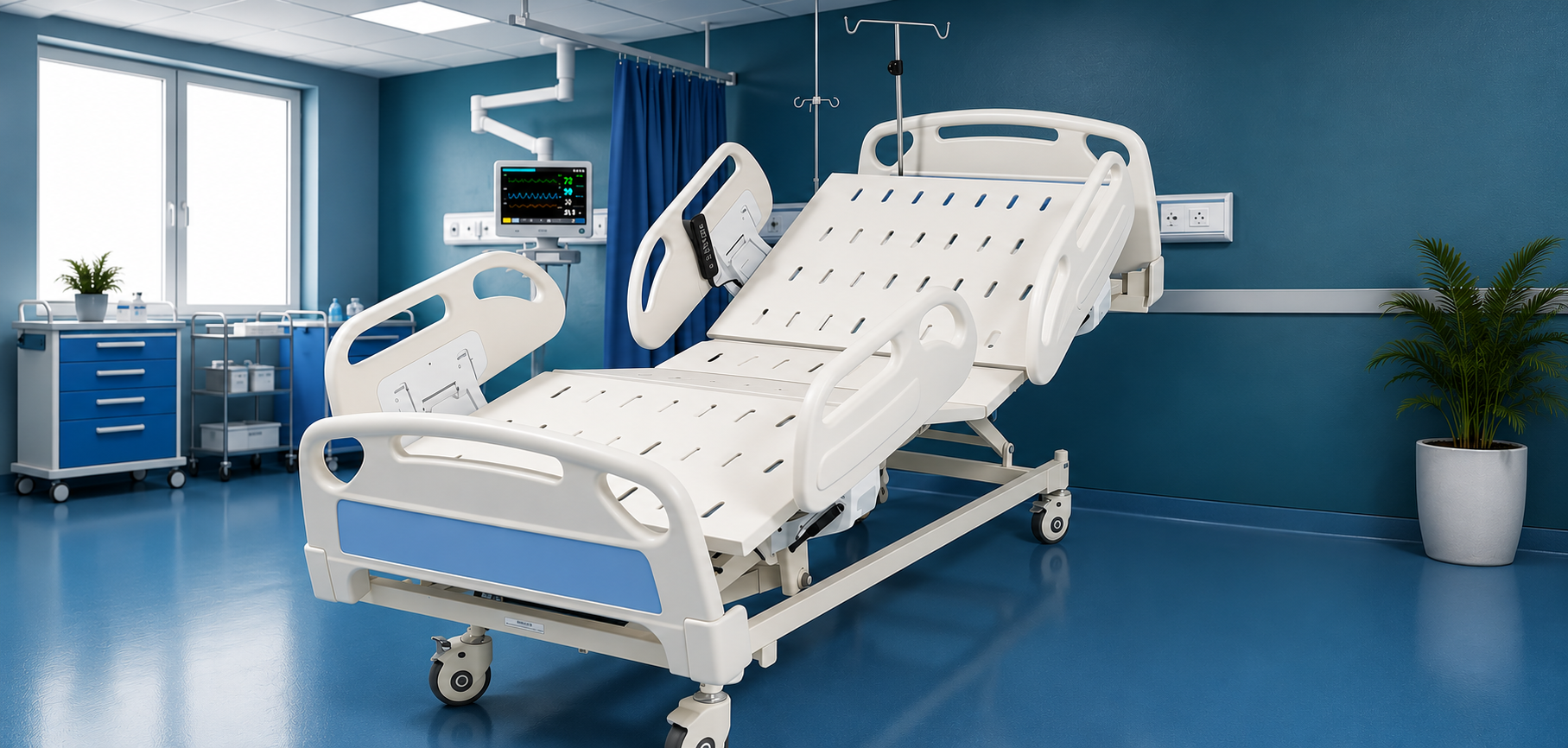
| Quick Answer: A 3-function electric bed may be useful when the individual care plan requires backrest, knee-rest and height adjustment. Height adjustment can support safer working posture for care tasks and allow the bed to be set for the planned transfer method, but it does not eliminate manual-handling or fall risk. The treating clinician or therapist should confirm the required functions, transfer plan and level of caregiver assistance. |
Six weeks in, your mother is still largely bedridden after her stroke. Your back has been aching for three weeks from repositioning her. You are doing this twice at night, twice during the day. Someone in the family suggested upgrading to a 3-function electric bed. You are not sure if the extra cost justifies the difference.
This blog answers that specific question with arithmetic and clinical context, not with marketing.

What the Three Functions Actually Are
Every electric hospital bed function refers to a motor-controlled movement. Understanding exactly what each does clarifies why the third one matters specifically for long-term care.
| Function | What the Motor Controls | How Adjusted on 1F or 2F Bed |
| Function 1 | Backrest elevation (head of bed raises and lowers) | Electric button on handset |
| Function 2 | Knee section elevation (lower leg raises independently of backrest) | Electric button on handset |
| Function 3 | Full bed height (entire platform raises and lowers) | Electric button on handset, absent on 1F and 2F beds |
On a 1-function or 2-function bed, the bed sits at a fixed height. The caregiver cannot change this. For a single repositioning task, this is manageable. For a caregiver performing 4 to 6 daily repositioning sessions, wound care, sponge baths, changing incontinence pads, and physiotherapy exercises, all while bending over a fixed-height bed for months: the cumulative physical load is what breaks caregivers.
The Height Motor: What It Changes for the Caregiver
The height function raises the entire bed platform to working height for the caregiver and lowers it back down for patient safety. In practice, this changes the following:
- Repositioning: turning a bedridden patient from back to side requires the caregiver to use their core and arms, not their lower back. At working height, the caregiver stands upright during the turn. At a fixed low height, they are bent at the waist for the entire manoeuvre, multiplied by every session every day.
- Wound care and skin inspection: examining the sacrum, heels, and hips for pressure injury requires the caregiver to access the patient’s underside. At working height this is done standing. At low height it involves prolonged awkward bending.
- Incontinence pad changes: among the most physically demanding regular care tasks. At correct working height this takes 3 to 5 minutes per change. At low height the physical difficulty extends the task and increases the chance of incomplete cleaning, which accelerates skin breakdown.
- Physiotherapy exercises: a physiotherapist visiting the home will raise the bed to working height to perform passive range-of-motion exercises. Without that function, they are working on the floor or in positions that limit what they can safely do.
Browse all hospital bed options including 3-function electric beds at sanjeevia.com/product-category/hospital-beds/. If you are currently on a 2-function bed and need to upgrade, WhatsApp us and we arrange the swap at the adjusted rate.
2-Function vs 3-Function: The Honest Comparison
| Factor | 2-Function Electric Bed | 3-Function Electric Bed |
| Backrest control | Verify model specification | Verify model specification |
| Knee section control | Verify model specification | Verify model specification |
| Bed height | May be fixed or manually adjusted, depending on model | May offer electric height adjustment, depending on model |
| Caregiver posture | Assess planned care tasks and safe handling technique | Height adjustment may support working posture; safe handling remains essential |
| Transfers | Follow the individual transfer plan | Set height only as directed by the individual transfer plan |
| Clinical access | Confirm needs with the treating team | Confirm needs with the treating team |
| Price and rental terms | Confirm the current product page or quote | Confirm the current product page or quote |
For rentals of 2 months or less with good caregiver support, a 2-function bed is adequate. For any care situation extending beyond 8 weeks with daily caregiver-intensive tasks, the 3-function cost difference is recovered in caregiver health within weeks.
Who Should Specifically Choose a 3-Function Bed
- Stroke patients with significant motor deficits who will be primarily bedridden for 3 or more months.
- Post-ICU discharge patients returning to complex care at home where clinical-level access is required.
- Any patient with confirmed pressure sores or high pressure sore risk, where caregiver access for skin care must be frequent and thorough.
- Situations where the primary caregiver is the sole care provider and there is no regular second person to share physical tasks.
- Elderly caregivers (themselves 60 or older) managing care for a bedridden patient. The physical tolerance for sustained bending is significantly lower in this group.
- Patients receiving physiotherapy at home, where the physiotherapist needs full bed height access to work effectively.
Frequently Asked Questions
Q: Can I start with a 2-function bed and upgrade to a 3-function if needed?
Yes. Upgrades mid-rental are standard. Contact Sanjeevia with 24 hours notice and we arrange the swap at the adjusted rental rate from the upgrade date. There is no penalty for upgrading.
Q: How high does the 3-function bed actually go?
Most 3-function hospital beds used in home care raise from a low position of approximately 35 to 40 cm (floor to top of mattress) to a working height of approximately 70 to 80 cm. The working height range covers most adult caregivers. Confirm the exact specification when ordering if you need a specific height range for a taller or shorter caregiver.
Q: Is the height adjustment noisy? Will it disturb the patient at night?
Electric height adjustment on home-grade hospital beds operates at a quiet motor level, broadly similar to a slow electric fan. It does not need to be used during sleep, as the bed is lowered to the safe patient height before the patient settles for the night. Night repositioning from side to side does not require height adjustment and can be done silently with good repositioning technique.
Q: My patient can partially self-reposition. Do they still need a 3-function bed?
Partial self-repositioning reduces the caregiver load for turning but does not eliminate the need for daily care tasks (skin inspection, wound care, bathing, physiotherapy) where working height matters. If the care situation involves any of these tasks regularly and the rental is expected to exceed 2 months, the 3-function bed is still the better choice.
| Rent a 3-function electric bed for long-term home care in Delhi NCR: Browse all hospital beds on Sanjeevia Currently on a 2-function bed and need to upgrade? WhatsApp us: +91 92179 10612 Same-day delivery across Delhi NCR for orders before 4 PM. |
| Next Read: For patients at risk of pressure injury, read: Do You Need an Anti-Bedsore Mattress with Your Hospital Bed? |
Related Guidance and Equipment
These links connect the patient’s positioning and transfer needs with the most relevant bed guidance and exact product specifications.
Continue Reading
- What Are the Three Functions in a Hospital Bed? — understand backrest, knee-rest and height adjustment.
- Hospital Bed Rental Checklist — confirm functions, mattress, rails and delivery details.
Relevant Product Pages
- 3-Function Electric Hospital Bed — review backrest, knee-rest and height-adjustment specifications.
- 2-Function Electric Bed — compare a simpler electric adjustment option.