
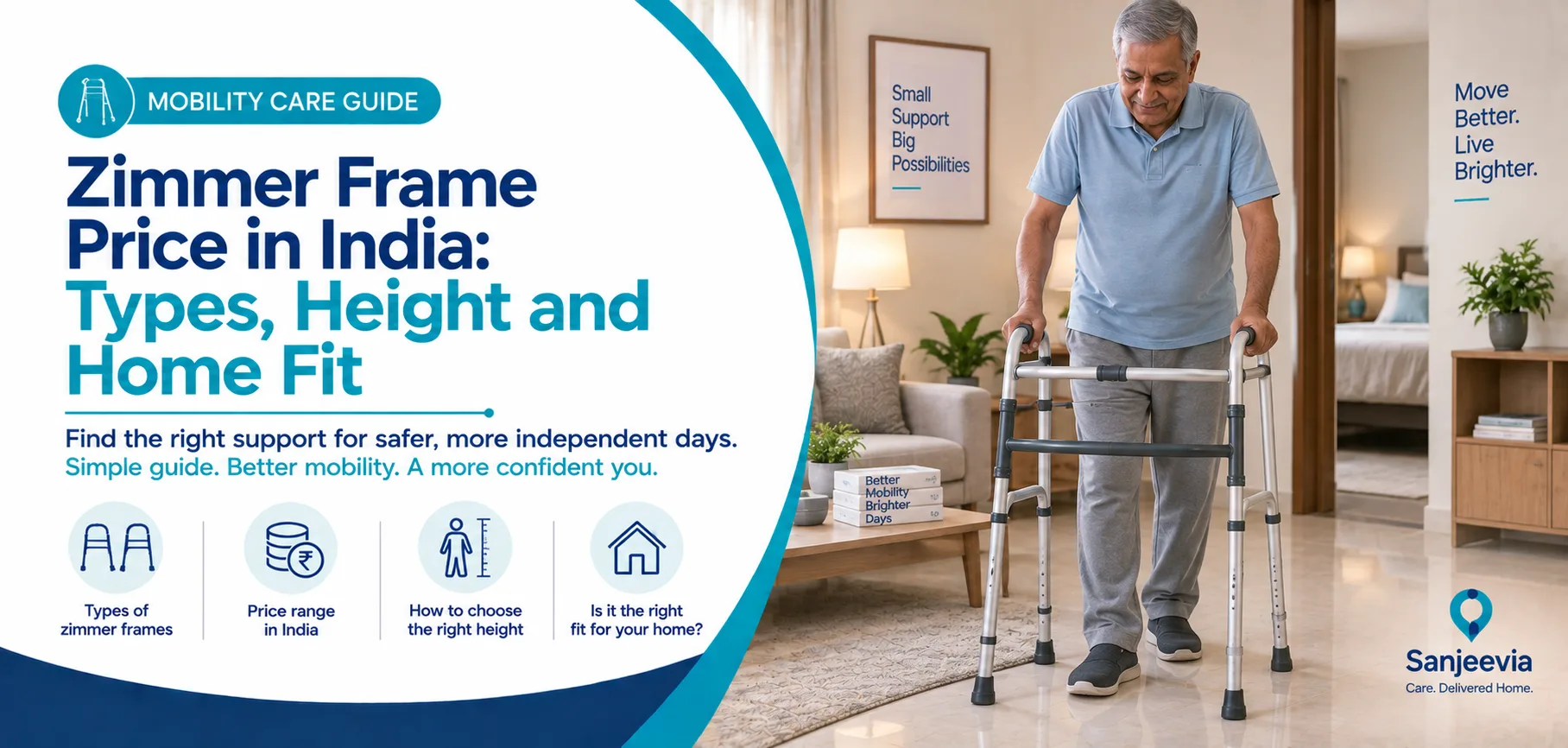
Quick answer: Sanjeevia lists a fixed aluminium Zimmer frame at ₹1,200 for one month, ₹960 per month on a six-month plan and ₹4,000 to buy. The listed frame adjusts from approximately 75 to 95 cm, weighs about 1.5 to 2 kg and supports a stated maximum user weight of 100 kg.

A walker that is too high, too low or wrong for the user’s balance can make movement harder. Price is only one part of the decision. Choose the frame type with a physiotherapist, check the fit while the user is wearing normal footwear, and confirm that it can move safely through the actual home.
Zimmer frame price in India: Sanjeevia’s listed options
| Option | Listed price | Useful when |
|---|---|---|
| One-month rental | ₹1,200 | Short recovery or a time-limited trial after clinical advice |
| Six-month rental | ₹960 per month | Longer rehabilitation without purchasing immediately |
| Purchase | ₹4,000 | The user expects ongoing use and the model is already known to fit |
| Transport | ₹1,000 | Delivery and collection charge listed on the product page |
| Security deposit | ₹0 | No deposit is currently listed for this product |
Prices were checked on 10 September 2026 and may change. Confirm availability and the final invoice before dispatch.
What is a Zimmer frame?
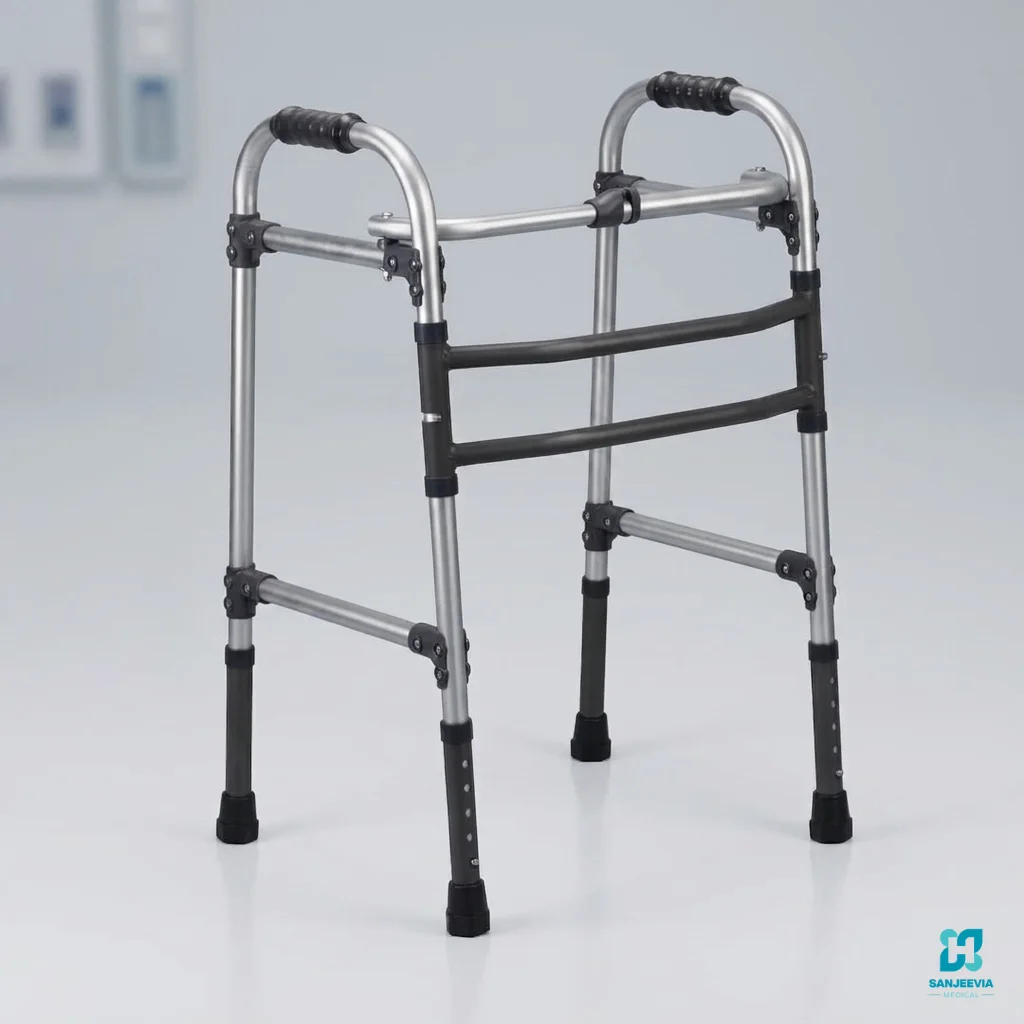
“Zimmer frame” is a common name for a walking frame. The Sanjeevia model discussed here is a fixed, no-wheel aluminium frame with four rubber-tipped legs and foam-covered handles. A user lifts or advances the frame, places all four tips securely on the floor, and then steps within the frame according to the walking pattern taught by a therapist.
The word “walker” covers several designs. They are not interchangeable:
| Type | How it moves | Points to discuss with a therapist |
|---|---|---|
| Fixed Zimmer frame | Lifted or advanced in small steps | Upper-body strength, stability and ability to place all four tips |
| Two-wheel walker | Front wheels roll while rear tips provide friction | Stride, braking control and floor transitions |
| Rollator | Three or four wheels, usually hand brakes | Brake use, turning, outdoor surfaces and tendency to move too quickly |
| Reciprocal frame | Sides move in sequence | Coordination and the prescribed gait pattern |
| Wheelchair | Used for seated mobility | Whether walking support alone is adequate for distance and fatigue |
Zimmer frame dimensions and specifications
- Height adjustment: approximately 75 to 95 cm
- Frame weight: approximately 1.5 to 2 kg
- Maximum stated user weight: 100 kg
- Construction: lightweight aluminium
- Feet: four rubber tips
- Handles: foam grips
- Wheels: none on this model
These specifications help narrow the choice, but they do not prove that the frame suits a particular user. If the user weighs close to the stated limit, has one-sided weakness, poor grip, severe pain, dizziness or difficulty lifting the frame, obtain professional advice before use.
How to check Zimmer frame height
MedlinePlus advises that walker handles should be around hip level and the elbows should remain slightly bent while the handles are held. Use this as a fitting discussion point with the physiotherapist, not as a substitute for an assessment.
- Ask the user to wear the footwear normally used for walking.
- Place the frame on a level, dry surface.
- Stand inside the rear of the frame without leaning heavily on it.
- Adjust all legs to matching settings so the frame remains level.
- Check the handle position and elbow bend with the therapist.
- Walk a few supervised steps and check posture, clearance and grip comfort.
- Recheck the locking buttons after every adjustment.
A very high frame can raise the shoulders and reduce effective support. A very low frame may encourage stooping. Pain, instability or an altered gait after adjustment is a reason to stop and ask the clinician to reassess.
Measure the home before renting
Equipment that fits the user can still be awkward in a narrow home. Measure these spaces in centimetres:
- The narrowest doorway on the regular route
- The clear path beside the bed and to the bathroom
- Turns in corridors and around furniture
- The usable width between toilet, wall and washbasin
- Thresholds, loose rugs, cables and changes in floor level
- Space for a caregiver to stand during transfers
Do not rely only on the door width. The frame and user need turning room on both sides of the doorway. Photograph difficult turns and share the measurements when asking Sanjeevia about product fit.
Fixed frame, wheeled walker or wheelchair?
| Question | Why it changes the choice |
|---|---|
| Can the user lift and place a fixed frame safely? | If not, a different walker design may be considered by the therapist. |
| Does the user understand and operate hand brakes? | A rollator can move unexpectedly if brakes are not used correctly. |
| How far must the user travel? | Fatigue may make a wheelchair appropriate for longer distances even when a walker is used for short transfers. |
| Are there stairs? | A walking frame should not be used on stairs unless a qualified professional has taught a specific safe method. |
| Is one leg restricted after surgery? | The surgeon or physiotherapist should prescribe the gait and weight-bearing status. |
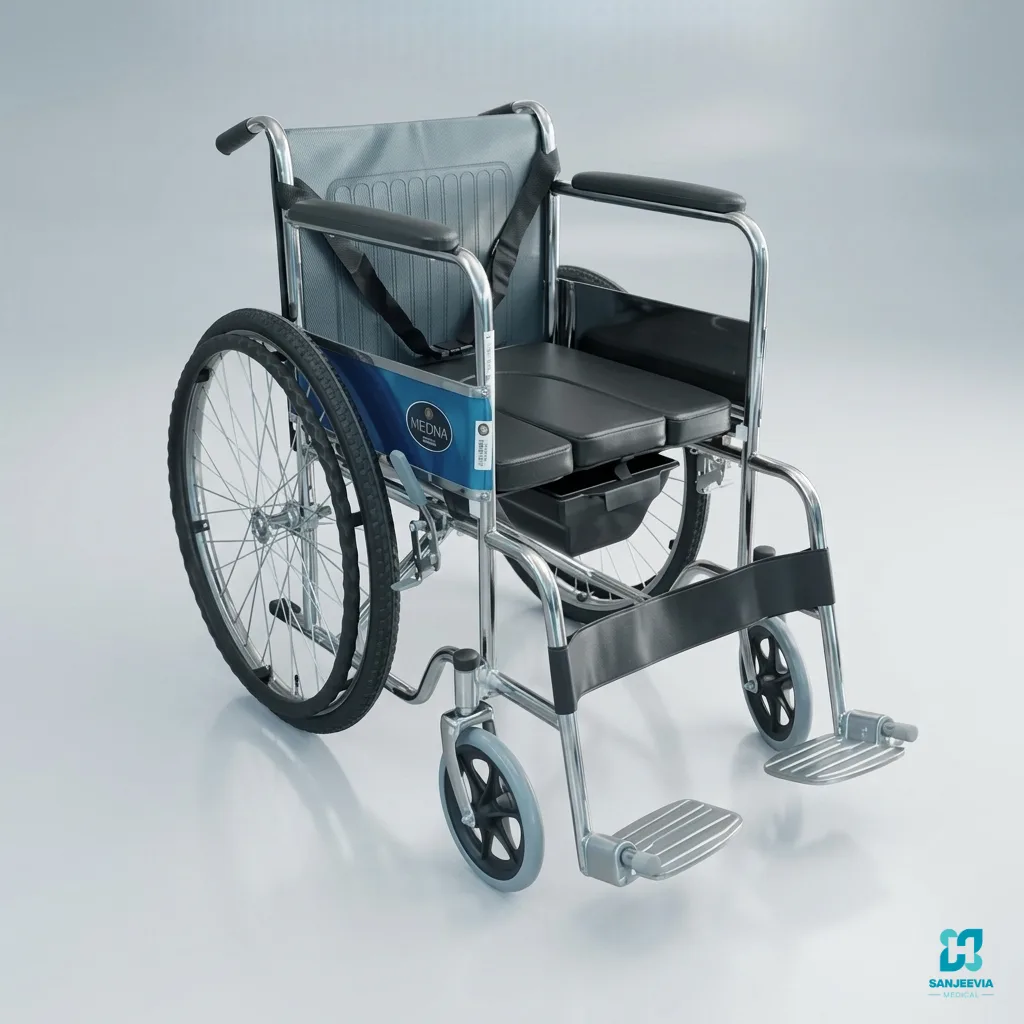
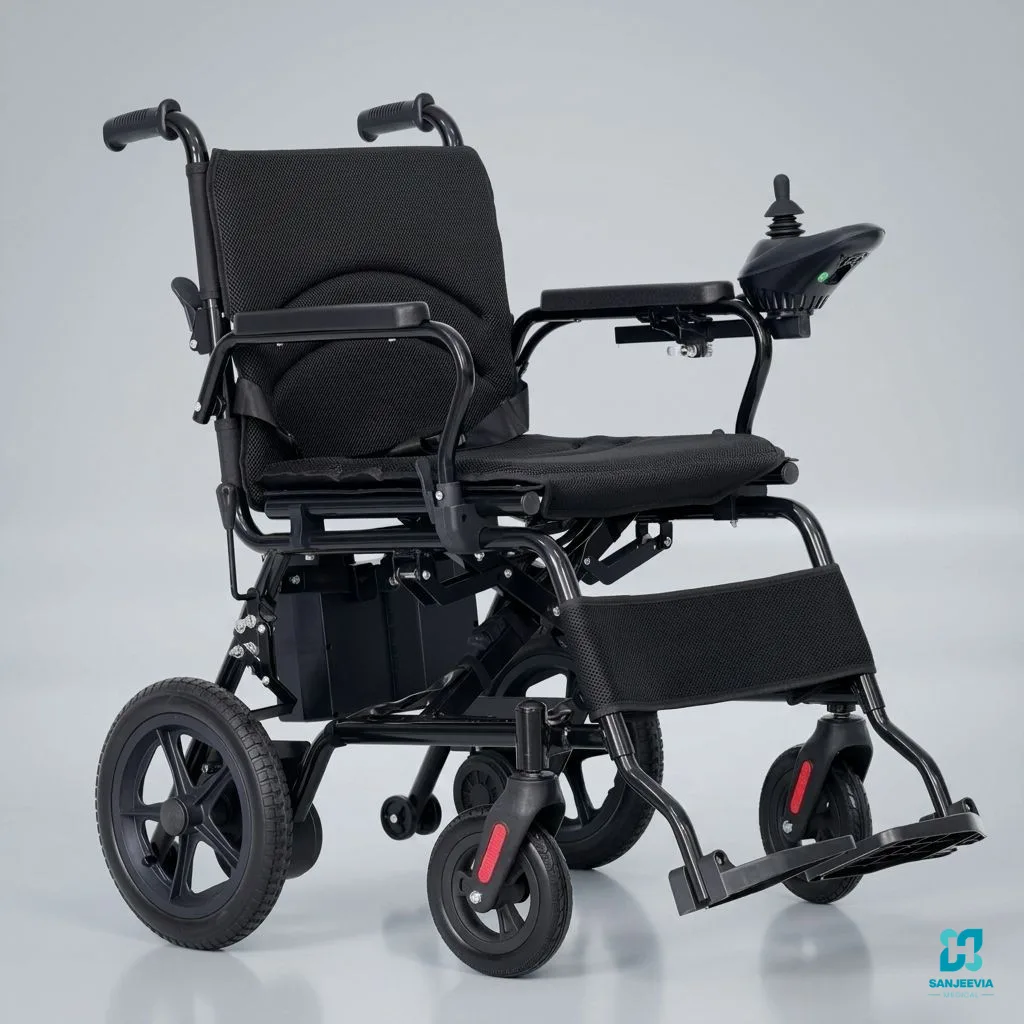
If seated mobility is needed, compare a standard manual wheelchair. For toileting needs, see the commode wheelchair. These products solve different problems, so choose around the care plan rather than the lowest price.
Inspection checklist at delivery
- Confirm all four height settings match.
- Press each adjustment button and verify it has locked through the correct hole.
- Inspect rubber tips for wear, splits or embedded dirt.
- Check that the frame stands level without rocking.
- Confirm handles are secure and foam grips do not rotate.
- Ask the user to try only supervised steps on a dry, clear surface.
- Record the delivered condition and keep the support number accessible.
Rubber tips are safety parts. If a tip is loose, worn or missing, stop using the frame until it is replaced. Do not wrap a damaged tip with tape as a temporary walking solution.
Daily use and home safety
Clear loose rugs, electrical cables, low tables and wet areas from the walking route. Keep frequently used items between waist and shoulder height so the user is less likely to reach while balancing on the frame. Do not hang heavy shopping bags from one side, because uneven loading can affect stability.
When rising from a chair, follow the method taught by the therapist. In many cases the user pushes from the chair rather than pulling on the walking frame, but the exact method depends on the user and furniture. Never use the frame as a transfer hoist.
Rent or buy a Zimmer walker?
Rental can make sense during a defined recovery period or when the clinician expects mobility needs to change. Purchase can be simpler for long-term use after the correct model and height range have been confirmed. Compare total planned rental cost, transport and the possibility that a different aid may be needed later.
Read the rent versus buy medical equipment guide and Sanjeevia’s rental policy. For a focused fitting checklist, see Walking Frame Height and Fit.
Frequently asked questions
What is the current Zimmer frame rent for one month?
Sanjeevia currently lists ₹1,200 for one month, plus ₹1,000 transport. Confirm the total before ordering.
Does this Zimmer frame have wheels?
No. The listed aluminium model is a fixed frame with four rubber-tipped legs.
Can it support a 100 kg user?
The stated maximum user weight is 100 kg. A clinician should still confirm the frame type, and the equipment should be inspected before use.
Can a Zimmer frame be used outdoors?
Surface condition matters. Uneven ground, slopes and wet areas can make a fixed frame unsafe. Ask a physiotherapist to assess the intended route and recommend the appropriate aid.
How do I request this model?
Open the Zimmer frame product page or contact Sanjeevia with the user’s height range, weight, prescribed frame type, location and expected duration.
Clinical reference
This article provides equipment-selection and rental information. A physiotherapist or treating clinician should prescribe the mobility aid and teach safe use.