
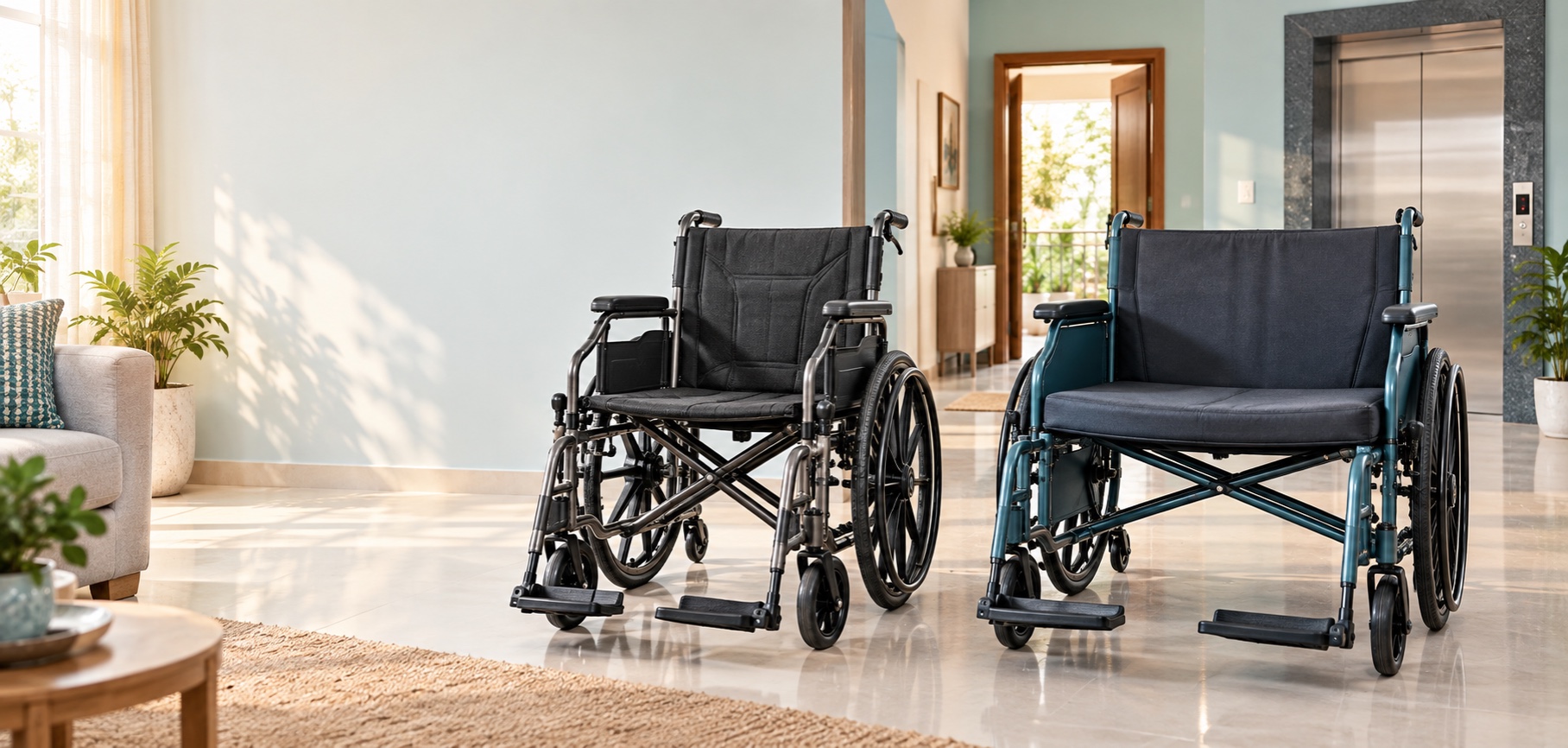
Quick answer: A heavy-duty wheelchair is usually chosen when the user needs a reinforced folding frame and a verified higher load rating. A jumbo wheelchair is usually considered when the user also needs more seat width, seat depth or body clearance. The names alone do not confirm fit. Measure the person, confirm the exact model specification, and check every doorway, lift and turning point before arranging the chair.
Families often start by asking for the “strongest” or “widest” wheelchair. Those are understandable shortcuts, but they can lead to a chair that supports the user’s weight yet pinches at the hips, or a spacious chair that cannot pass through the home. The safer decision is to match the user, the transfer method, the caregiver and the actual route through the house.
This guide compares Sanjeevia’s heavy-duty manual wheelchair and jumbo manual wheelchair. Exact dimensions and load limits vary by the model available, so confirm them in writing before booking.
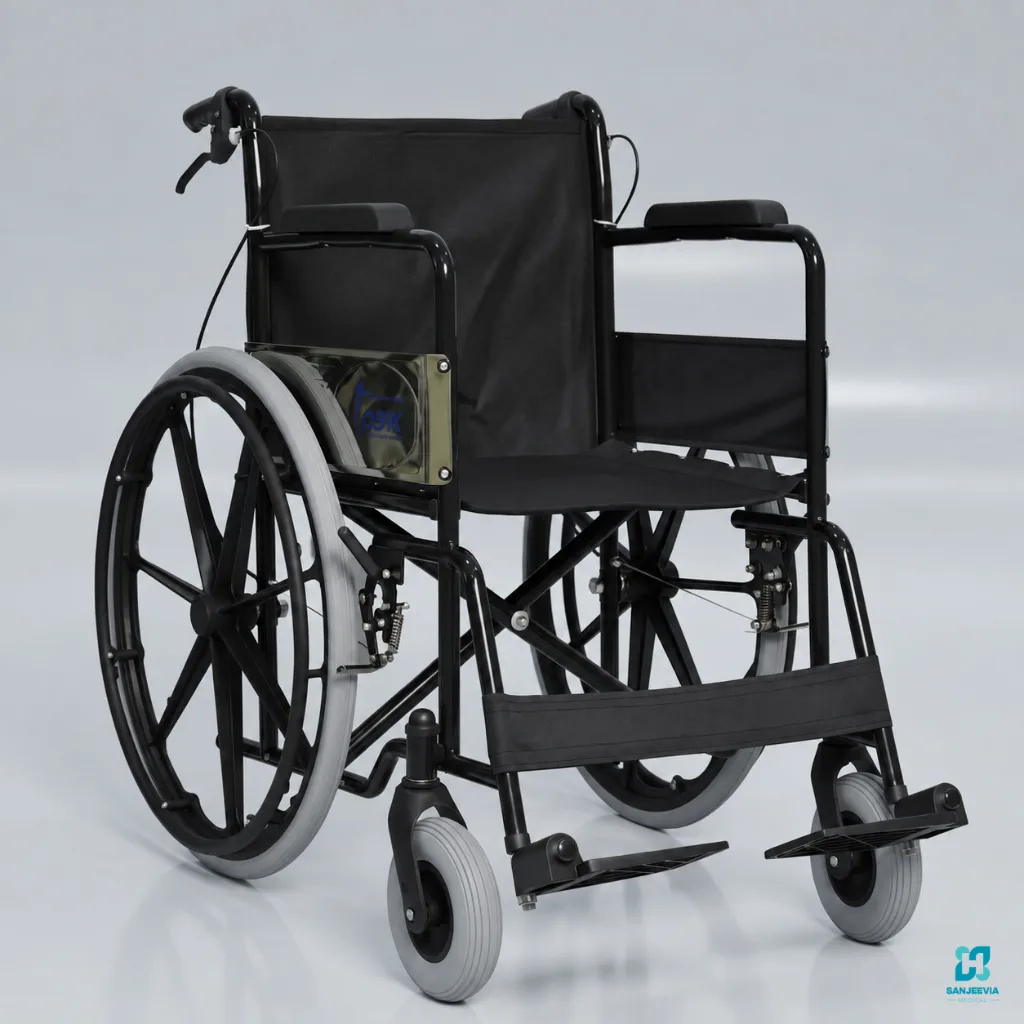
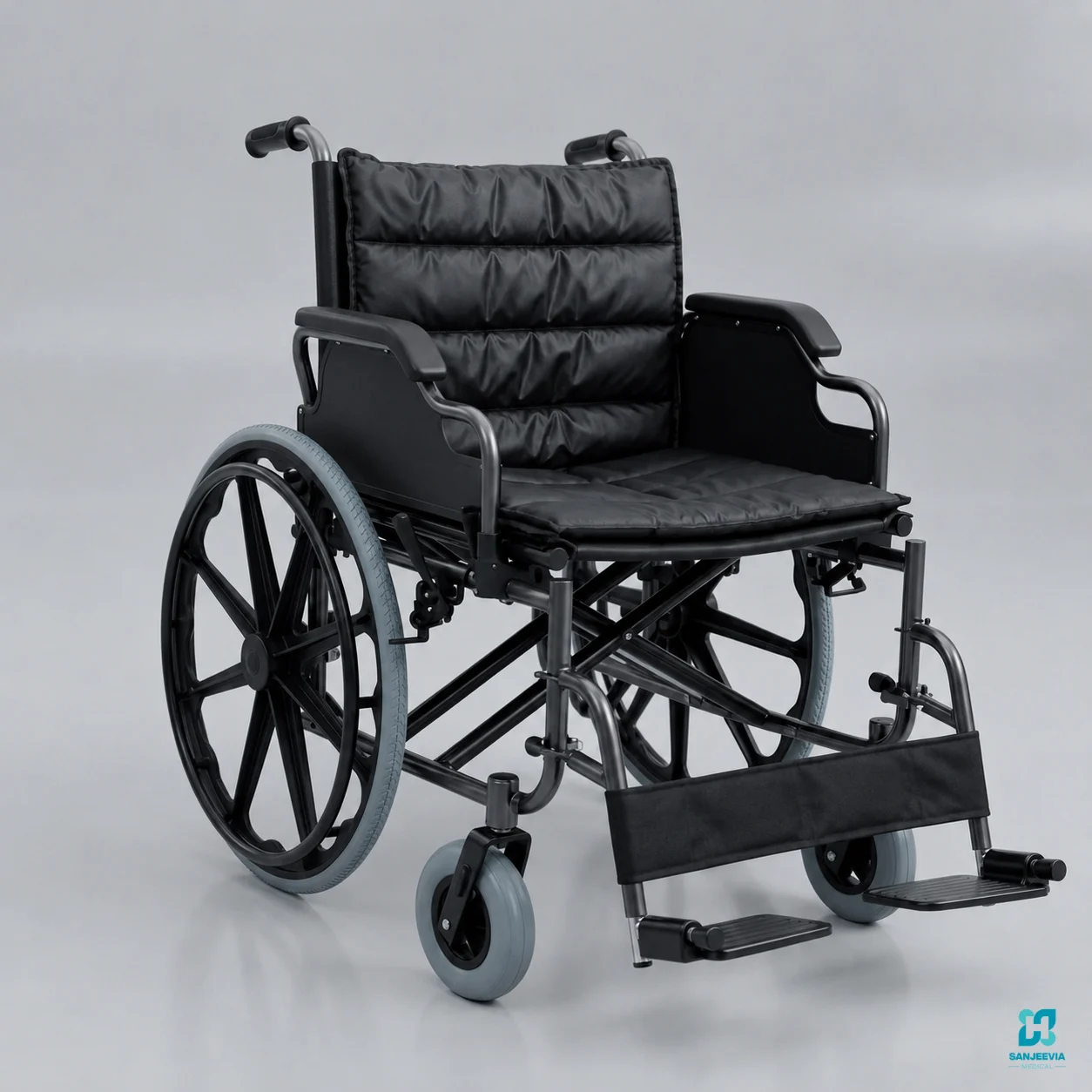

Heavy-duty and jumbo do not mean the same thing
| Decision point | Heavy-duty wheelchair | Jumbo wheelchair |
|---|---|---|
| Main reason to consider it | Reinforced frame and a higher verified user-load requirement | More seating space and body clearance, often with a reinforced frame |
| Most important checks | User weight, frame rating, seat width, transfer method | Hip width, seat depth, armrest clearance, doorway and lift access |
| Home challenge | May be heavier for a caregiver to fold, lift or push | Greater overall width may restrict movement through doors and narrow passages |
| What the label cannot prove | Comfort, posture, usable seat dimensions or route clearance | Load rating, turning space or whether the user can reach the footrests safely |
A product may be described differently by different manufacturers. Ask for the exact model name, usable seat width, seat depth, overall open width, folded width and maximum supported user weight. Sanjeevia’s product pages deliberately advise families to confirm these details for the supplied model.
Start with the person, not the wheelchair label
The World Health Organization’s wheelchair provision guidelines emphasise individual assessment, fitting, training and follow-up. That principle matters even when a chair is needed quickly for recovery at home.
1. Measure seated hip width
Seat the person on a firm, level surface in their usual clothing. Measure the widest point across the hips or thighs. The usable space between the wheelchair arm supports should allow comfort without letting the person slide sideways. A cushion changes the seated position, so include the intended cushion when checking the final fit.
If you are unsure how measurements relate to the chair, use Sanjeevia’s wheelchair seat-width guide and wheelchair fitting checklist before speaking with the team.
2. Check seat depth and lower-leg support
Seat depth should support the thighs without pressing into the back of the knees. Footrests should support both feet and allow safe clearance from the floor. Ask whether swing-away or detachable footrests are included, because they can make side transfers and close approaches to the bed easier.
3. Confirm the verified load limit
Do not estimate this from frame appearance. Share the user’s current weight and ask for the rating of the exact chair being supplied. Allow for normal clothing and any equipment routinely carried on the chair. Bags should never hang where they can change balance or interfere with the wheels.
4. Review posture, skin and sitting time
A wider chair is not automatically more supportive. Too much side clearance can make it harder to maintain an upright position. Long sitting periods, reduced sensation, weakness or a history of pressure injury require clinical advice about posture and pressure redistribution. A basic padded seat is different from a clinically selected cushion.
Measure the whole route through the home
Overall chair width matters as much as seat width. Measure the narrowest clear opening with the door fully open, not just the frame-to-frame size. Include the main entrance, bedroom, bathroom, balcony route and lift. Look for handles, shoe racks, raised thresholds and furniture that reduce usable space.
Then assess turning space. A chair may pass through a doorway in a straight line but fail at the turn immediately beyond it. Sanjeevia’s doorway-width guide explains how to check the route before the wheelchair arrives.
For vehicle use, confirm folded dimensions and chair weight. A reinforced or jumbo frame may be difficult for one caregiver to lift. If repeated car transfers are expected, compare this practical burden with the user’s seating needs rather than choosing only by appearance.
Match the chair to transfers and caregiver effort
Ask how the person will move between bed, chair and toilet. A user who can stand briefly may need removable footrests and brakes that a caregiver can reach easily. A lateral transfer may require removable or flip-back armrests, which are not standard on every model. If a hoist is used, the therapist should confirm that its legs and sling can work safely around the chair.
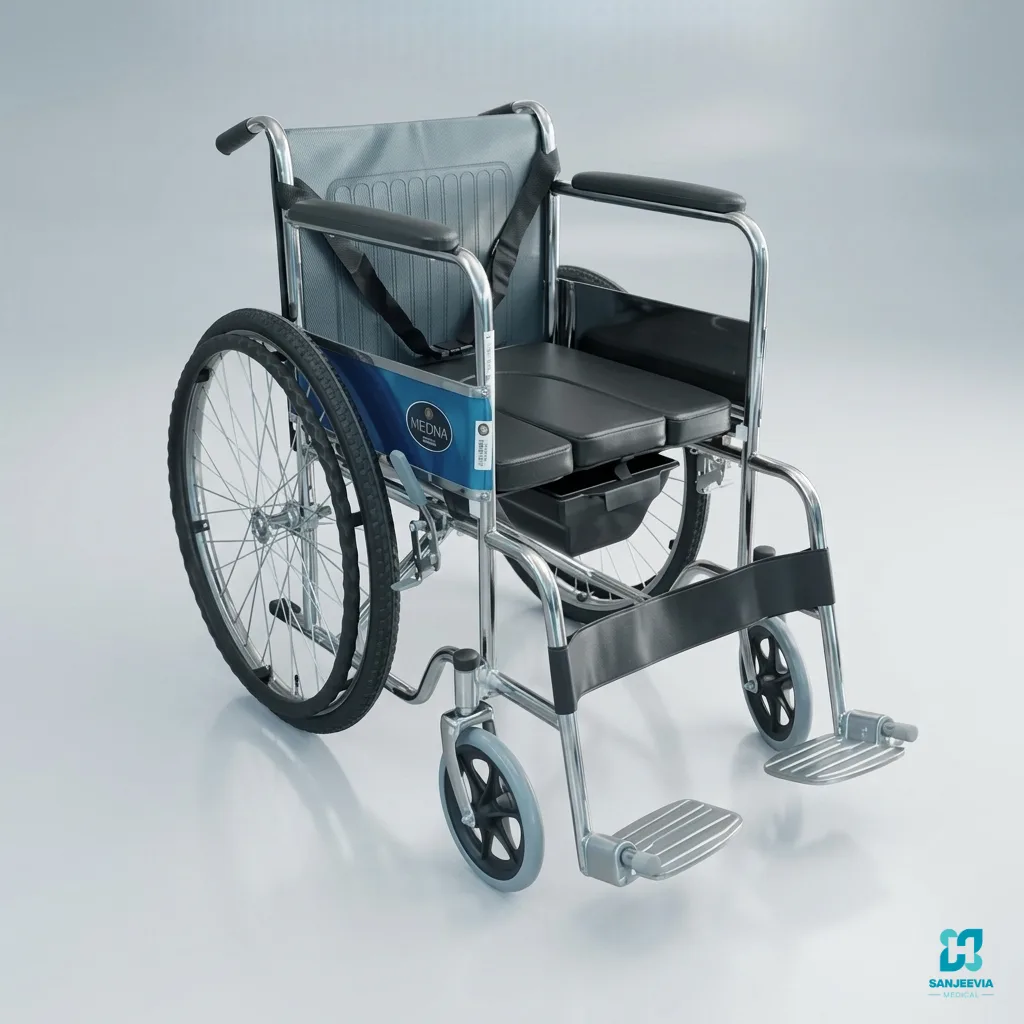
For toileting needs, compare a purpose-built commode wheelchair. For independent powered mobility, review the motorised wheelchair only after checking cognition, hand control, turning radius and charging access. A standard manual wheelchair may be more manageable when extra width or a reinforced rating is not needed.
A practical selection sequence
- Write down the clinical need: diagnosis, expected sitting time, posture concerns, current weight and ability to transfer.
- Measure the user: seated hip width, thigh length and lower-leg length with the intended cushion.
- Measure the environment: narrowest doorway, lift opening, corridor turns, bathroom entry and storage space.
- Confirm the exact model: usable seat dimensions, overall width, supported user weight, folded size and chair weight.
- Confirm included parts: footrests, armrests, parking brakes and seat upholstery. Ask separately about cushions, belts or special supports.
- Plan the handover: test brakes, folding, footrest release, safe pushing and the user’s sitting position.
What to check during handover
Before accepting the chair, inspect the frame and upholstery, engage both parking brakes, rotate the front castors and check the rear tyres. Open and fold the chair with the caregiver who will use it. Attach and remove the footrests, then confirm that they lock securely. With appropriate assistance, check that the user sits without hip compression, knee pressure or unsupported feet.
Repeat the real home route rather than testing only an open room. Sanjeevia’s wheelchair handover checklist can help families record what was confirmed. If the need may change after rehabilitation, the rental-versus-purchase guide explains how duration and expected recovery can shape the arrangement without relying on a fixed online figure.
Frequently asked questions
Is a jumbo wheelchair always stronger than a heavy-duty wheelchair?
No. “Jumbo” often describes a roomier seat, while “heavy-duty” often highlights the frame and load rating. Only the exact model specification can confirm both.
Can I choose using the user’s weight alone?
No. Weight is essential, but hip width, seat depth, posture, foot support, transfers and home access also determine whether a chair is appropriate.
How much doorway clearance is enough?
Use the chair’s stated overall open width and compare it with the narrowest clear opening. Leave working clearance for hands and safe steering. A fitting professional should review tight routes.
Does a wider seat improve comfort?
Only when it matches the user. Excess width can reduce side support and make self-propulsion harder, while insufficient width can cause pressure and discomfort.
Can a heavy wheelchair be used on stairs?
Do not carry a person on stairs in a standard manual wheelchair unless a trained professional has provided a suitable evacuation method and equipment. Plan lift access or another safe route.
Discuss the measurements before booking
Send Sanjeevia the user’s measurements, current weight, preferred transfer method and the narrowest doorway or lift opening. The team can then confirm which available model should be assessed. Browse the wheelchair and mobility range or contact Sanjeevia with the checklist.
This guide supports equipment discussions and does not replace assessment by a doctor, physiotherapist or occupational therapist.
Next read: Wheelchair types for home use in Delhi NCR.