
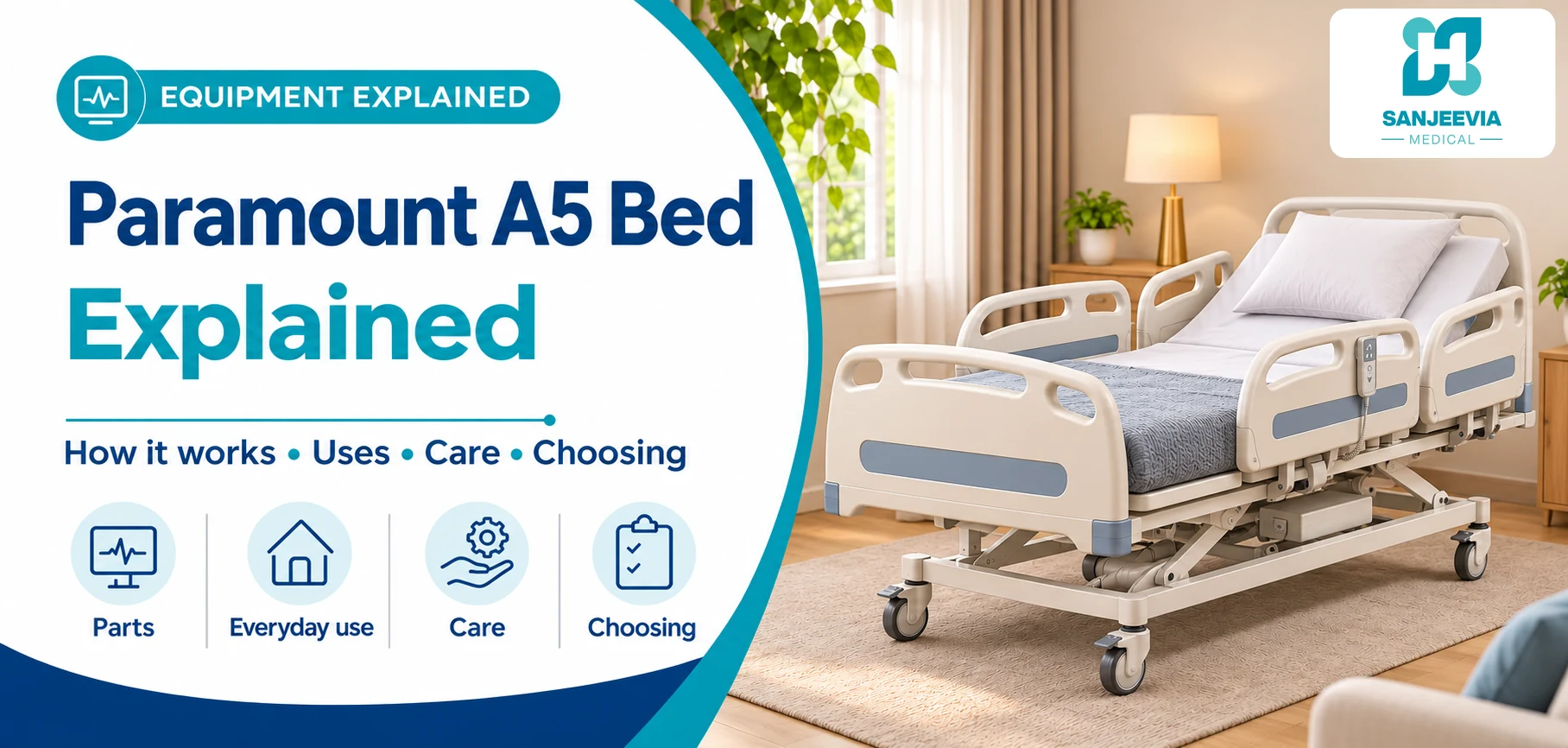
“Paramount A5” identifies a bed family—not a promise that every unit has the same buttons and options. That is the most useful fact to know before comparing quotations. The Paramount A5 is a manufacturer’s hospital-bed range with model-dependent positioning and care features. For home use, the exact model code, mattress, rails and installed controls matter more than the brand name alone. This guide explains how to recognise the system, ask the right questions and plan safe daily care without assuming that optional hospital features come with every bed.
Explore relevant equipment
Jump to equipment details
- Start with the model code, not the photograph
- How the bed works and what the controls mean
- Recognise the parts and load limits
- Choose the complete bed system for the person
- What to practise at handover
- Power, cleaning and maintenance planning
- Questions for an A5 rental or purchase quotation
- Frequently asked questions
Start with the model code, not the photograph
Sanjeevia lists a Paramount A5 bed. Before ordering, request the full model code from the unit’s identification label and the matching instructions. Paramount publishes separate A5 manuals for different model groups. Its wider range also includes manual variants; therefore “A5” by itself does not tell you the powered movement set.
Ask the provider to distinguish the actual installed functions, optional accessories and features shown only in promotional photographs. Whole-platform tilt, an extension frame, control panels, emergency releases and a battery cannot be assumed from the family name.
A useful written confirmation says which movements this bed provides and who should operate them. “Premium bed” is not a specification. The existing A5 versus 3-function comparison can help once your required movements are clear.
How the bed works and what the controls mean
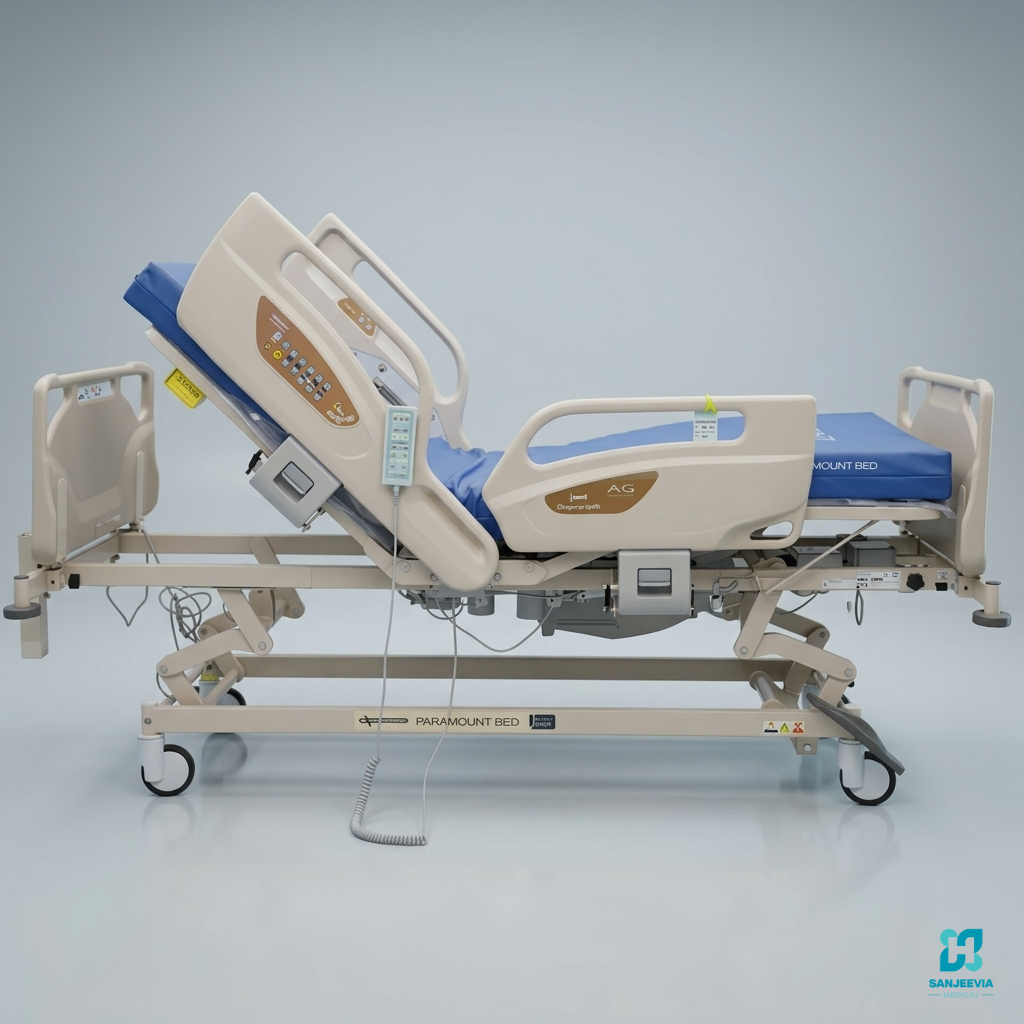
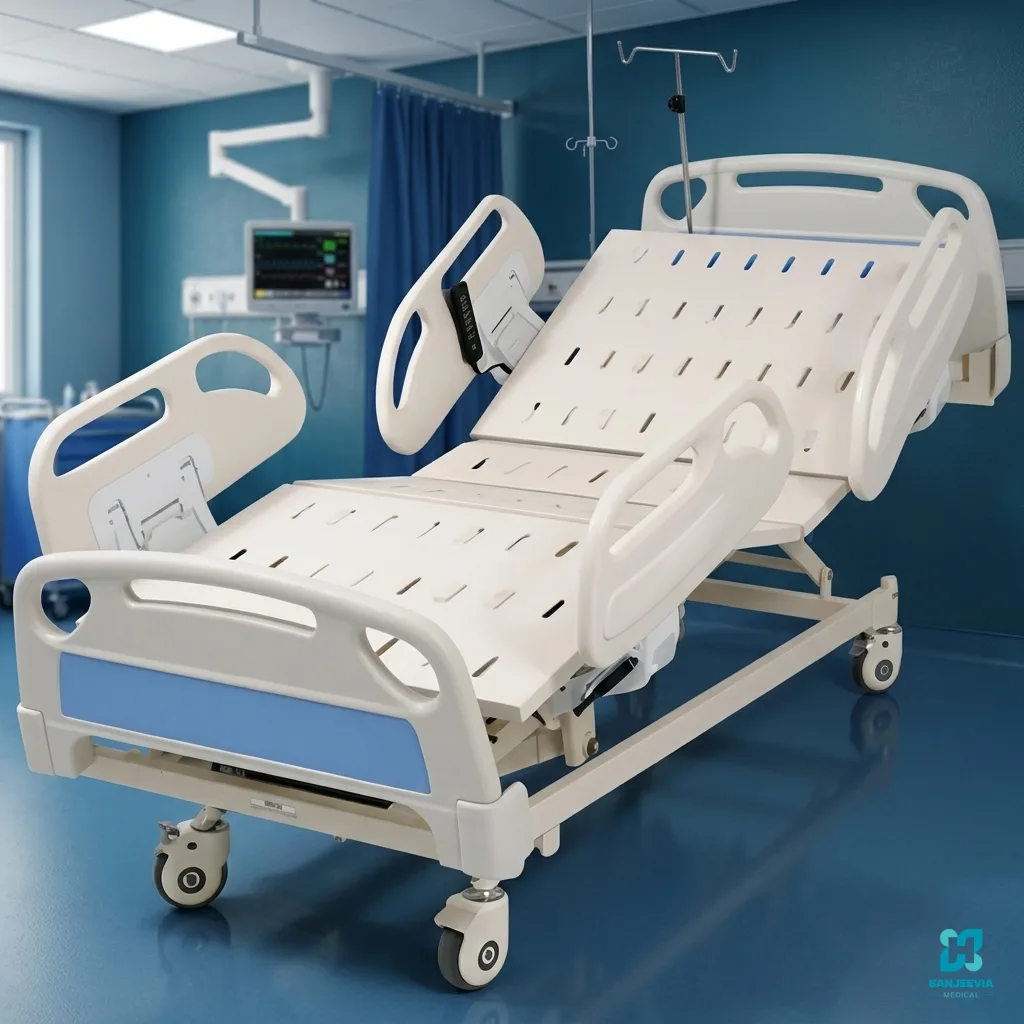
On an electric configuration, actuators move the articulated mattress platform and lifting mechanism under control of the fitted electronics. Backrest movement changes upper-body support, knee movement changes the bent platform sections, and height movement changes the whole platform’s level. Whole-platform tilt, where fitted, is different from raising the backrest.
The A5 electric manual describes a handheld controller and other control arrangements for the models it covers. Identify only what your unit actually has. Ask the provider to label permitted controls and explain any lock function. Do not copy a button sequence from another model.
Routine adjustments support the prescribed positioning and transfer plan. Head-down or head-up tilt requires patient-specific clinical direction; neither should be tried as a home treatment for new symptoms. A branded hospital bed does not replace monitoring, nursing or medical decisions.
Recognise the parts and load limits
Look for the headboard and footboard, sectional support platform, mattress retainers, side rails and latches, base frame, castors and brake controls, power lead and identification label. Check the location of approved accessory sockets. An IV pole or cylinder holder must be a compatible accessory installed as instructed, not a makeshift attachment.
Millimetres describe dimensions; degrees describe angles; kilograms describe load limits. Maximum patient weight and safe working load are not the same quantity. The latter accounts for the total load defined by the manufacturer, including relevant mattress and accessory weight. Read the exact model’s label and manual rather than transferring a specification from another A5 listing.
Ask whether the quoted footprint includes boards, bumpers or extensions. This matters for the lift, bedroom and access around the foot end. Mattress-platform dimensions answer a different question: which surface fits properly.
Choose the complete bed system for the person
The frame, mattress, rails and accessories need to work together. Paramount’s manuals identify compatible products for the covered models. Use the matching list and provider assessment rather than adding an ordinary mattress because its dimensions look close. An overlay can alter rail height, clearances and the patient’s sitting level.
Rails require individual assessment and regular checks. They may introduce entrapment or climbing hazards, especially for someone confused, very small or prone to sliding. Never improvise a rail, fill a gap with loose bedding or assume a rail is a standing support. Ask for an assessment whenever the mattress or patient’s condition changes.
Compare practical care tasks: turning, personal care, edge sitting and the assessed wheelchair transfer. If two caregivers or a hoist are needed, A5 features do not remove that need. Our mattress explainer provides additional questions about surfaces and pressure care.
What to practise at handover
- Match the identification label to the supplied manual and record the provider’s service number.
- Practise the fitted brakes, rail latches and permitted controls with the provider.
- Before movement, explain the task and check the patient, surrounding space and under-bed area.
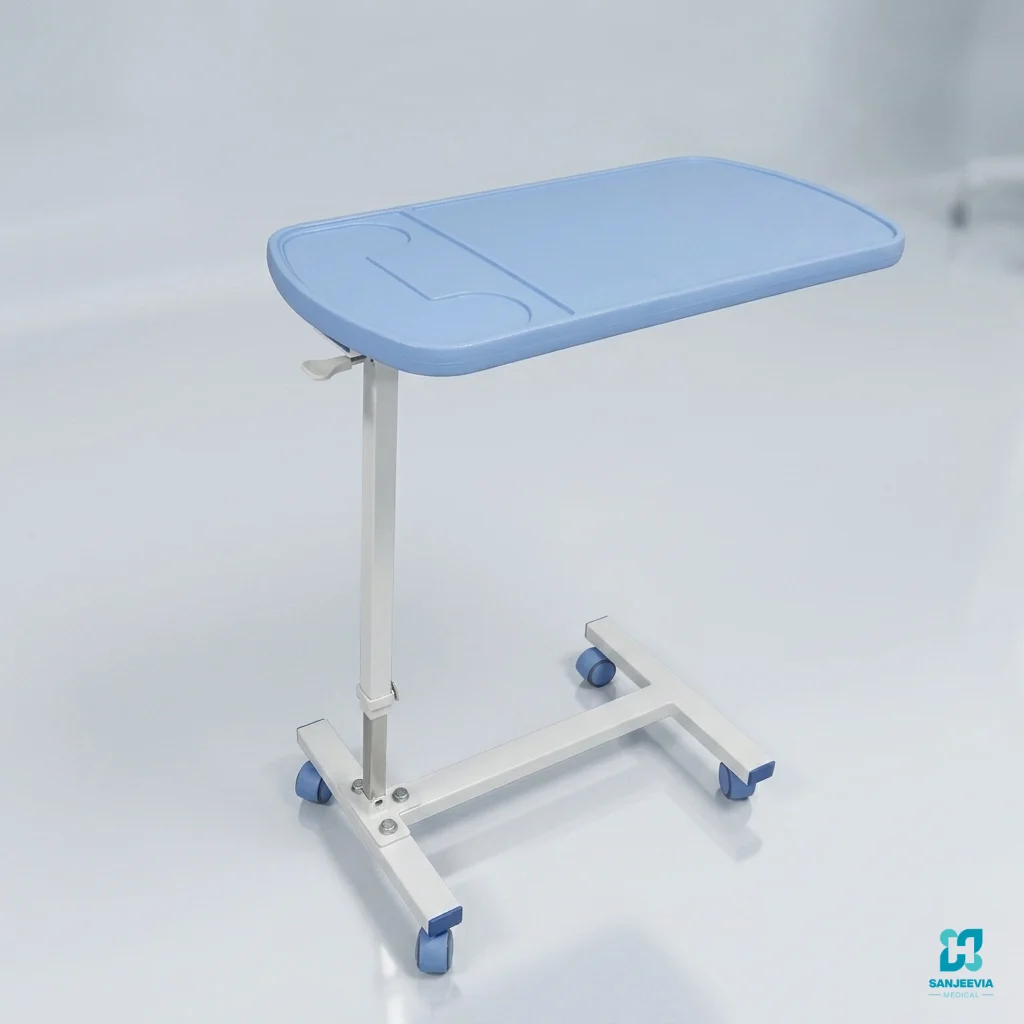
- Move the over-bed table clear; check limbs, bedding, tubes and cables for trapping or pulling.
- Operate only the taught control, observe continuously and stop for discomfort or unexpected motion.
- Return to the agreed resting arrangement and leave controls accessible only when appropriate.
Have all regular caregivers perform a supervised return demonstration. Ask the provider to explain any fitted emergency back-lowering feature without turning it into a routine positioning control. Emergency equipment use must match the model instructions and caregiver training.
No exact-model Sanjeevia A5 demonstration was found during preparation. Request a demonstration of the supplied unit; a generic five-function bed video cannot establish its controls or emergency procedure.
Power, cleaning and maintenance planning
Use the electrical supply specified for the unit. Route the cable clear of wheels, moving components, water and walking paths. Confirm whether a battery is installed, its maintenance condition, permitted uses and charging requirements. An optional battery is not a guarantee of unlimited operation or of every function during an outage.
Need help choosing suitable equipment?
Share your care requirements, room measurements and expected duration. Ask Sanjeevia about compatible options and current rental or purchase terms in Delhi NCR.
Before delivery, measure the approach route and leave room for the bed’s approved movement envelope. Keep under-bed space clear. Ask whether and how the unit may be moved while occupied; do not assume it is a home transport trolley.
Follow the matching manual when isolating power and cleaning. Wipe permitted surfaces with approved products, keep electrical housings dry and use separate mattress/accessory instructions. Inspect visible cables, latches, brakes and mattress condition. Unusual heat, smell, noise, damaged wiring or unexpected movement needs provider review. Do not open controls, lubricate mechanisms speculatively or bypass a lock.
Questions for an A5 rental or purchase quotation
Request the model code, installed movement list, compatible mattress and rails, load limits, external dimensions, electrical requirements and any fitted backup system. Ask what comes with the package and what is optional. Confirm installation, handover, fault reporting, maintenance, exchange, collection, deposit and other charges in writing.
In Delhi NCR, share access measurements and the actual care tasks when asking Sanjeevia to compare options. A 3-function electric bed may meet those needs; the A5 name alone does not establish a better match. Rental may suit changing needs, while purchase requires long-term service planning. Review the system after falls, new confusion, changed mobility or a mattress change.
Frequently asked questions
Is every A5 a five-function electric bed?
No. A5 identifies a range. Confirm the full model code and installed movement list against the matching manufacturer manual.
Does every A5 include a battery or CPR release?
Do not assume this. Ask what is fitted on the supplied unit and have its permitted operation demonstrated.
Can we use another mattress?
Only when compatibility with the exact platform and rail system has been established. Size alone is insufficient.
Is the bed enough for ICU care at home?
No. A bed does not supply the assessment, staffing, monitoring, treatment or emergency arrangements required for critical care.
Explore your equipment options
Sources and further reading
Manufacturer instructions apply to the exact supplied model. International safety resources below support general equipment principles; they are not Indian prescribing rules.
- Paramount Bed: A5 family, model groups and official manuals.
- Paramount A5 electric-bed instruction manual: controls, precautions, cleaning and model-dependent features.
- MHRA: bed rails, compatibility, individual assessment and safe use
- NHSRC, India: Biomedical Equipment Management and Maintenance Programme and technical resources
- Sanjeevia catalogue: Paramount A5 Bed — current listing; verify the assigned unit at handover.
Educational information: Follow the person’s clinical care, transfer and emergency plan and the exact equipment instructions. Equipment does not replace professional assessment or required care staff. Sources and catalogue checked November 2026.
