
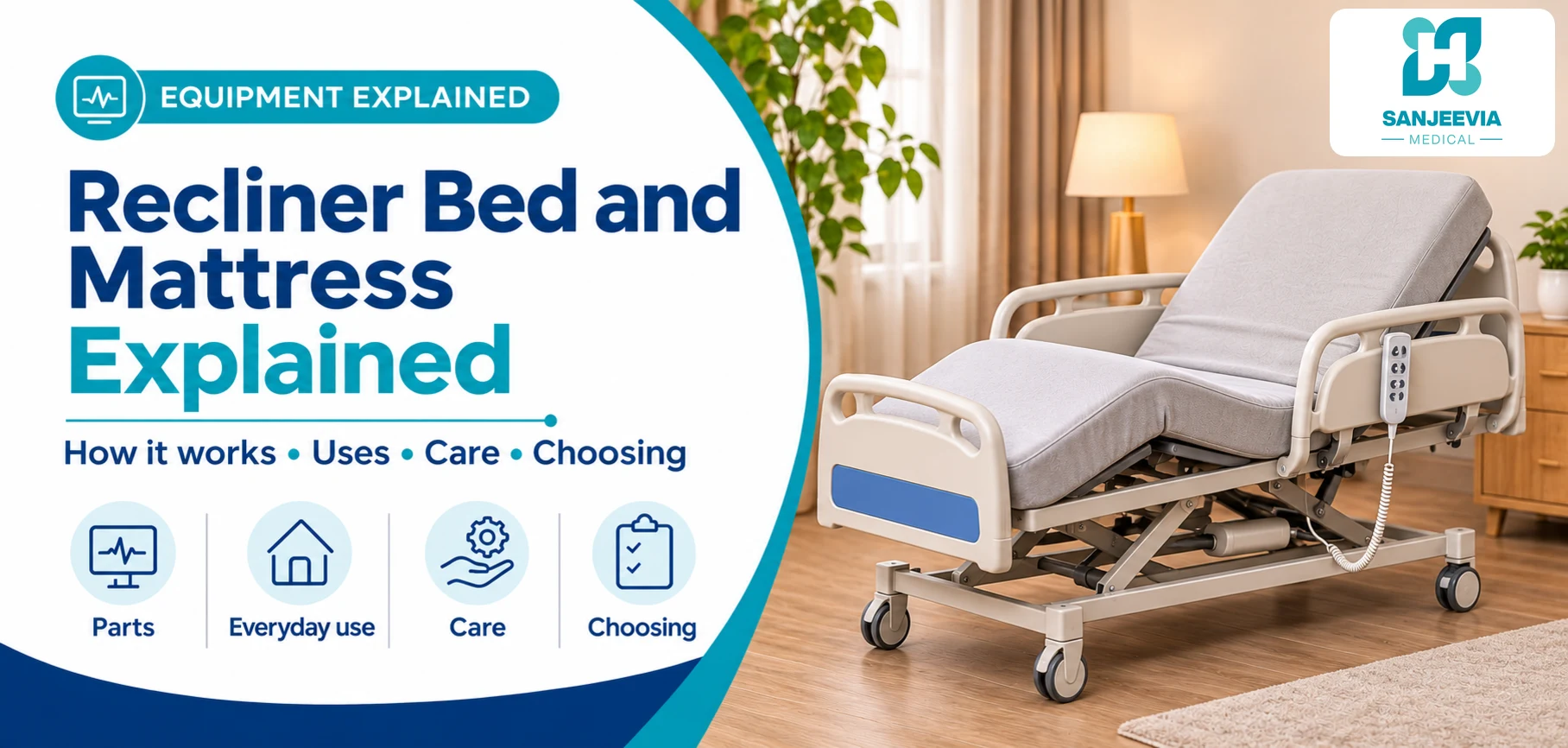
A recliner bed can look like an adjustable chair, yet its real value is the transition between supported sitting and resting positions. The important questions are not only “does it recline?” but also how the user transfers, where the mechanism moves and whether the mattress follows it correctly.
Quick answer: A recliner bed and fitted mattress form one powered positioning system. It can change the back-and-leg profile for comfort and care, but it is not automatically a hospital bed, a pressure-relieving mattress or a safe transfer aid.
Explore relevant equipment
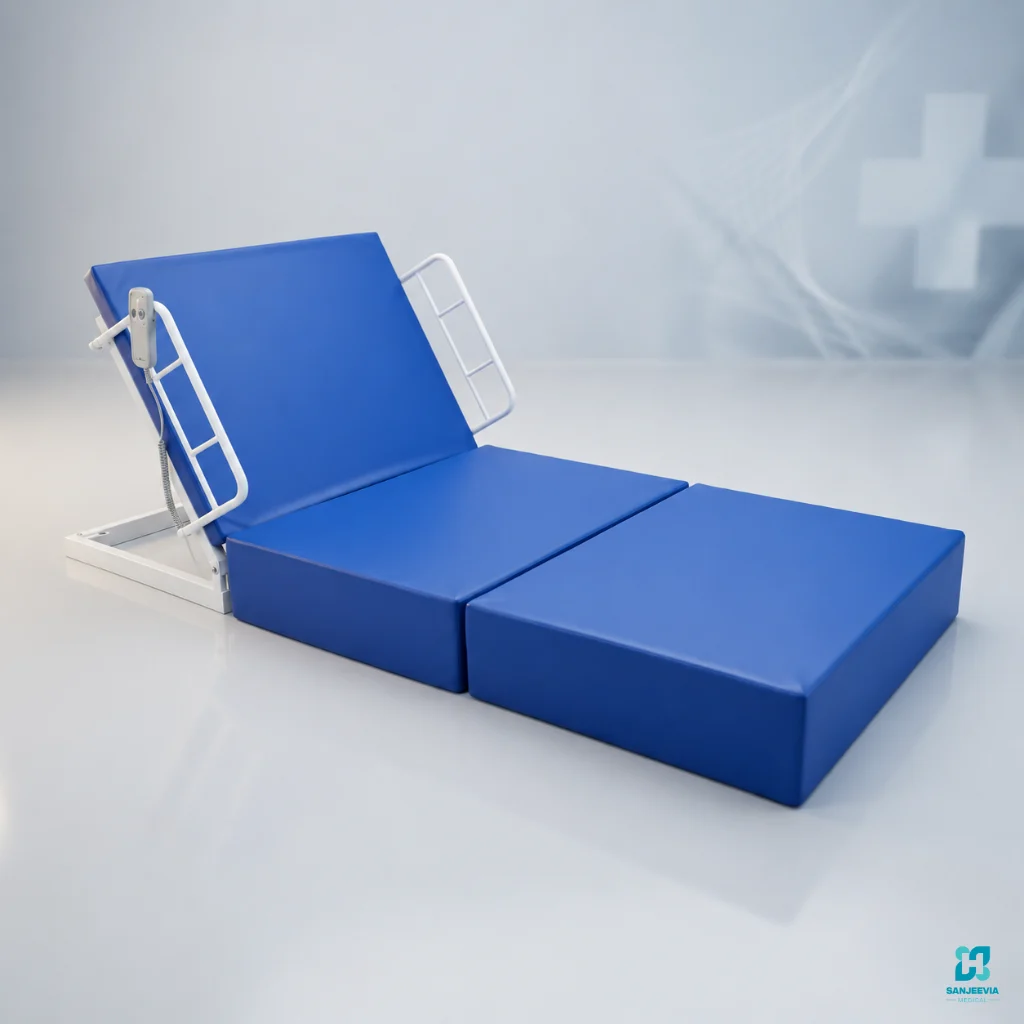
Recliner Bed & Mattress
Review the live listing for the confirmed configuration, included parts and current Delhi NCR rental or purchase options.
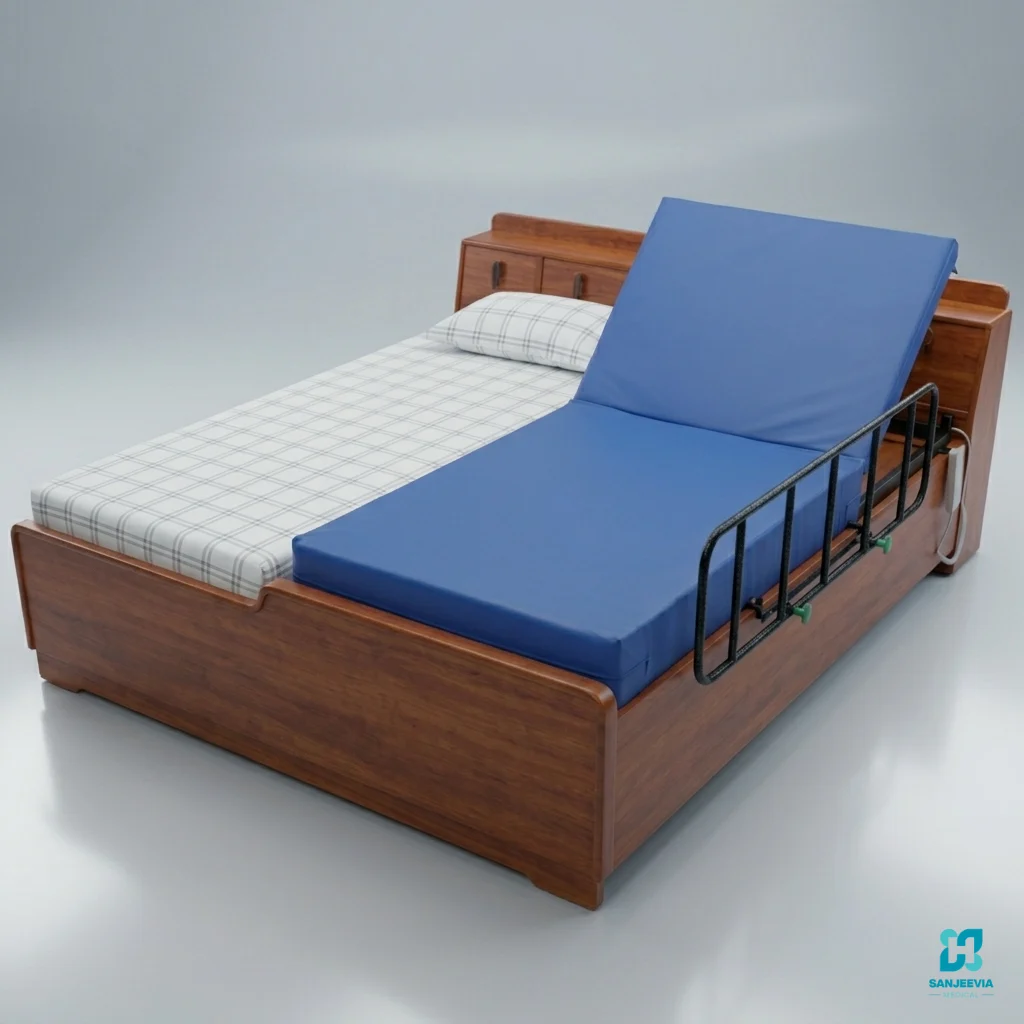
Recliner Bed & Mattress with Side Rails
Review the live listing for the confirmed configuration, included parts and current Delhi NCR rental or purchase options.
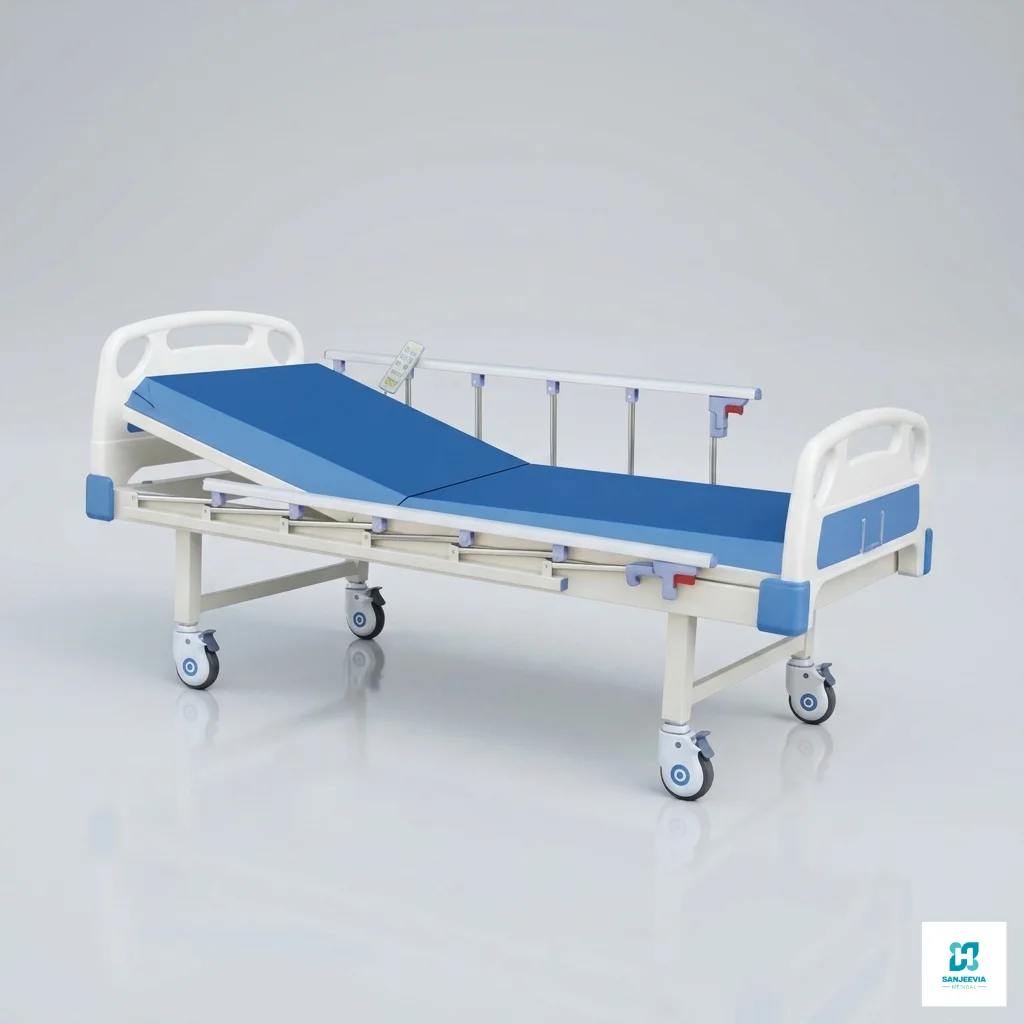
1 Function Electric Bed
Review the live listing for the confirmed configuration, included parts and current Delhi NCR rental or purchase options.
Confirm the exact bed, mattress, rails, accessories, room access and handover before booking.
Jump to equipment details
What a recliner bed actually does
The Sanjeevia listings combine a reclining frame, adjustment mechanism and fitted two-section mattress. When the control is pressed, the moving frame changes the relationship between the back and lower-body support. The mattress must remain aligned with those moving sections rather than bridging, folding sharply or sliding away.
This is different from a multi-function hospital bed. A hospital bed may offer independently controlled backrest, knee break and platform height; a recliner system may move in a more linked chair-to-rest pattern. Compare the movements, not the marketing names.
Positioning may make sitting, reading, eating or supervised breathing comfort easier for some people, but the treating team must decide whether a particular position is appropriate. The bed does not diagnose or treat the underlying condition.
Parts, controls and terms
| Part | What it does | What to check |
|---|---|---|
| Reclining frame | Supports and changes the resting profile. | No bent links, loose joints, unusual movement or contact with the wall. |
| Motor and actuator | Converts electrical power into controlled movement. | No exposed wiring, liquid entry, grinding noise or repeated stopping. |
| Hand control | Commands the permitted movements. | Buttons are labelled, cable is intact and the user knows which direction each button moves. |
| Fitted mattress | Follows the moving support surface. | Correct sections, intact cover, no deep sagging, bunching or unsafe gaps. |
| Side rails, if supplied | May help reduce a clinically assessed fall risk. | Compatible with this bed and mattress; latches fully engage. |
“Recliner”, “zero gravity” and “cardiac position” are sometimes used loosely. Ask for a demonstration of the actual movement and do not assume a named position equals a clinician-prescribed setting.
Who may use it—and its limitations
A recliner bed may be considered when a person spends long periods supported upright, finds a chair-to-bed change difficult, or benefits from adjusting position without repeated pillow stacking. Suitability still depends on strength, cognition, skin condition, transfer ability, body dimensions and caregiver support.
It may be unsuitable when the user needs independent bed-height adjustment, a defined knee break, frequent lateral transfers, specialist pressure care or intensive nursing access. A person who slides forward, becomes confused around controls or tries to climb over rails needs reassessment rather than simply a different button sequence.
The fitted mattress is not automatically a therapeutic pressure surface. People at pressure-injury risk need an individual skin and support-surface plan.
A practical everyday routine
- Lock or stabilise the frame as demonstrated and keep the route around it clear.
- Check the mattress is seated correctly and linen is not caught in moving joints.
- Arrange tubing and cables so movement cannot pull, trap or crush them.
- Make transfers only in the position and with the assistance taught for that user.
- Operate one control at a time while watching the user, mattress, rails and nearby furniture.
- Stop if the person reports pain, breathlessness, dizziness or feels as if they are sliding.
- Return the control where it cannot be pressed accidentally or caught under the mattress.
Before first use, cycle the empty bed through its allowed movement and confirm wall, curtain, table and socket clearance. Do not sit on unsupported moving sections unless the instructions specifically permit it.
Common mistakes and safety risks
- Placing the head end too close to a wall and damaging the frame or plug during recline.
- Using a loose topper that changes rail gaps or slides during movement.
- Pulling on a side rail that is not designed as a transfer handle.
- Leaving the handset where children, visitors or a confused user can activate it.
- Moving the frame while the power cable or another device’s tubing is stretched.
- Assuming rails always prevent falls; incompatible rails and mattresses can create entrapment gaps.
- Continuing after jerky movement, burning smell, unusual noise or a damaged cable.
Bed rails require a person-specific risk assessment. They are not restraints and can increase injury risk if a user attempts to climb over them.
Need help matching the bed?
Share the patient’s mobility, transfer method, required bed movements, mattress needs and delivery access. Sanjeevia can help confirm the configuration and current Delhi NCR options.
Cleaning, inspection and power planning
Disconnect power before cleaning unless the manufacturer instructs otherwise. Wipe high-touch surfaces such as the handset, rails and frame with a compatible product; do not spray liquid into the motor, connectors or handset. Clean visible soil first, follow the product’s contact time and dry all surfaces before reconnecting.
Inspect the mattress cover, seams and underside for tears, moisture or contamination. Check the plug, power cable, handset cable, moving joints and rail latches. Remove the bed from powered use if electrical parts are damaged.
Ask whether the exact model has a backup battery or emergency-lowering feature; do not assume it does. During a power cut, most beds remain usable in their last position but may not move. Keep the plug accessible and avoid an unverified extension board.
Questions before renting or buying in Delhi NCR
- Which movements are powered, linked or fixed?
- Does the fitted mattress match the frame, and is pressure redistribution required separately?
- Are rails included, compatible and clinically appropriate?
- What are the overall dimensions in flat and reclined positions?
- Can the bed pass the lift, doorway, corridor and room turn?
- Who will use the control, and can they recognise a problem?
- What happens during a power failure, fault, exchange or return?
- Are delivery, installation, demonstration and pickup included?
Compare this guide with the hospital bed overview, the hospital mattress guide and Sanjeevia’s recliner-versus-hospital-bed comparison.
Frequently asked questions
Is a recliner bed the same as an electric hospital bed?
No. Their movement patterns, height control, rails and care access can differ. Compare the exact functions.
Can a normal mattress be placed on it?
Only if the manufacturer confirms compatibility. A rigid or oversized mattress may not follow the moving frame safely.
Do side rails make it safer?
Only when assessed, compatible and correctly fitted. Rails introduce gaps and climbing risks as well as potential benefits.
Can the patient sleep in a raised position?
Use only the position advised for that individual and monitor comfort, skin and sliding.
Explore your equipment options
Recliner Bed & Mattress
Review the live listing for the confirmed configuration, included parts and current Delhi NCR rental or purchase options.
Recliner Bed & Mattress with Side Rails
Review the live listing for the confirmed configuration, included parts and current Delhi NCR rental or purchase options.
1 Function Electric Bed
Review the live listing for the confirmed configuration, included parts and current Delhi NCR rental or purchase options.
Confirm the exact bed, mattress, rails, accessories, room access and handover before booking.
Sources and useful reading
- MHRA: Bed rails—management and safe use.
- FDA: Hospital bed system guidance to reduce entrapment.
- NHSRC India: Biomedical Equipment Management and Maintenance Programme.
- CDC: Environmental cleaning procedures and noncritical equipment.
- Sanjeevia Recliner Bed & Mattress listing.
- Sanjeevia Recliner Bed with Side Rails listing.
Prepared by Sanjeevia’s editorial team. Updated 10 November 2026. This guide explains equipment; positioning, transfers, rails and pressure care require individual assessment.
