
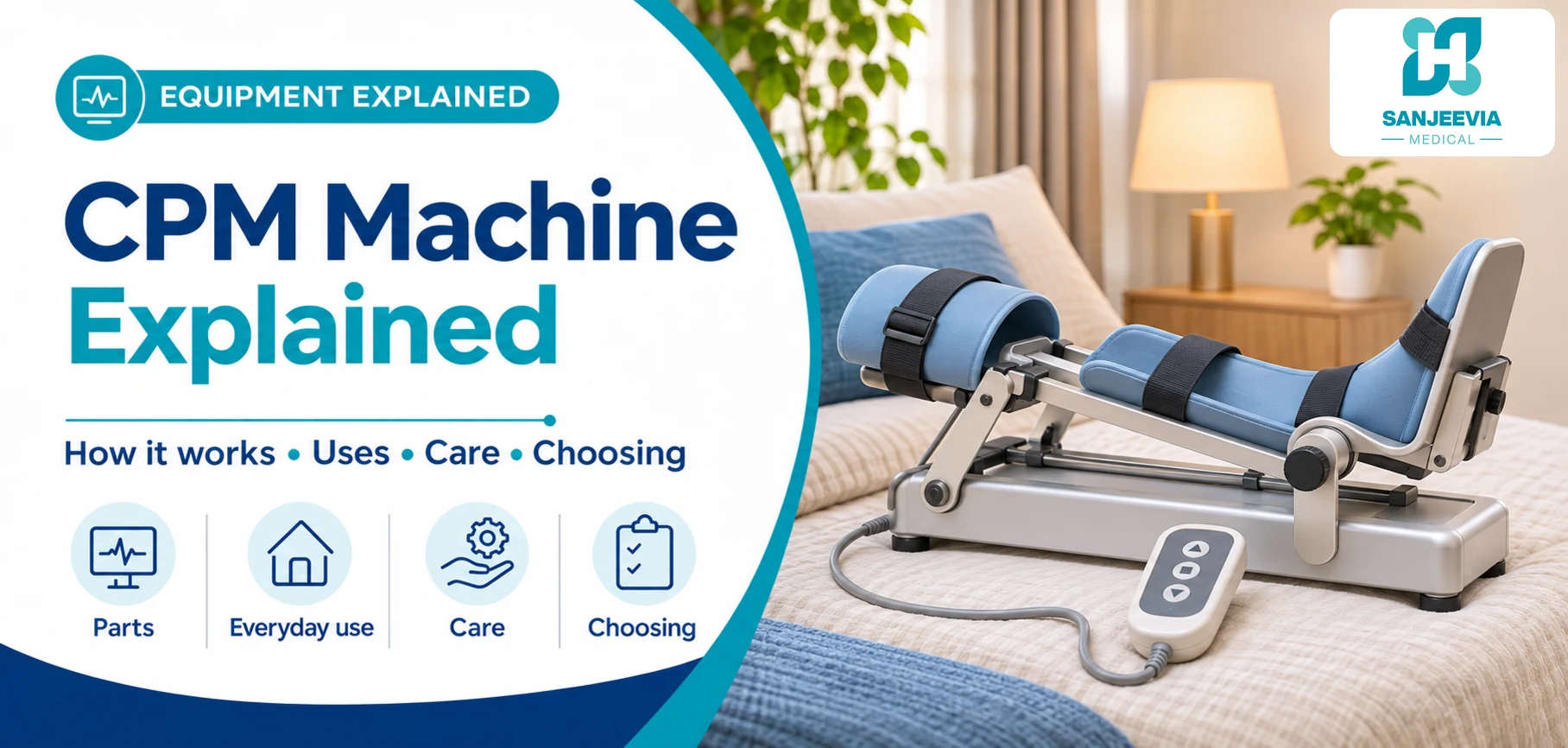
A knee CPM machine moves a leg while the person rests. That can make it look like an exercise machine that does all the rehabilitation—but passive movement and rebuilding strength are different tasks. Understanding the distinction helps families decide what role, if any, CPM has in recovery.
Quick answer: CPM means continuous passive motion. A motorised device repeatedly bends and straightens a supported joint through a prescribed range, without the person actively driving the movement. This guide focuses on knee CPM. It is used selectively under a rehabilitation plan and does not replace active exercises or physiotherapy.
Explore relevant equipment
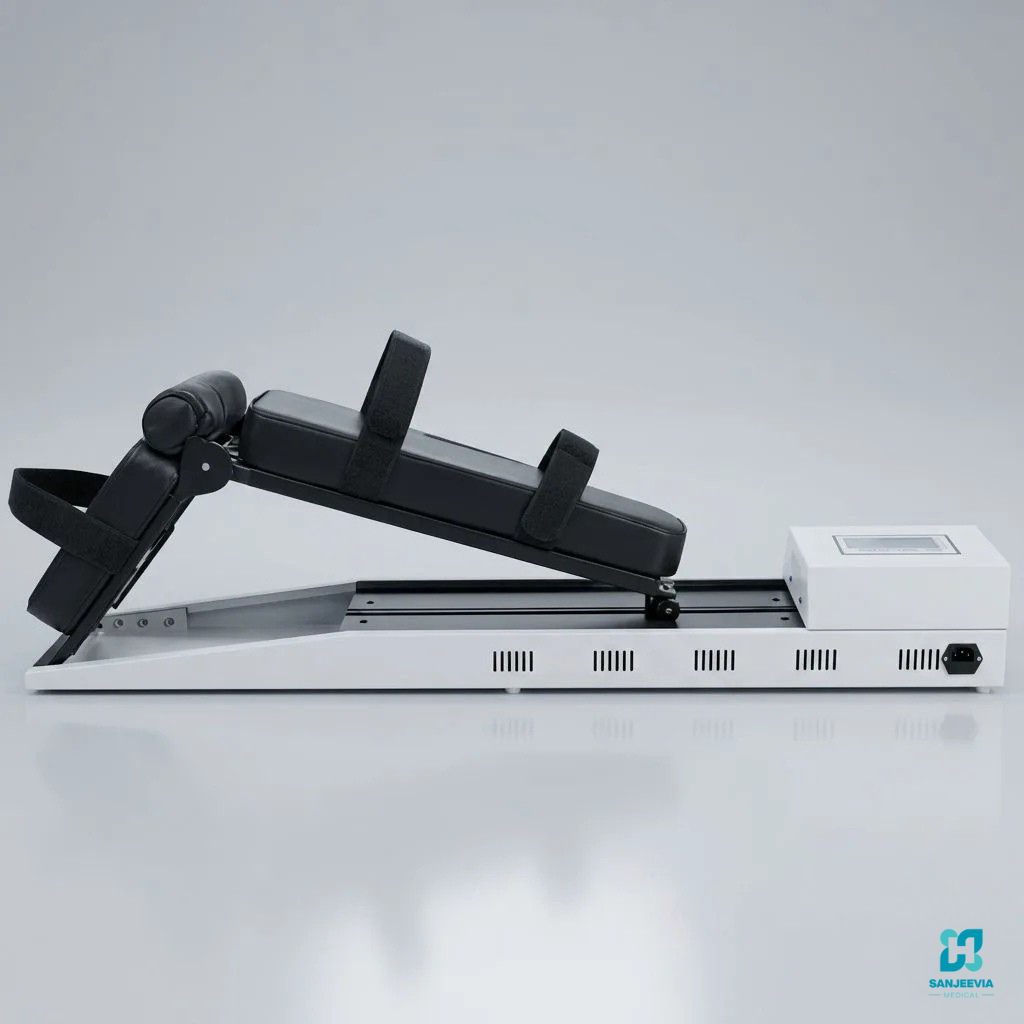
Knee CPM Machine
Knee CPM machine: confirm patient fitting, prescribed movement range, hand controller and the included setup demonstration.
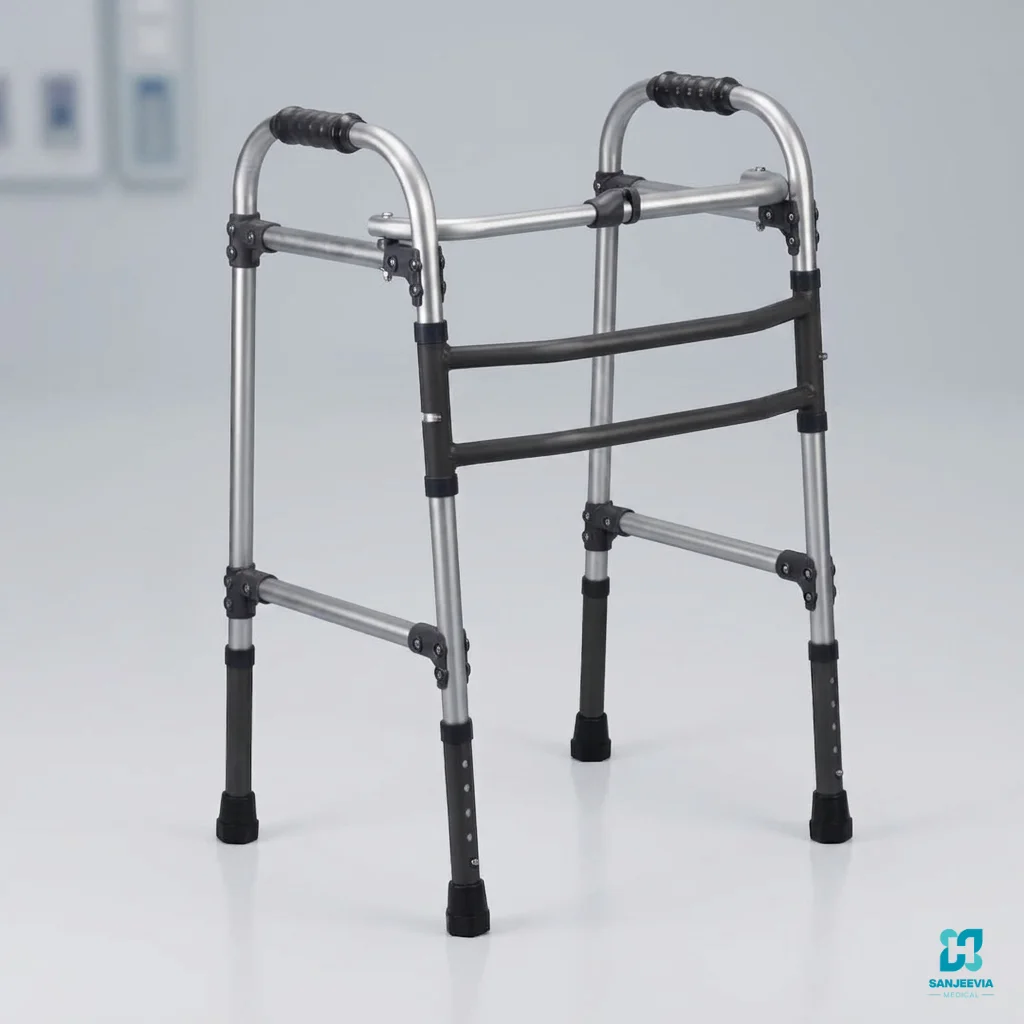
Walker / Zimmer Frame
Related recovery aid: a walking frame for assessed mobility needs. It supports walking when prescribed; it does not perform CPM therapy.
Open the product pages for current charges, rental or purchase options and package details. Confirm the exact supplied model, accessories and delivery availability for your PIN code.
Watch Sanjeevia’s how-to-use video
Sanjeevia’s knee CPM demonstration introduces the device and home-use controls. The patient’s movement limits, session duration and progression must come from the treating team, not the video.
Knee CPM Machine After Surgery? How to Use It at Home | Sanjeevia — watch on YouTube
Use this demonstration alongside the instructions for your supplied model and the patient’s care plan. Controls and accessories can differ.
Jump to equipment details
What does “passive motion” actually mean?
During active exercise, the person’s own muscles produce the movement. With CPM, a motor moves the supported limb between selected endpoints. The person does not need to actively lift the leg to create each bend, which is why it is called passive movement.
The purpose of a prescribed CPM session is controlled joint movement within a defined rehabilitation plan. The device does not measure muscle strength, establish whether a wound has healed or decide whether a patient is ready to walk. A larger angle on the controller does not necessarily mean recovery is going better.
CPM devices exist for different joints, but they are not interchangeable. A knee unit supports the leg and has a particular movement mechanism; a shoulder or hand CPM is a different device. Match the machine to the clinical recommendation rather than the general abbreviation.
The parts and controls: what is moving?
| Part or term | Plain-language meaning | Why it matters |
|---|---|---|
| Base and motor | Support the machine and drive its movement. | They need a stable, appropriate position on the intended support surface. |
| Thigh and lower-leg supports | Cradle the limb along its length. | They must be adjusted to the patient rather than used at a previous person’s fit. |
| Pads, straps and foot support | Help support and position the leg. | Placement must avoid pressure, rubbing and pulling on the surgical area. |
| Flexion and extension limits | The endpoints of bending and straightening, usually shown in degrees. | These are prescribed treatment limits, not goals to maximise independently. |
| Speed, pause and time | How the movement cycle and session run, where these controls exist. | Features and allowed adjustments vary by model and protocol. |
| Hand control / stop function | Starts, pauses or stops movement as designed. | The person or assisting caregiver must be able to reach and use it. |
Ask for a demonstration of what every enabled button does. A machine’s full technical range is different from the range selected for a particular patient. Do not copy an online angle schedule just because the controller looks similar.
Does everyone need CPM after knee replacement?
No. The American Academy of Orthopaedic Surgeons has advised against routine CPM after knee replacement, because routine use has not shown sufficient benefit to justify making it a standard step for everyone. That is an important question to raise before renting equipment simply because another patient used it.
A treating surgeon or physiotherapist may still recommend CPM selectively as part of an individual plan. Ask what problem it is intended to address, what benefit is expected, when the response will be reviewed and what would lead to changing or stopping it. The operation, restrictions and patient’s progress all matter.
Passive movement does not replace the active exercises, safe walking practice and functional rehabilitation prescribed by the team. The machine can move a knee without rebuilding the strength and balance needed for stairs or transfers.
Our CPM versus physiotherapy comparison separates those roles. A useful rental decision starts with a clear clinical reason and a review point, not a promise of guaranteed faster recovery.
How is a knee CPM machine used at home?
- Obtain the written plan: which leg and joint, movement limits, speed if specified, session timing, restrictions and who may change the programme.
- Have the supplied device adjusted to the person. Limb length, support positions and joint alignment need checking by someone trained for that machine.
- Confirm the bed or support surface is suitable and stable. Keep cables clear and the controller accessible; do not let pillows or bedding obstruct moving parts.
- Learn the model’s start, pause and stop controls before a supervised initial session. Use the device only within the agreed programme.
- Check comfort, skin contact and the limb’s position during use. Record issues and progress for the team, and follow their review instructions.
Do not force the knee into a support or add improvised weights. If the limb repeatedly slips, the mechanism rubs the skin or the support pulls at the wound, stop and have the fit assessed. Read bed compatibility and CPM setup questions before delivery.
What should make you pause and ask for help?
The aim is controlled prescribed motion, not pushing through sharp or increasing pain. Stop the session for new severe pain, bleeding, wound disturbance, numbness, unusual skin pressure or equipment problems, and contact the treating team as appropriate. Do not increase the range to “break through” resistance.
New marked swelling or calf pain should be assessed rather than assumed to be ordinary exercise soreness. Sudden breathlessness or chest pain needs urgent medical attention. A CPM machine does not diagnose a clot or provide a substitute for a prescribed clot-prevention plan.
Keep children and pets away from moving sections. Do not sit or stand on the machine. Disconnect power before the cleaning or adjustments for which the manual requires it, and do not use a damaged cable or controller.
The care team should also explain how to get into and out of the setup safely. A walking frame may assist separately assessed mobility, but it does not make every transfer or walking attempt safe. The level of help and weight-bearing instructions still apply.
What should you confirm before renting CPM in India?
For a temporary postoperative need, rental may be practical, but first confirm that CPM has actually been recommended. Ask for the exact model, size and fit range, controller, pads, straps, foot support, power cable, cleaning preparation and handover demonstration. Clarify which patient-contact items are included or supplied separately.
Sanjeevia’s knee CPM listing includes the unit, supports, hand control, power and a setup demonstration. Physiotherapy, a clinical assessment, a hospital bed, dressings, braces, compression devices and power backup are separate arrangements unless explicitly agreed. The demonstration explains the equipment; it does not create a rehabilitation prescription.
Confirm the delivery PIN code, current rental charge, deposit, minimum period, extension and collection terms. Ask who handles a fitting problem or equipment fault and whether a replacement is available. Do not assume a battery is fitted or that the unit will run through a power cut.
Follow the exact instructions for cleaning the supports and patient-contact materials; keep liquid away from the motor and electronics. If more use is being considered, get the clinical plan reviewed rather than automatically extending the rental. Our CPM rental guide covers the booking questions in more detail.
Frequently asked questions
Is CPM essential after every knee replacement?
No. AAOS advises against routine use after knee replacement. Ask the treating team whether there is an individual reason for prescribing it in this case.
Can it replace physiotherapy?
No. It creates passive movement and does not replace prescribed strengthening, functional practice or walking rehabilitation.
What angle and session length should I use?
Use the patient-specific written programme. A universal online schedule cannot account for the operation, restrictions, wound or response.
Can a knee CPM be used for a shoulder?
No. Joint-specific devices differ. Order the equipment actually recommended and have the fit checked.
Is a bigger range a sign of faster recovery?
Not by itself. Recovery is assessed using several clinical and functional measures. Do not increase settings independently to chase an angle.
Explore your equipment options
Knee CPM Machine
Knee CPM machine: confirm patient fitting, prescribed movement range, hand controller and the included setup demonstration.
Walker / Zimmer Frame
Related recovery aid: a walking frame for assessed mobility needs. It supports walking when prescribed; it does not perform CPM therapy.
Open the product pages for current charges, rental or purchase options and package details. Confirm the exact supplied model, accessories and delivery availability for your PIN code.
Sources and useful reading
- Kinetec: CPM patient information — Manufacturer explanation of passive movement; the Sanjeevia rental is not necessarily this manufacturer.
- AAOS: Choosing Wisely recommendations — Recommendation to avoid routine CPM after knee replacement.
- AAOS: Surgical management of knee osteoarthritis guideline — Evidence review supporting the routine-use distinction; not an individual rehabilitation protocol.
- Sanjeevia: Knee CPM product and package — The listed equipment and package used for this guide.
- CDSCO: Medical devices and diagnostics — Official Indian medical-device information; this is not an endorsement of an individual listing.
- NHSRC: Materiovigilance Programme of India — Information about reporting suspected medical-device adverse events in India; urgent care comes first.
Prepared by Sanjeevia’s editorial team. Updated 7 November 2026. This guide explains equipment; individual treatment, settings and suitability must be confirmed with the treating clinical team.
