
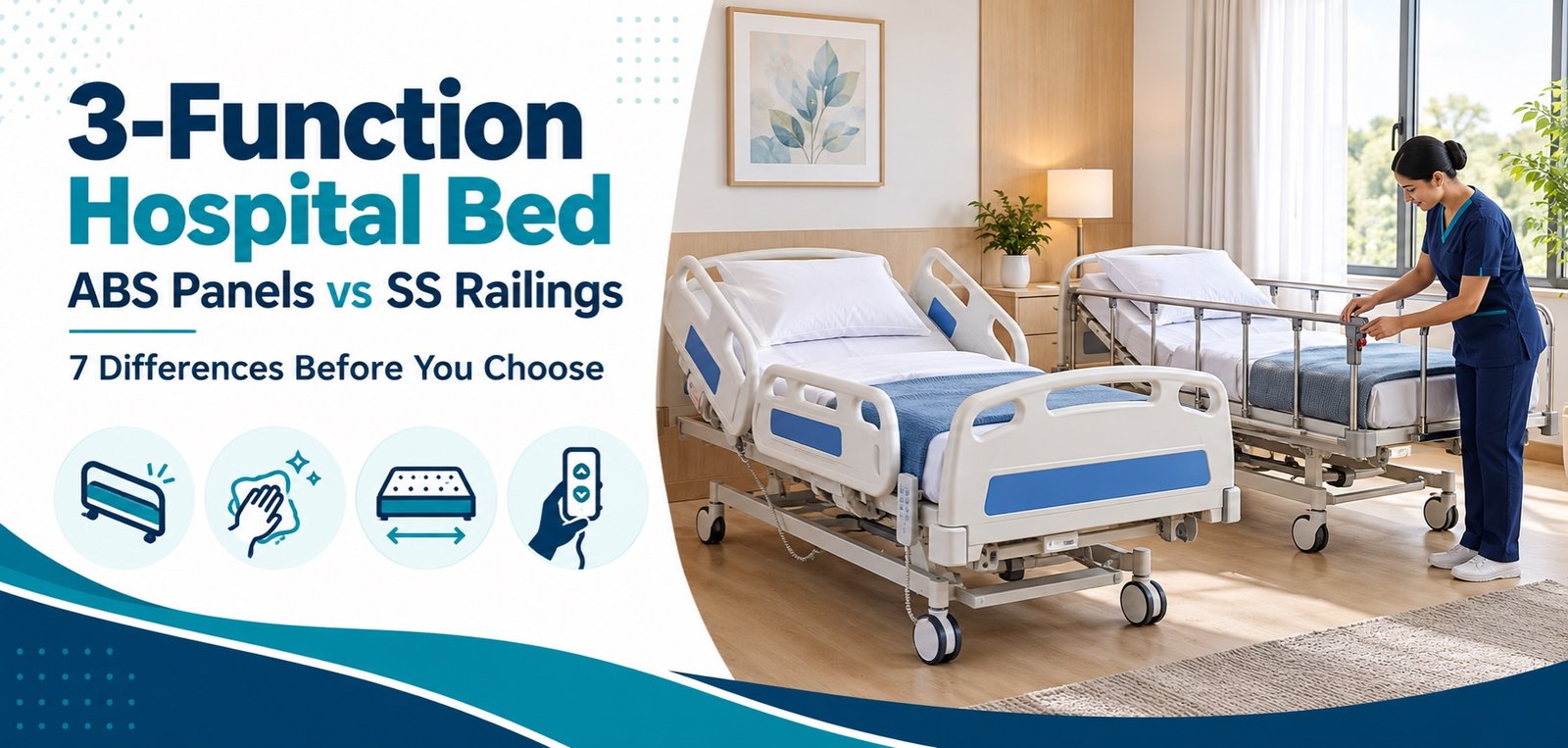
Compare the two Sanjeevia configurations
Both listings provide powered backrest, knee-rest and bed-height adjustment through a hand control. The major visible difference is the side-rail system. That difference must be assessed as part of the complete setup, not as a cosmetic preference.
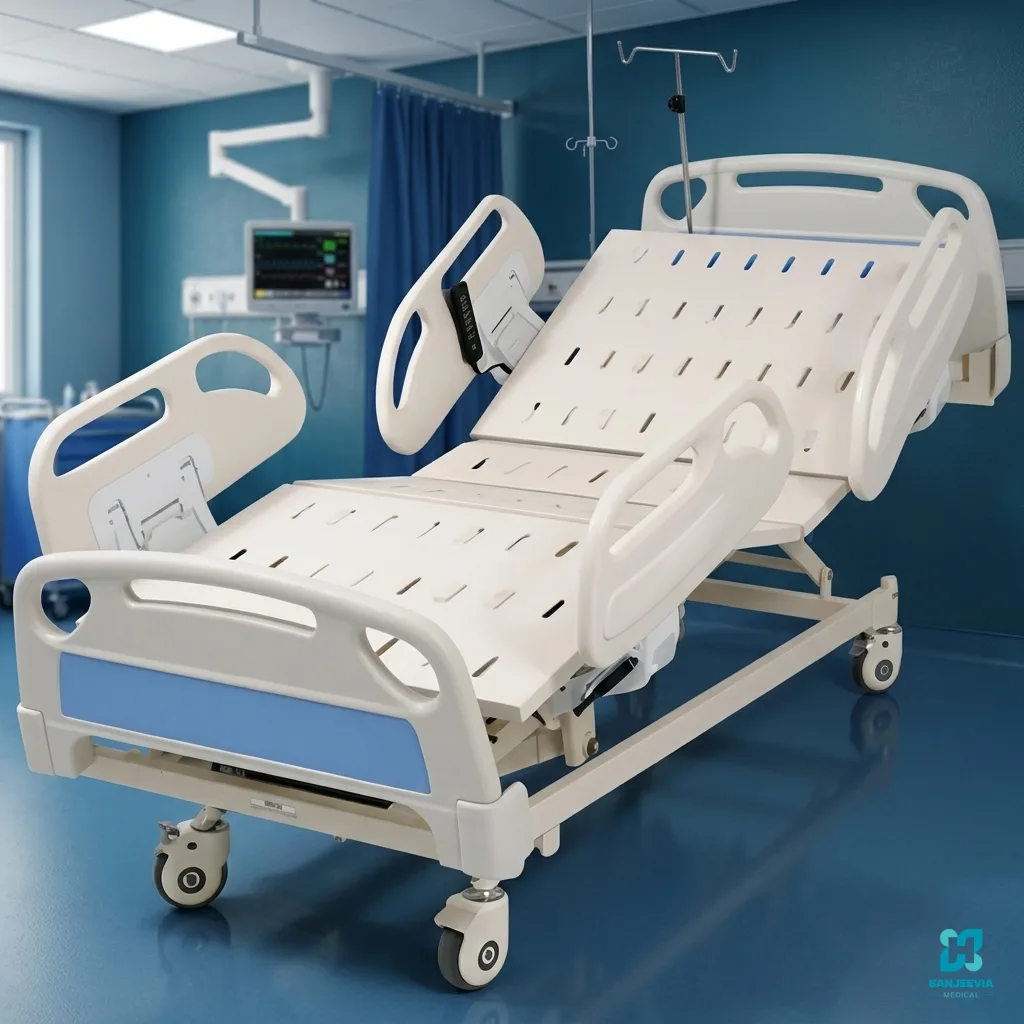
3-Function Electric Bed with ABS Panels
Three motors, hand remote, four-section mattress, four-part ABS side rails, IV pole and castors.
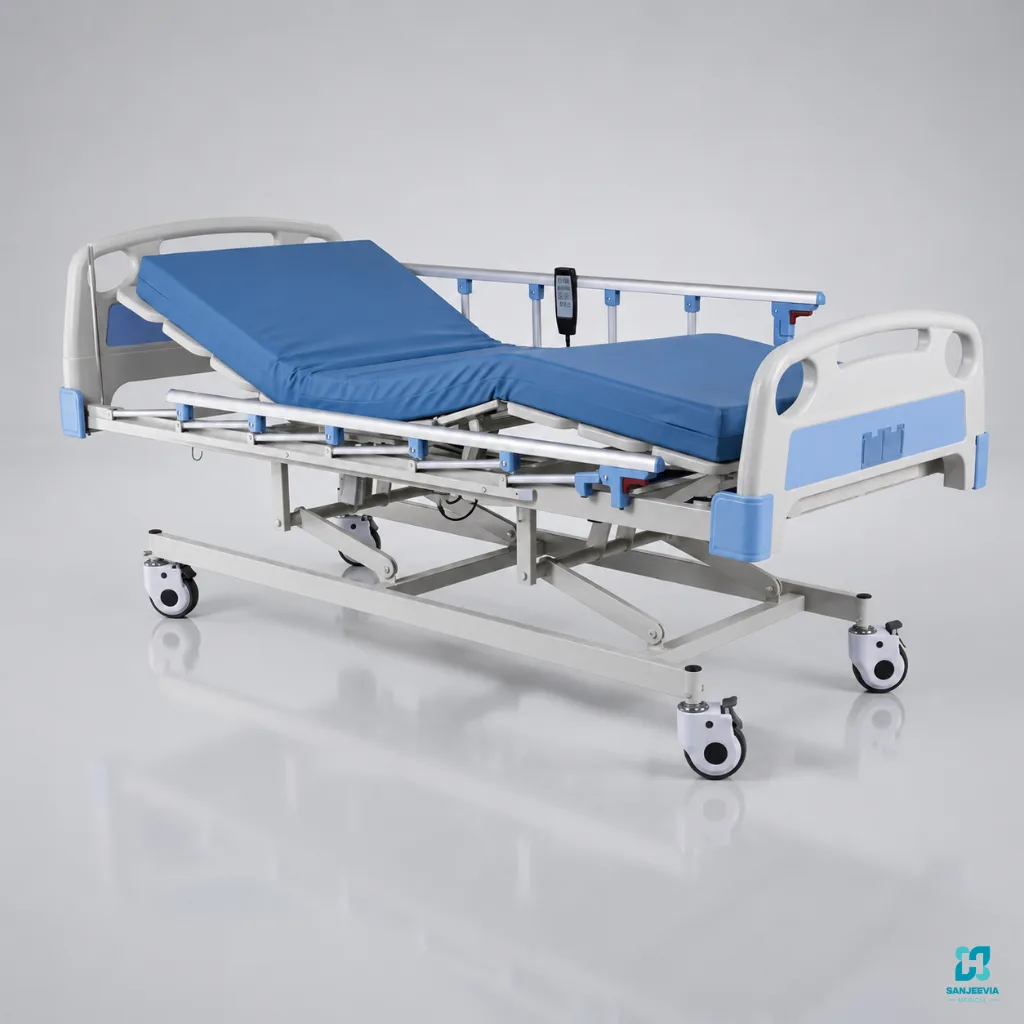
3-Function Electric Bed with SS Railings
Three-function electric bed with collapsible stainless-steel side railings, hand remote, mattress, IV pole and braked castors.
Side-by-side overview
| Check | ABS-panel configuration | SS-railing configuration |
|---|---|---|
| Core powered functions | Backrest, knee-rest and height adjustment | Backrest, knee-rest and height adjustment |
| Side structure | Four-part moulded ABS panels | Four-section collapsible stainless-steel railings |
| Included mattress | Four-inch, four-section foam mattress listed | Four-inch, four-section foam mattress listed |
| Controls | Six-button hand remote listed | Six-button hand remote listed |
| Safety decision | Requires assessment of gaps, latches, mattress compatibility, patient movement and transfer method | |
7 differences that matter in a home-care decision
1. Surface shape and contact points
ABS panels usually present broader moulded surfaces, while stainless-steel railings use narrower horizontal and vertical members. A broad panel is not automatically protective, and an open rail is not automatically easier to use. Observe where the patient’s hands, feet, head and clothing could contact or enter the structure in every intended bed position.
2. Openings and entrapment assessment
Any rail system can create hazardous gaps between the rail, mattress, bed deck, headboard or footboard. Mattress compression and patient movement can change those spaces. The FDA’s bed-entrapment questions and answers explain why dimensional fit and patient assessment matter more than the material name.
3. Rail movement and latch design
The two configurations may lower or collapse differently. At delivery, the caregiver should demonstrate that each section locks, releases and moves smoothly without forcing it. A loose, damaged or partly latched rail should be taken out of use and reported to the provider.
4. Transfer access
The therapist’s transfer plan may require a specific opening near the patient’s stronger side, a wheelchair position or space for a transfer aid. Check whether the rail sections open far enough for the planned method. Do not improvise by removing parts or using the rail as a lifting handle unless the manufacturer permits it.
Need help checking the exact model?
Share the clinician’s requirement, city and intended use. A Sanjeevia coordinator can confirm the listed equipment and availability. Do not send medical records on WhatsApp.
5. Grip and caregiver interaction
Some patients may try to grip the rail during repositioning. Whether a surface is suitable depends on hand function, cognition, pain, instructions and the exact structure. The treating physiotherapist or occupational therapist should decide what the patient may safely use for support.
6. Cleaning and inspection
Both materials need routine cleaning according to the supplied instructions. ABS panels may have moulded seams and joints; stainless-steel assemblies may have tubes, welds, hinges and latch points. Neither should be described as universally more hygienic without a validated cleaning process. Inspect all joints, fasteners and moving parts during the rental.
7. Appearance does not prove capacity
A stainless-steel railing may look stronger, but it does not establish the safe working load of the bed. Likewise, an ABS panel does not establish impact resistance or suitability for a particular patient. Confirm the full bed’s manufacturer-rated load, dimensions and current condition in writing.
What to test before accepting delivery
- Match the exact bed, mattress and rail configuration to the booking.
- Operate backrest, knee-rest and height adjustment through the full intended range.
- Test every rail latch and castor brake.
- Check the mattress width, length, thickness and compression against all rail gaps.
- Place the bed on a level surface with caregiver access on the required side.
- Confirm safe electrical connection and cable routing.
- Ask the clinician or therapist to review positioning and transfers.
Use the practical 3-function hospital-bed rental checklist to prepare the room and handover. The FDA’s clinical guidance on bed-rail entrapment gives further risk-assessment detail.
Frequently asked questions
Are ABS side panels safer than stainless-steel railings?
Not automatically. Safety depends on the complete bed, rail, mattress, gaps, latches, patient assessment and intended transfer method, not the rail material alone.
Do stainless-steel railings support a higher patient weight?
Rail material does not establish the bed’s safe working load. Confirm the exact manufacturer’s load rating for the complete bed and never infer it from appearance.
Can bed rails prevent every fall?
No. Rails are not a universal fall-prevention solution and can introduce entrapment or climbing risks. Their use should follow an individual clinical assessment.
What are the three functions on these beds?
The compared Sanjeevia listings provide powered backrest elevation, knee-rest elevation and whole-bed height adjustment through a hand control.
Why must the mattress be checked with the rails?
Mattress thickness, compression, width and position can alter gaps around the rails, deck and head or foot ends. Compatibility must be assessed in all intended bed positions.
This article is general equipment information. Bed, rail and mattress selection should follow an individual clinical and environmental assessment.