
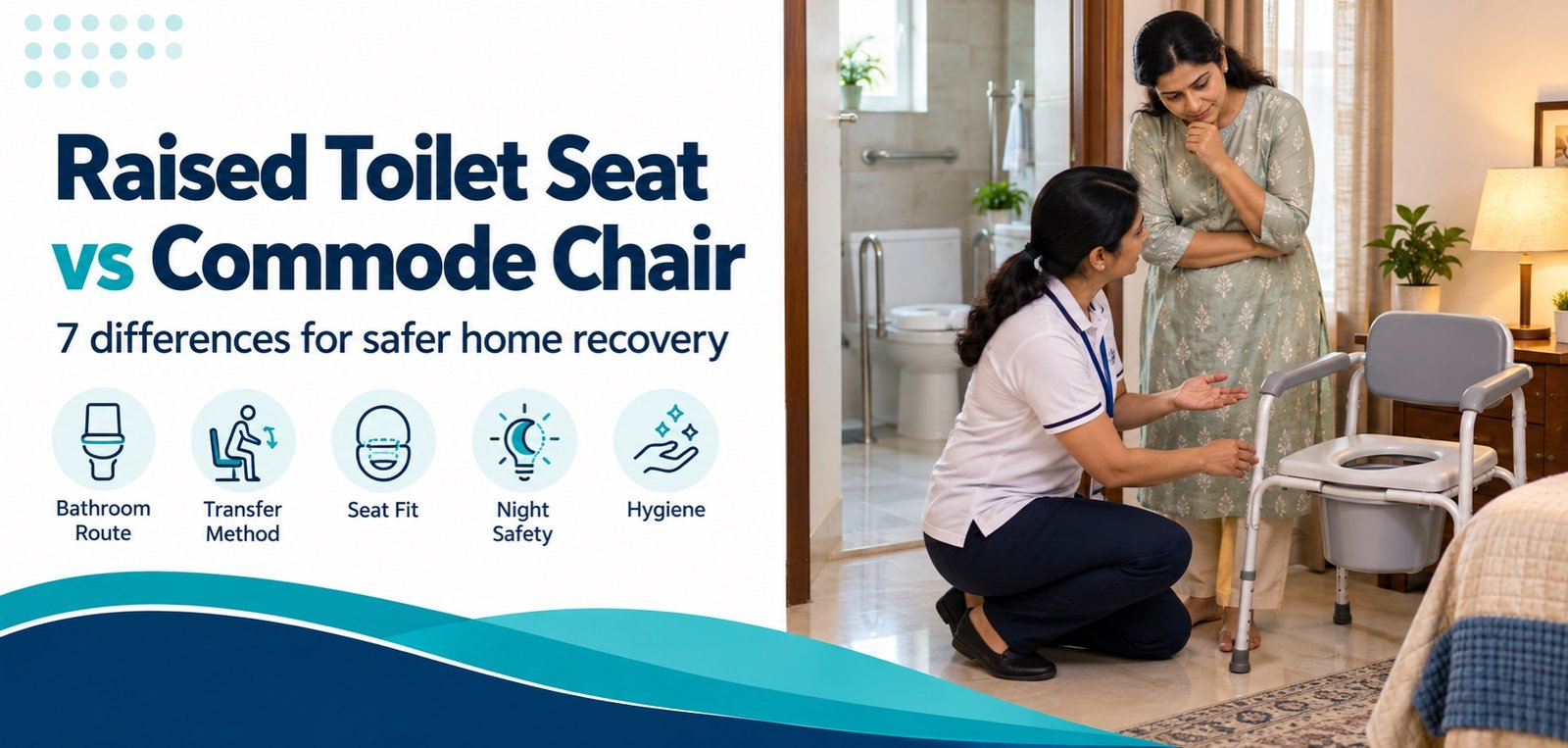
Toileting becomes a major safety issue when a person is weak, recovering from surgery or unable to walk the full route to the bathroom. A raised toilet seat and a commode chair can both reduce effort, but they solve different problems. One changes the height of an existing toilet. The other creates a toileting place closer to the patient or combines toileting with a supported chair.
Quick answer
Choose between a raised toilet seat and a commode chair by assessing the route to the bathroom, transfers, balance, toilet fit, posture, caregiver help and hygiene plan. A raised seat still requires the person to reach and use the bathroom. A commode can be placed nearer to the bed, but it needs space, stable positioning, safe transfers and a clear cleaning plan. A clinician or occupational therapist should assess uncertain or high-risk transfers.
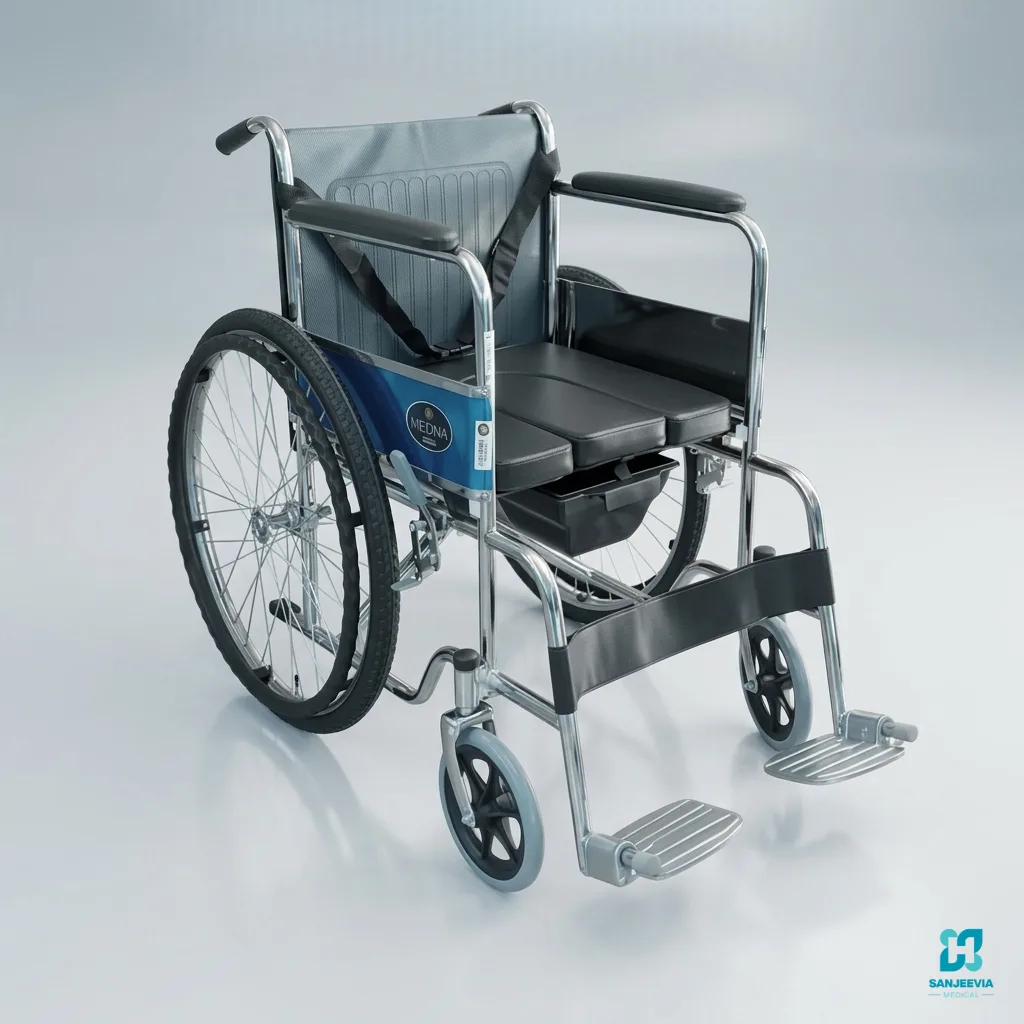
Sanjeevia currently lists a commode wheelchair, not every raised-seat design discussed here. Confirm the prescribed equipment type, dimensions and user fit before booking.
Raised toilet seat vs commode chair at a glance
| Difference | Raised toilet seat | Commode chair |
|---|---|---|
| Where it is used | On a compatible existing toilet | Near the bed or in another suitable private area; some designs may be positioned over a toilet |
| Bathroom journey | The user must still reach the bathroom | Can shorten the journey |
| Main purpose | Raises sitting height to change the effort of lowering and standing | Provides a separate toileting seat and receptacle |
| Support | Depends on design; some have a frame or arm supports | May have armrests, back support and a stable frame |
| Fit questions | Toilet shape, fixing method, height, feet position and surrounding space | Seat dimensions, user capacity, feet support, brakes if wheeled, transfer space and doorway access |
| Cleaning | Seat and toilet must be cleaned | Seat, frame and removable pan need a documented hygiene routine |
| Best decided by | Assessment of mobility, balance, joint precautions and bathroom fit | Assessment of mobility, urgency, night use, caregiver support and room layout |
The NHS guide to household equipment identifies raised toilet seats and commodes as different options. Its advice to obtain an assessment is particularly important when the person has poor balance, weakness, recent surgery or a history of falls.
Seven differences that matter at home
1. A raised seat changes height, while a commode changes location
A raised toilet seat may reduce the depth of the sit-to-stand movement. It does not shorten the route from the bed to the bathroom. If the person cannot safely cover that route, especially at night, a bedside commode may address a problem the raised seat cannot.
A commode is not automatically safer because it is closer. The selected location must allow the caregiver to assist without twisting, let the user place the feet securely and preserve privacy. Do not block emergency access, doorways or the route around the bed.
2. The transfer method is different
Using a raised seat requires turning and lowering onto the toilet in the bathroom. A bedside commode may involve standing and pivoting from the bed, or a more complex transfer when the person cannot stand. The clinical team should specify the permitted transfer and assistance level.
If the user needs lifting, do not assume armrests alone make the transfer safe. Clarify whether one or two trained helpers or a transfer device is required. Read the bedpan vs bedside commode guide when getting out of bed may not be permitted.
3. Raised seats must fit the toilet and the user
Toilet bowls and fixing methods vary. The seat should be compatible, correctly secured and stable before use. The final height should allow an appropriate sitting position and secure foot contact. A seat that is too high may leave the feet unsupported; one that is too low may not reduce the effort enough.
Kingston and Richmond NHS guidance says a raised seat should be individually assessed and fitted, and it may be unsuitable when poor balance, spasms or weakness make use unsafe. These principles should be applied by the patient’s local care team.
4. Commode chairs need their own fit checks
Check seat width and depth, armrest position, feet support, user limits and whether the model is static or wheeled. If it has wheels, confirm how the brakes are applied and who checks them before each transfer. A commode wheelchair and a static bedside commode are not the same product.
Sanjeevia’s manual commode wheelchair is intended for dry indoor toileting use and has model-specific limits. It should not be described as a shower chair. Confirm the actual supplied model and pan arrangement before booking.
5. Night-time urgency changes the decision
A person who manages the bathroom in daytime may be unsteady when sleepy, rushed or using poor lighting. Ask whether the route remains safe at night and whether assistance will be present. Consider the distance, floor surfaces, thresholds, footwear and the need to manage clothing.
A bedside commode may shorten the route, but it must not create a new trip hazard. The home fall-prevention guide helps families inspect the whole path rather than choosing an item in isolation.
6. Hygiene work differs
A raised seat adds surfaces around the toilet that need cleaning according to its instructions. A commode requires timely emptying and cleaning of the receptacle, plus cleaning of the seat and frame. Agree who will do this, what protective supplies are needed and where the clean equipment will be stored.
Skin care and continence needs may affect the plan. Equipment suppliers can demonstrate components, but clinical concerns about skin, bowel or bladder symptoms need the healthcare team.
7. Recovery may change the best option
The safest choice can change as walking, transfers and joint movement improve. Set a review point. A commode may be useful early, followed by a raised seat when the person can safely reach the bathroom. Some people need a longer-term arrangement.
After hip or knee surgery, restrictions differ by operation and surgeon. Use the hospital’s instructions and see Sanjeevia’s hip and knee home-setup checklist for questions to coordinate before discharge.
A practical selection checklist
- Can the person safely reach the bathroom every time, including at night?
- What transfer has the physiotherapist or occupational therapist authorised?
- Can the feet rest securely and the user sit without leaning or sliding?
- Does the raised seat fit the actual toilet and lock securely?
- Does the commode fit the user, doorway and transfer space?
- Who will provide assistance, and have they been shown the technique?
- Who will clean the seat, frame and receptacle after use?
- When will the equipment choice be reviewed?
Frequently asked questions
Is a raised toilet seat the same as a commode chair?
No. A raised seat attaches to or sits over an existing toilet. A commode provides a separate toileting seat and receptacle, often closer to the bed.
Which option is better after knee or hip surgery?
The better option depends on the surgical instructions, bathroom route, transfer ability, joint movement and caregiver support. Ask the treating team or occupational therapist.
Can a commode wheelchair be used in the shower?
Only if the specific manufacturer approves that model for shower use. Sanjeevia’s listed manual commode wheelchair is described for dry indoor toileting, not use under running water.
How high should a raised toilet seat be?
There is no universal height. It should be individually selected so the user can sit and stand safely with suitable foot support and without conflicting with precautions.
Does Sanjeevia rent every item described in this guide?
No. The guide compares equipment categories. Confirm the currently listed products, availability, dimensions and the actual supplied model before booking.
Educational home-recovery guide reviewed on 23 October 2026. It does not replace an individual mobility, transfer or bathroom assessment.
Next Read
If getting out of bed is difficult, compare Bedpan vs Bedside Commode: 7 Differences for Home Care.