
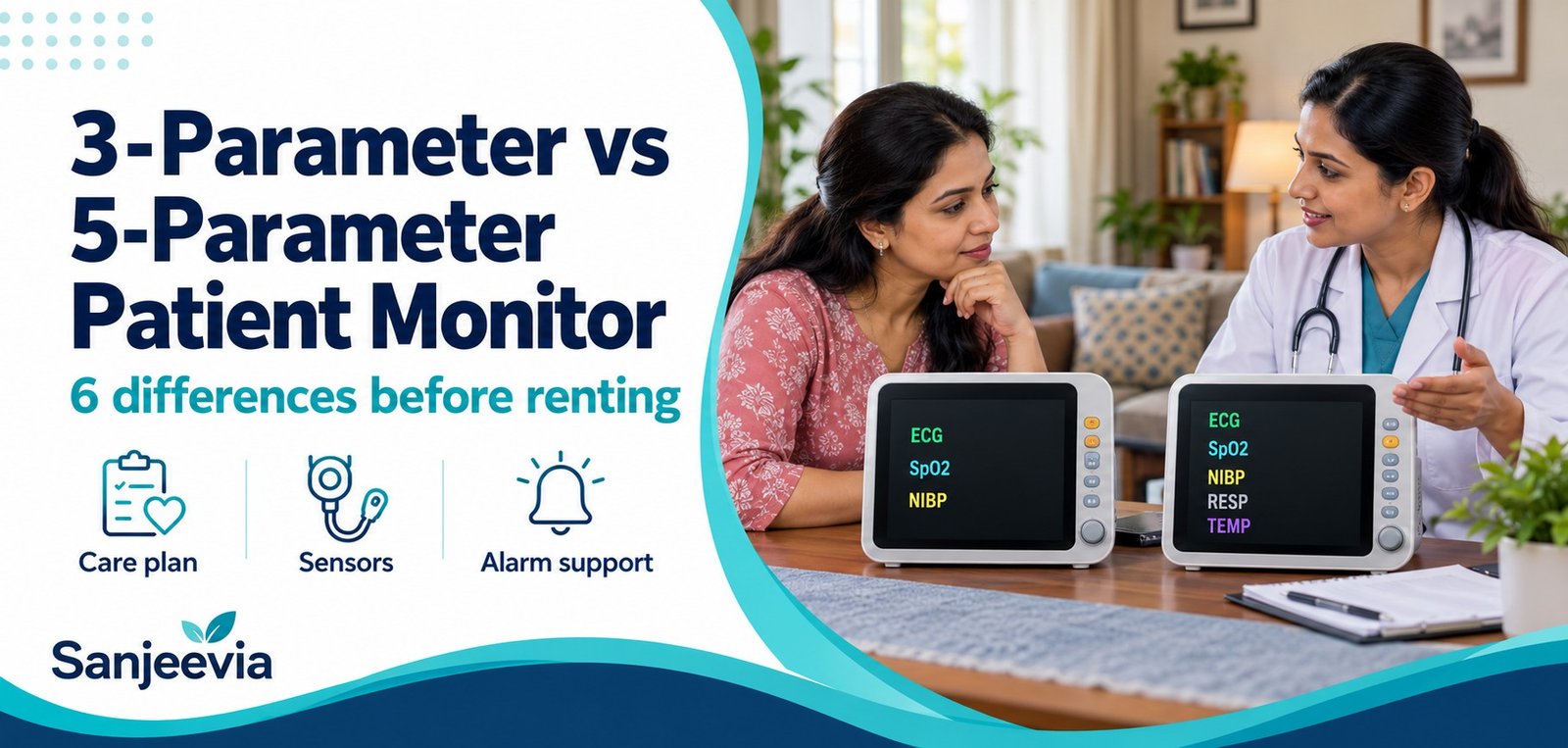
A discharge note may ask the family to arrange a patient monitor, while the catalogue offers both three-parameter and five-parameter models. More displayed numbers do not automatically mean a more suitable home setup. Comparing a 3-parameter vs 5-parameter patient monitor starts with what the clinician needs measured, who will observe it and how the information will be used.
Quick answer
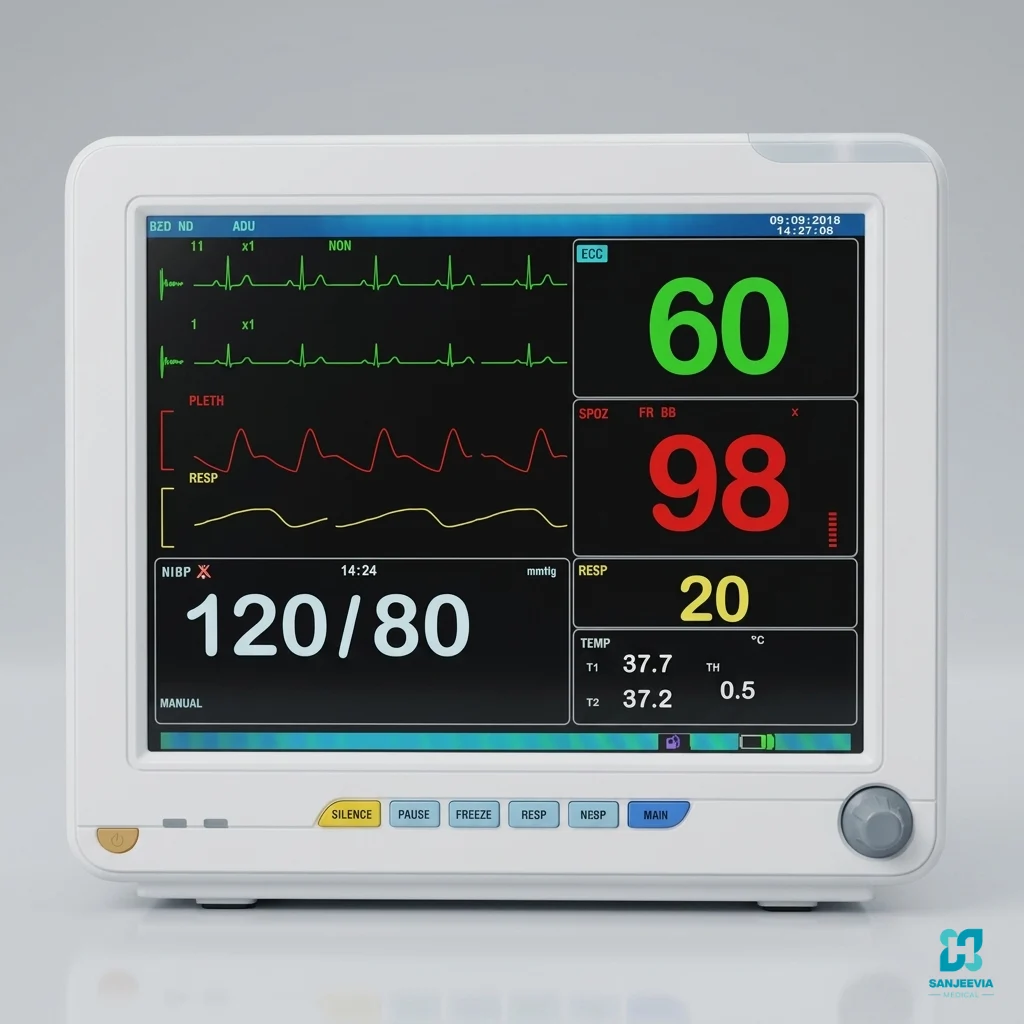
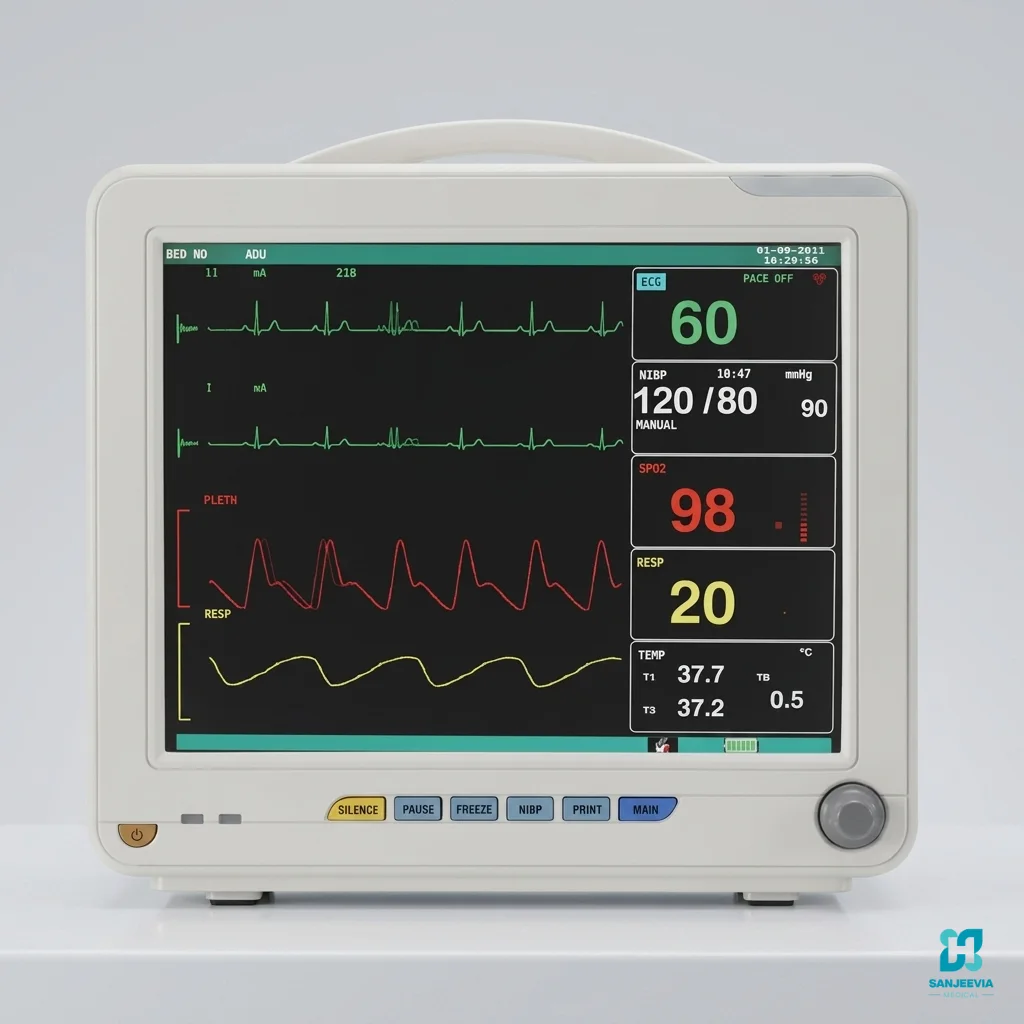
Sanjeevia’s listed three-parameter monitor measures ECG/heart rate, SpO₂/pulse rate and non-invasive blood pressure. Its listed five-parameter monitor adds respiration and temperature. Confirm the exact supplied model and sensors because configurations vary. Neither option diagnoses the patient, replaces a diagnostic 12-lead ECG or automatically provides remote clinical supervision.
Confirm the exact model, measurement channels and patient-specific accessories with the clinical team. These listings do not include remote clinical supervision.
What do three and five parameters mean here?
A parameter is a type of measurement. A screen can display several related numbers from one measurement channel: for example, an oxygen-saturation channel can also display pulse rate. Counting every number on a screen is therefore not a reliable way to classify a monitor.
The comparison below reflects Sanjeevia’s current listings, not a universal specification for every manufacturer’s product. Ask for the supplied model’s manual, patient population, fitted options and included sensors. Check these details in the allocated device’s own manual rather than relying on a generic photograph or another manufacturer’s specification.
| Measurement or feature | 3-parameter listing | 5-parameter listing |
|---|---|---|
| ECG / heart rate | Included measurement channel | Included measurement channel |
| SpO₂ / pulse rate | Included measurement channel | Included measurement channel |
| NIBP, cuff blood pressure | Included measurement channel | Included measurement channel |
| Respiration | Not part of the listed three-parameter configuration | Listed as impedance respiration |
| Temperature | Not part of the listed three-parameter configuration | Listed with a compatible temperature probe |
| Diagnostic 12-lead ECG | Not included | Not included |
| Remote clinician supervision | Not included in the equipment listing | Not included in the equipment listing |
Review the three-parameter patient monitor and five-parameter patient monitor with the care team. Confirm accessories and compatibility again when the actual unit is allocated.
Six differences and decisions before renting
1. The required measurements come before the product name
Ask the clinician which measurements are required, for what purpose and for how long. If respiration or temperature monitoring is part of the plan, clarify the required method, rather than assuming any “five-parameter” unit will meet it. If only particular channels are needed, ask whether the proposed configuration is appropriate.
The decision should not be based on a general label such as “post-surgery” or “elderly patient.” Two people with the same diagnosis may have different monitoring needs. A written requirement also helps prevent a provider and family from interpreting a short prescription differently.
2. Extra channels require suitable sensors and a usable setup
A measurement may need its own sensor, probe or connection. Confirm the ECG cable and electrodes, SpO₂ probe, blood-pressure cuff and any temperature probe for the exact model and patient. A standard adult accessory is not automatically appropriate for a child, a newborn or every adult arm size.
Sanjeevia’s five-parameter listing describes impedance respiration. This is not the same as measuring exhaled carbon dioxide with capnography. Neither listed configuration includes a diagnostic 12-lead ECG. Ask the clinical team to specify any requirement that goes beyond the advertised channels.
3. A five-parameter label does not guarantee better accuracy
The number of channels does not establish the accuracy of each measurement. Suitability depends on the model, patient, accessories, placement, intended use and operating conditions. An unexpected reading needs the response agreed with the clinician, including assessment of the patient and possible measurement problems.
For example, the FDA’s guidance on pulse oximeter limitations explains that oxygen-saturation estimates have limitations and should not be interpreted without symptoms and clinical advice. More screen information does not remove those limitations.
4. Alarm planning becomes more important as the setup expands
Ask who will set alarm limits and blood-pressure measurement intervals, who will respond and which situations need urgent clinical help. Do not copy another patient’s limits or adjust alarms simply because they are inconvenient.
Additional measurements can create additional alerts and interpretation tasks. Confirm which channels are intended to be active and what the caregiver should do if a sensor is disconnected or a value is unexpected. Our patient-monitor numbers and alarms guide explains the handover questions without supplying universal treatment thresholds.
5. The equipment does not determine staffing or remote supervision
A monitor does not watch the patient in the human sense. A screen or local audible alarm does not prove that a doctor is receiving information elsewhere. Continuous observation, nursing and remote monitoring are separate care arrangements that must be explicitly confirmed.
Ask whether the person available at home is trained to follow the monitoring plan and can respond at the required times. If staffing is unclear, read our comparison of a home nurse, attendant and equipment rental. Renting a more complex monitor does not resolve a gap in clinical care.
Watch: Patient monitor overview
This video introduces patient-monitor components. Confirm the required parameters, sensors, alarm plan and clinical supervision for the individual patient.
6. Power, records and support vary by model
Check the actual unit’s power requirements, battery condition, expected operation under the agreed use and response to a power interruption. Do not infer backup duration from the presence of a battery symbol. Ask how readings are recorded and whether the device’s memory or export functions meet the care team’s needs.
Keep the equipment identifier, accessories and support contacts together. Understand which problems go to the equipment provider and which need clinical assessment. The FDA home-device checklist is a useful prompt for instructions, alarms, caregiver demonstrations and backup arrangements.
A decision guide to take back to the clinician
- The requirement is unclear: ask for the specific measurements and care plan before choosing a model.
- ECG, SpO₂ and cuff blood pressure are requested: ask whether the confirmed three-parameter unit and accessories meet the requirement.
- Respiration and temperature are also requested: verify the required methods and the actual five-parameter configuration.
- Capnography, invasive pressure or diagnostic ECG is requested: do not assume either listed monitor includes it.
- The family expects unattended or remote surveillance: clarify the staffing and clinical service separately.
The pulse oximeter vs patient monitor comparison answers an earlier question: whether the care plan requires a multiparameter monitor at all. This article then helps distinguish the two listed monitor configurations.
What to include in your Sanjeevia enquiry
Share the clinician’s measurement requirements, the patient age group, accessory requirements, service address and planned duration. Ask for the actual model, its manual, included items and handover arrangements. Use Help Me Choose to organise the equipment request or contact the team to confirm availability.
Do not send patient readings into an ordinary sales enquiry expecting emergency interpretation. For a new serious symptom or deterioration, use the clinical or emergency pathway already agreed with the treating team.
Frequently asked questions
Is a five-parameter monitor always better for home use?
No. The appropriate choice is the model and configuration that meet the clinician’s monitoring requirements with suitable accessories and a workable response plan.
Does a three-parameter monitor measure blood pressure?
Sanjeevia’s current three-parameter listing includes non-invasive blood pressure alongside ECG and SpO₂. Confirm the actual model and suitable cuff before booking.
Does five-parameter mean a five-lead ECG?
No. The number of measurement categories and the ECG lead configuration are different specifications. Check both in the actual unit’s documentation.
Does a five-parameter monitor include carbon-dioxide monitoring?
Not in the listed Sanjeevia configuration. Its respiration channel is described as impedance respiration; capnography is a separate requirement.
Can the family set its own alarm limits?
No. Alarm limits and measurement intervals must follow the treating professional’s instructions. Ask for a documented response plan at handover.
Educational equipment-comparison guide. Sources and catalogue checked on 22 October 2026. The treating team must determine monitoring, settings and response requirements. Cover image is illustrative and does not show a supplied model.
Next Read
Prepare for daily use with Patient Monitor at Home: What Do the Numbers and Alarms Mean?.
