
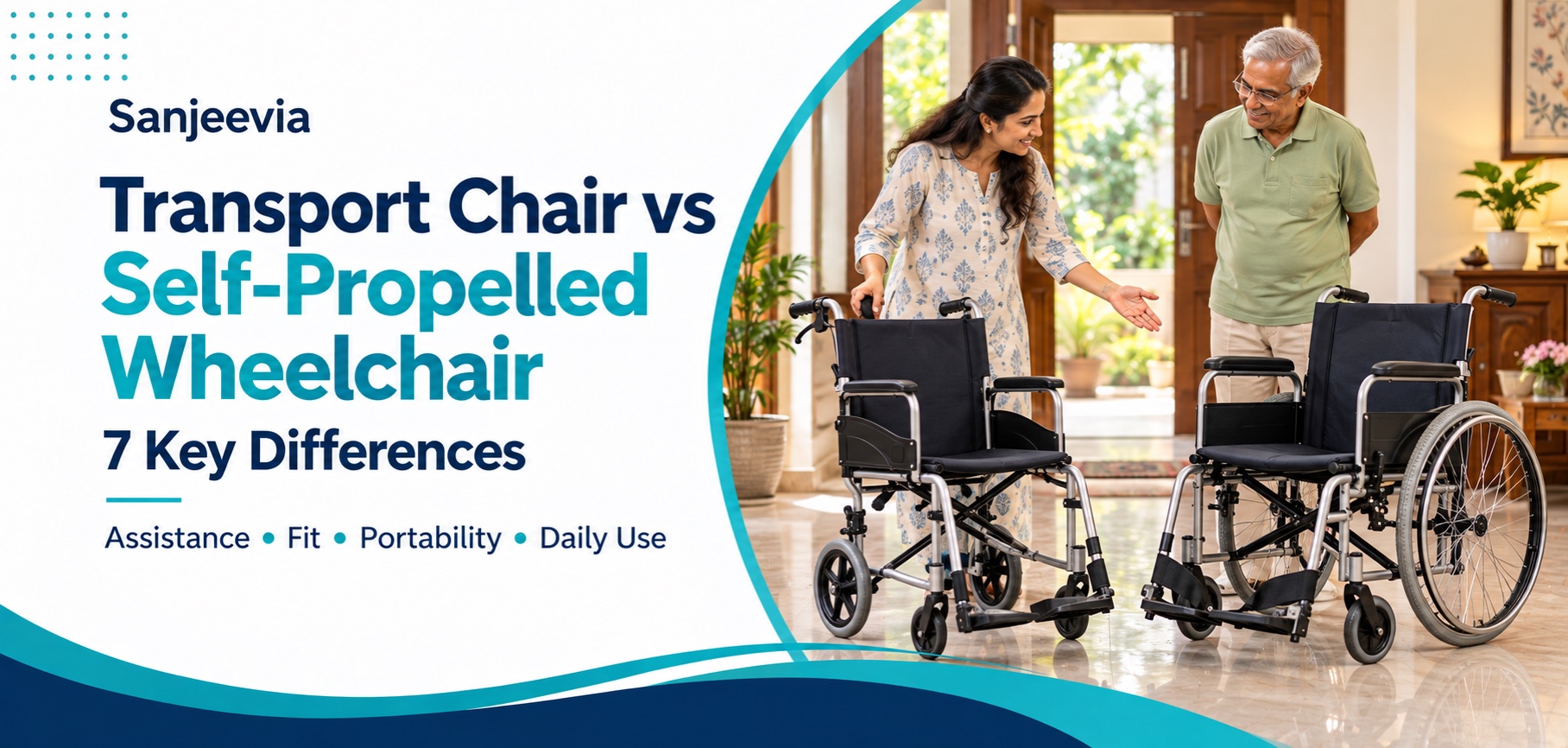
Your family may need a wheelchair for a clinic visit, everyday movement at home or a period of recovery. Before comparing folding frames or product names, resolve one question: will the person move the chair themselves, will someone push it, or will both happen? That is the central decision in a transport chair vs self-propelled wheelchair comparison.
This guide explains seven differences to discuss with the assessing professional and equipment provider. It concerns the chair’s mobility function, not patient travel services. A transport chair is not an ambulance, and neither chair should be assumed suitable as a vehicle passenger seat.
Quick answer: what is the difference?
A transport chair, also called an attendant-propelled or transit chair, is moved by another person and usually has smaller rear wheels. A self-propelled manual wheelchair has large rear wheels with hand rims for the user to propel, although an attendant may also push it when the model permits. Neither wheel size nor a folding frame proves that a chair fits the user, suits a route or meets a seating prescription.
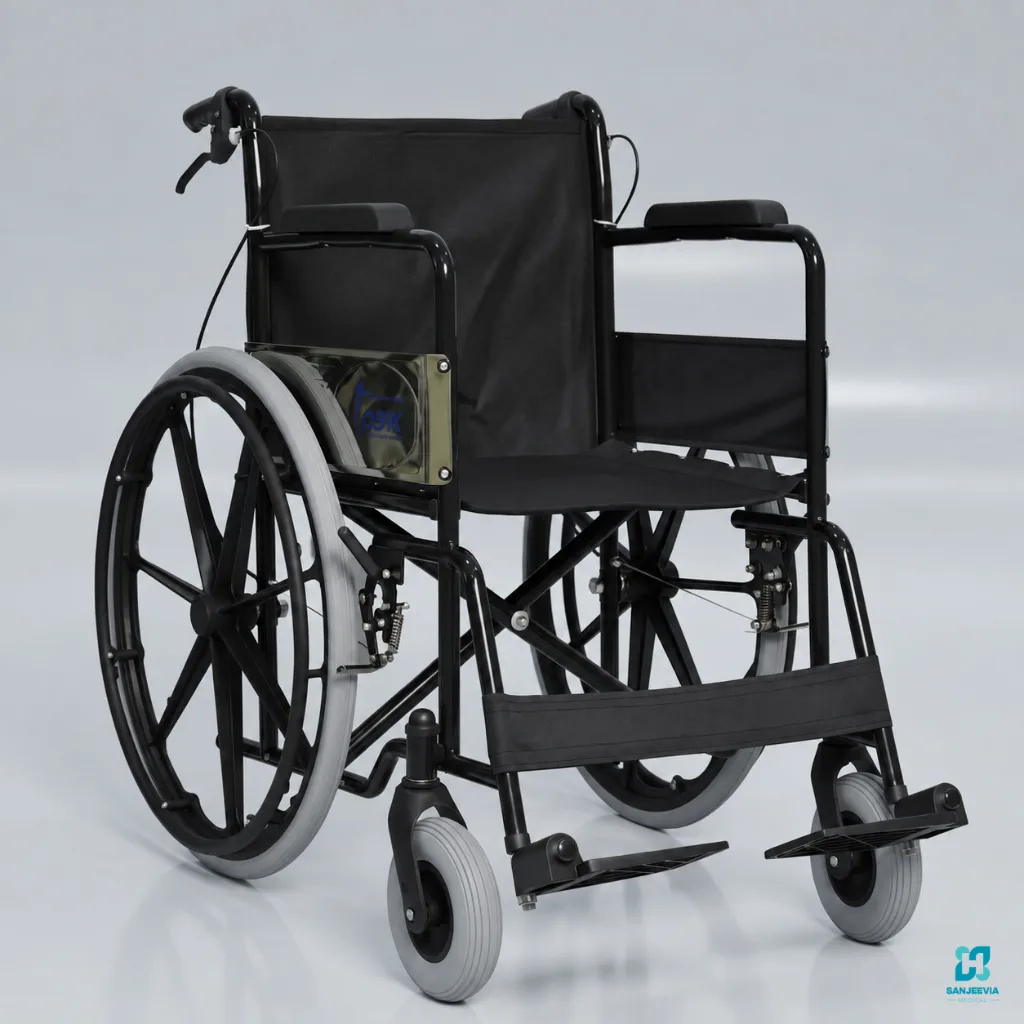
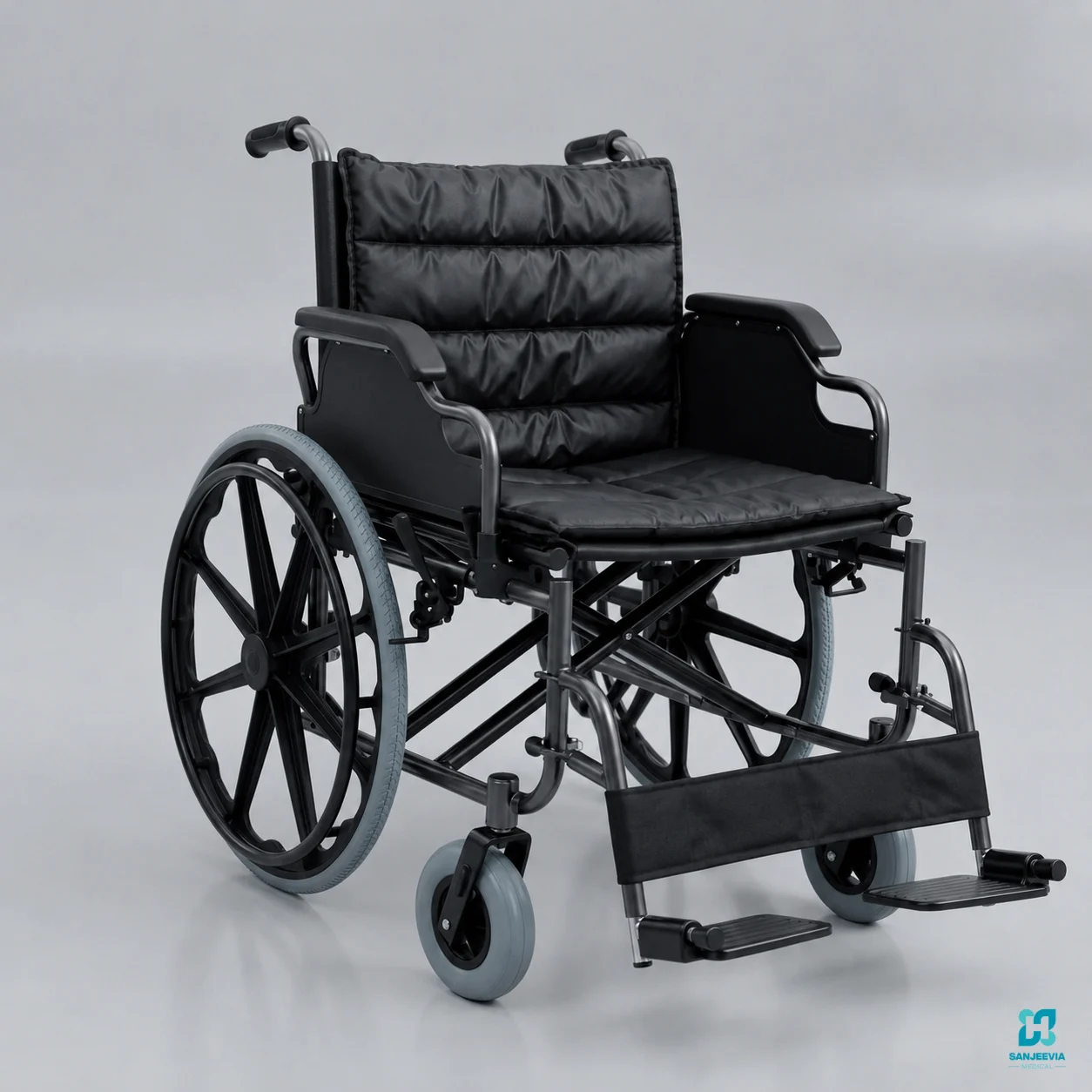
These catalogue links do not confirm that a dedicated small-wheel transport chair is available. Ask about the actual model, fit and configuration.

Transport chair vs self-propelled wheelchair: seven differences
Oxford University Hospitals’ wheelchair-types guide distinguishes small-wheel attendant-pushed chairs from large-wheel self-propelled designs. Its clinical service arrangements are UK-specific; the design distinctions are useful when preparing an equipment enquiry in India. The comparison below is a planning aid, not an individual seating recommendation.
1. Who supplies the movement?
With a transport chair, another person is responsible for moving the chair. Ask whether that helper will be available for every part of the intended use, including reaching the bathroom, waiting at an appointment and returning home. A plan that depends on an attendant needs a named attendant, rather than an assumption that someone will be nearby.
For a self-propelled wheelchair, ask the therapist whether the person can propel, steer and manage the intended route. Having hand rims does not establish that they can use them effectively. If a helper will push a standard manual wheelchair, confirm the delivered model’s push handles and operating instructions.
2. Rear-wheel design changes the controls you must understand
Transport chairs commonly use small rear wheels without user hand rims. Self-propelled designs use larger rear wheels with hand rims. Confirm which controls belong to the occupant and which belong to the attendant, including parking brakes and any attendant braking system fitted to that model.
A feature on a catalogue photograph may not be fitted to every supplied chair. Ask for a demonstration of the actual controls at handover, and identify the manual’s limits. Parking brakes must not be treated as interchangeable with brakes designed to control movement. Never assume the person can use a chair independently because a brake lever is within reach.
3. Total width matters more than the label compact
A family may choose a transport chair expecting it to solve a narrow doorway problem. Check the actual total width, including any parts that project beyond the seat. For either design, measure the approach to the doorway and the turn after it. A clear opening alone does not establish a usable route.
Use the wheelchair size and doorway guide to organise the measurements. If a wider seat or different capacity is needed, compare the heavy-duty wheelchair specification against the full route. Do not reduce the recommended seating space just to fit a doorway.
4. Portability has several separate measurements
Small wheels do not guarantee a light chair, and a large-wheel chair is not necessarily impossible to fold. For the exact model, request total weight, folded dimensions, the weight of the component that must be lifted and which parts can be removed according to the manual. Ask the usual helper whether they can manage the empty chair.
For car storage, compare these figures with the boot opening and usable internal space, not just the vehicle’s advertised capacity. Keep this separate from the patient’s travel plan. Our hospital-visit wheelchair checklist covers the wider appointment journey.
5. Seat fit and postural support remain essential for both designs
Do not choose solely around who will push. Ask the assessor about seat width and depth, back support, foot support, capacity and any prescribed cushion or specialised component. The ability to sit comfortably for the intended activity matters as much as moving between rooms.
If there is an existing seating prescription, send it with the enquiry and identify requirements that must not be substituted. A jumbo wheelchair is a catalogue category to investigate, not a clinical assessment. Neither a transport chair nor a standard wheelchair should be presented as a substitute for specialist seating that it does not provide.
6. The route and daily routine may favour different arrangements
Write down where the chair will actually go: bedroom, living room, building exit, clinic corridors or outdoor paths. Ask the professional and provider to review thresholds, turns, surface conditions and slopes against the exact chair and the abilities of the user and attendant. Avoid assuming that larger wheels make every outdoor route safe.
Also identify tasks the person wants to perform independently. A chair that works for an accompanied appointment may not meet their daily mobility needs. Conversely, a person who uses a self-propelled wheelchair may still need assistance in particular places. Assess the real combination of activities instead of assigning one chair type to every older person.
7. Rental suitability depends on the confirmed configuration
Before agreeing to a rental, ask for the supplied chair’s model, dimensions, capacity, accessories and handover arrangements. Confirm whether the configuration matches the recommendation and what happens if it does not. A verbal request for a small wheelchair leaves too much unspecified.
Sanjeevia lists standard, heavy-duty and jumbo manual wheelchairs. This comparison does not promise that a dedicated small-wheel transport chair is available. Send the assessed requirement to Sanjeevia and ask the team to confirm the available configuration. Do not accept an unsuitable substitution merely because it is available sooner.
A decision table to take to the assessment
| Your situation | Question to resolve | What to record |
|---|---|---|
| A helper will push for all use | Which attendant-propelled design meets the person’s support and route needs? | Required assistance, controls and availability |
| The person wants independent manual mobility | Can they use an assessed self-propelled configuration on the intended routes? | Seating prescription and training requirements |
| The empty chair must go in a car | Does the actual folded chair fit, and can the helper manage it? | Folded size, handling weight and permitted removable parts |
| Standard seating does not meet the recommendation | What specialised chair or accessory is needed? | Exact requirement and who will confirm compatibility |
Before the chair is first used at home
Compare the delivered chair with the written specification. Ask for the model-specific instructions and a demonstration of folding, brakes, footrests and any removable components. Keep a record of the supplied parts and support contact. Transfer training should be provided by the appropriate professional for the person, not inferred from the delivery demonstration.
For broader clinical context, the NHS mobility-aids guide describes assessment as part of choosing a wheelchair. In Delhi NCR, use your own treating team and local assessment arrangements. Sanjeevia’s role in this enquiry is equipment provision and operating support, rather than determining the person’s rehabilitation programme.
Keep the chair’s instructions separate from your individual transfer plan. A helper may understand a folding mechanism while still needing professional instruction in assisting the person.
Frequently asked questions
Can a transport chair user move it independently?
A conventional transport chair is designed for another person to push. Do not assume it offers independent propulsion. Ask the assessor which mobility arrangement meets the person’s goals and abilities.
Can a caregiver push a self-propelled wheelchair?
Many models include attendant push handles, but check the exact chair’s design and instructions. Confirm how its brakes and any other controls should be used by the helper.
Is a transport chair always lighter or narrower?
No model-independent guarantee can be made. Compare the manufacturer’s actual weight, overall width and folded dimensions, and confirm the required seat fit.
Which wheelchair is best for hospital visits?
The right chair must suit the person, available assistance, access route and intended waiting time. Resolve those needs first, then confirm the exact rental model and the travel arrangements separately.
Does transport chair mean patient transport is included?
No. It describes a wheelchair design. It does not mean a vehicle, ambulance, escort or medical travel service is included.
Equipment comparison, not a seating or transfer prescription. Sources and catalogue links checked on 15 October 2026. The cover is an illustrative comparison, not a statement that both pictured models are available from Sanjeevia.
Next Read
Once the chair type has been discussed, read Wheelchair Size Guide: Doorways, Seat Width and Fitting Questions before confirming the model.