
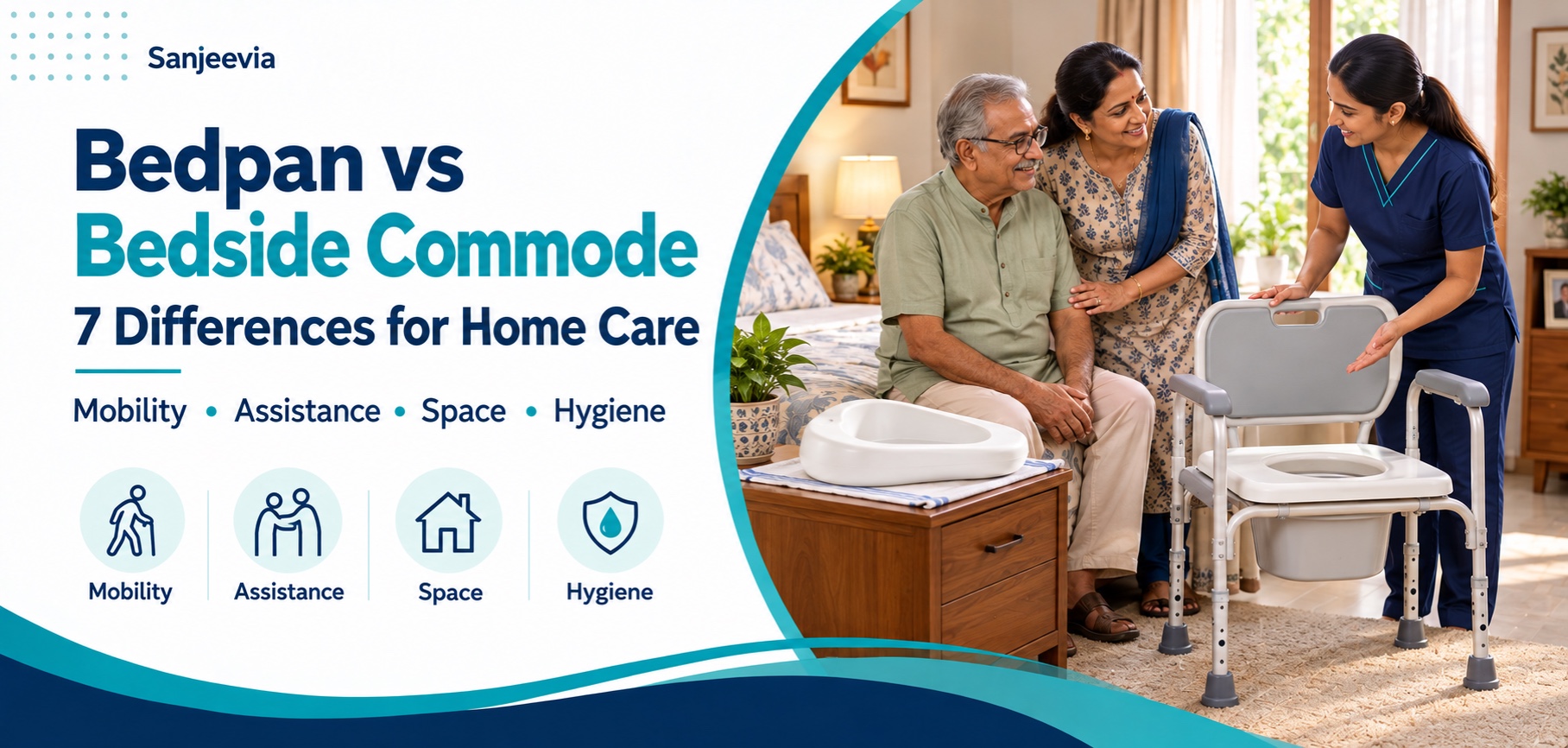
When a parent cannot comfortably reach the bathroom, families often have to make an unfamiliar decision quickly. A bedpan and a bedside commode both help with toileting, but they ask very different things of the person using them and the caregiver helping. This bedpan vs bedside commode guide compares seven practical differences so you can prepare the right questions before choosing equipment.
The starting point is the person’s assessed ability to move, sit and transfer, together with any surgical restrictions. An online comparison cannot establish those abilities. Ask the nurse, physiotherapist or occupational therapist to demonstrate the agreed method using the actual bed and toileting aid.
Quick answer: bedpan or bedside commode?
A bedpan allows toileting in bed when leaving the bed is not appropriate. A bedside commode is a separate toilet chair with a collection container, so the person must be able to transfer to it using an assessed method and any required assistance. Neither is automatically the safer or more comfortable choice for everyone. A commode wheelchair is another design and should not be confused with a static bedside commode.
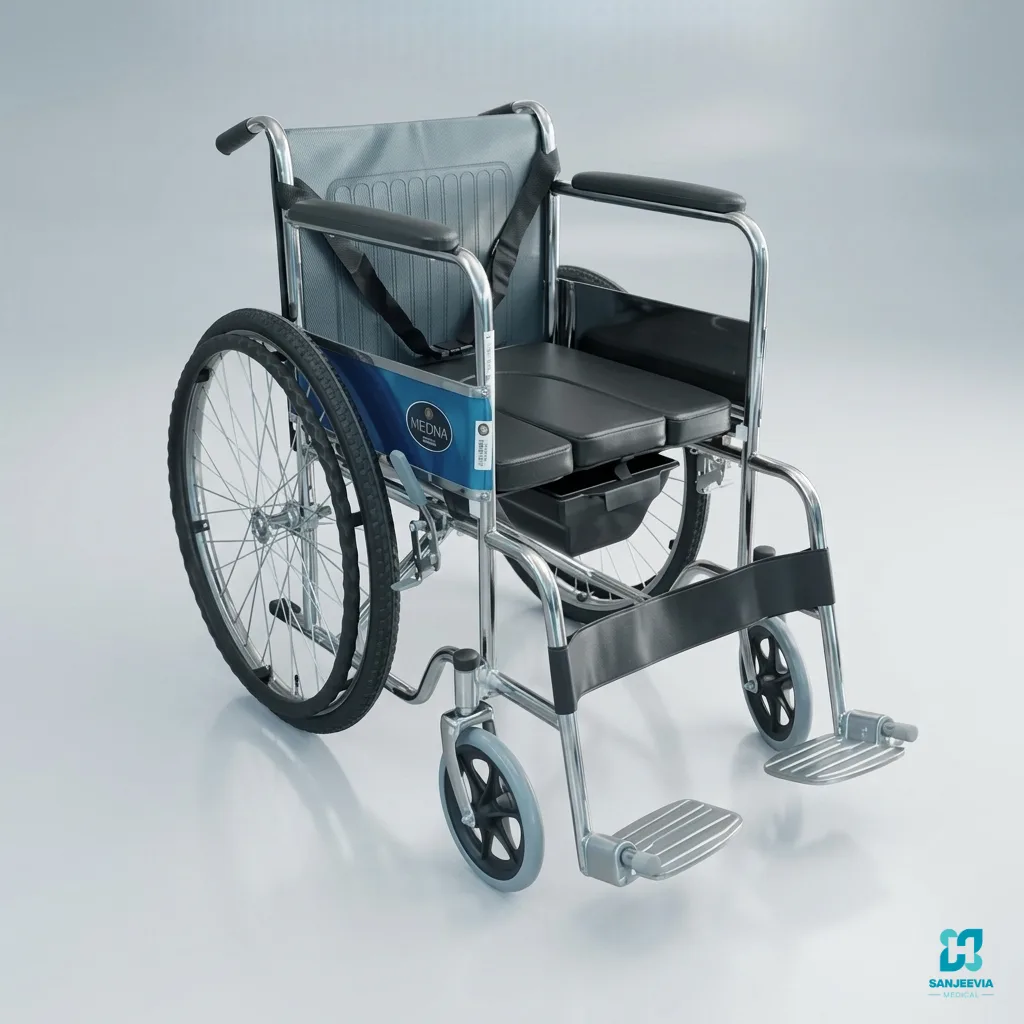
This is a manual commode wheelchair, not a static bedside commode or bedpan. Confirm the recommended design and availability before enquiring.
Bedpan vs bedside commode: the comparison at a glance
| Decision | Bedpan | Bedside commode |
|---|---|---|
| Where it is used | In the person’s bed | On a separate toileting chair |
| Movement required | Positioning in bed with the agreed assistance | An assessed transfer out of bed or another seat |
| Space to plan | Caregiver access beside the bed and a clean supplies area | Chair footprint plus the full transfer and caregiver area |
| Fit to confirm | Pan design, positioning and compatibility with restrictions | Seat, height, support, capacity and container arrangement |
| After use | Prompt removal and the prescribed hygiene routine | Help with the return transfer and the hygiene routine |
Seven differences that matter in a real home
1. Staying in bed is different from transferring to a chair
The most important distinction is the movement needed to reach the toileting position. A family may assume that a commode beside the mattress removes the transfer problem. It shortens the distance to a toilet, but it does not remove the need to get onto another seat. Ask the care team what movement is permitted and what help is required, including during the night.
For a bedpan, ask the nurse how it should be positioned and removed within the person’s restrictions. Do not improvise lifting or turning from a product photograph. Record the demonstrated method in the caregiver transfer plan.
2. The caregiver’s work changes, rather than disappearing
A smaller device is not necessarily easier to manage. With a bedpan, help may be needed for positioning, clothing, wiping and removing the container without spilling. With a commode, assistance may also be needed for the journey onto and off the seat. Think about the person who will actually provide that help, rather than the strongest relative who happens to attend delivery.
Ask for a practical handover with the usual caregiver present. If the agreed method requires trained assistance that is not available at home, tell the discharge team before booking. Renting a commode wheelchair does not include a clinical transfer assessment or supply a caregiver.
3. The usable space is larger than the device’s footprint
A bedside commode needs a stable place where it can be approached and used without blocking access to the bed or room exit. Measure the complete arrangement: the bed, open doors, nearby furniture and space for the helper and any assessed transfer equipment. A chair that fits into a corner may still be unusable for the agreed transfer.
A bedpan does not need a separate chair footprint, but the caregiver still needs working space and somewhere appropriate to keep supplies. Do not balance clean or used equipment on an unstable surface. The room-preparation guide can help you organise the layout before handover.
4. Fit involves different measurements and features
For a commode, confirm seat height, usable seat dimensions, arm support, overall width and the manufacturer’s user-weight limit. Ask whether the selected model’s arms and collection container work with the agreed transfer and hygiene arrangements. A familiar label such as adult, folding or standard does not confirm these details.
A bedpan should also be selected with professional advice when pain, wounds, reduced movement or surgical restrictions affect positioning. Do not choose between products solely because one looks softer or has a lower profile. Write down the recommended design and check it against what will actually be supplied.
5. Comfort and privacy need an individual conversation
Ask the person what they find difficult or embarrassing, and how they can request help. A bedside chair may feel more familiar to some people; another person may find the transfer distressing. The right plan should account for their preferences without asking them to attempt a movement that has not been cleared.
The Government of Alberta’s bedpan guidance discusses privacy and checking on the person so the pan can be removed soon after use. Arrange an accessible way to call the caregiver. Privacy should not mean leaving someone without the assistance they need.
6. Both options need an organised hygiene routine
Before either aid is used, decide where clean supplies will be stored, where the container will be emptied and which cleaning products the manufacturer permits. Ask the nurse about hand hygiene, gloves, personal cleaning and any infection-specific precautions. Do not mix cleaning chemicals or assume that one disinfectant suits every material.
For a commode, the seat, frame and removable parts also need the model’s cleaning instructions. The Alberta bedside-commode guide provides general caregiving context. For a wheeled model, use our commode wheelchair cleaning guide alongside the supplied manual, rather than treating different designs as identical.
7. A static commode and a commode wheelchair are separate choices
A static commode is intended to remain in place for toileting. A commode wheelchair has a wheeled frame, but that does not automatically make it suitable for showering, use over every toilet, long periods of sitting or vehicle passenger travel. Confirm the exact model’s intended uses and components.
Sanjeevia lists a manual commode wheelchair. This article does not establish availability of a separate static commode or bedpan. Ask about the precise requirement and available options before deciding. Read commode chair vs commode wheelchair if the recommendation is for a chair rather than a bedpan.
What should you ask before renting or buying?
Take a short written brief to the care team and provider. Include the recommended toileting aid, any movement restrictions, assistance needed, bed and seat measurements, available floor space and the usual caregiver’s questions. Ask the provider to identify the model and list the supplied parts. Keep the manufacturer’s cleaning and operating information with the handover record.
Ask what to do if the planned method becomes painful, difficult or unsafe. A new difficulty with toileting, sitting or transfers needs the care team’s advice, not an improvised equipment change. If the model does not match the agreed requirement, pause its use and contact the appropriate clinician or equipment support contact.
For equipment enquiries in Delhi NCR, contact Sanjeevia with the confirmed recommendation and home-access details. The team can discuss listed equipment and availability. Clinical suitability and transfer training remain with the treating professionals.
Frequently asked questions
Is a bedside commode better than a bedpan?
There is no universal answer. The decision depends on permitted movement, transfer ability, assistance, comfort and the home layout. Ask the care team which option matches the person’s current needs.
Can a bedridden person use a commode chair?
The word bedridden does not describe a safe transfer method. A clinician or therapist must assess whether and how the person can move to a separate seat. Do not lift them onto a chair simply because it is close to the bed.
Can a commode wheelchair be used as a shower chair?
Only if the manufacturer confirms that use for the exact model and the care team has assessed the person and bathroom. A toileting opening alone does not establish water resistance or shower suitability.
What measurements should I share for a commode enquiry?
Share the care team’s seating and transfer requirements, the person’s relevant size and weight information, and the available approach and working space. Confirm seat height, capacity and overall dimensions for the actual model.
Does Sanjeevia supply every device described in this comparison?
No availability promise is made for every alternative discussed. The linked catalogue item is a manual commode wheelchair. Contact the team to confirm whether a listed model matches the exact recommendation.
Educational equipment guide. Sources and linked catalogue pages checked on 15 October 2026. Clinical advice, toileting assistance and transfer training must come from the person’s care team. Cover image is illustrative.
Next Read
If a toileting chair has been recommended, read Commode Chair vs Commode Wheelchair: Practical Home-Care Questions before choosing the design.