
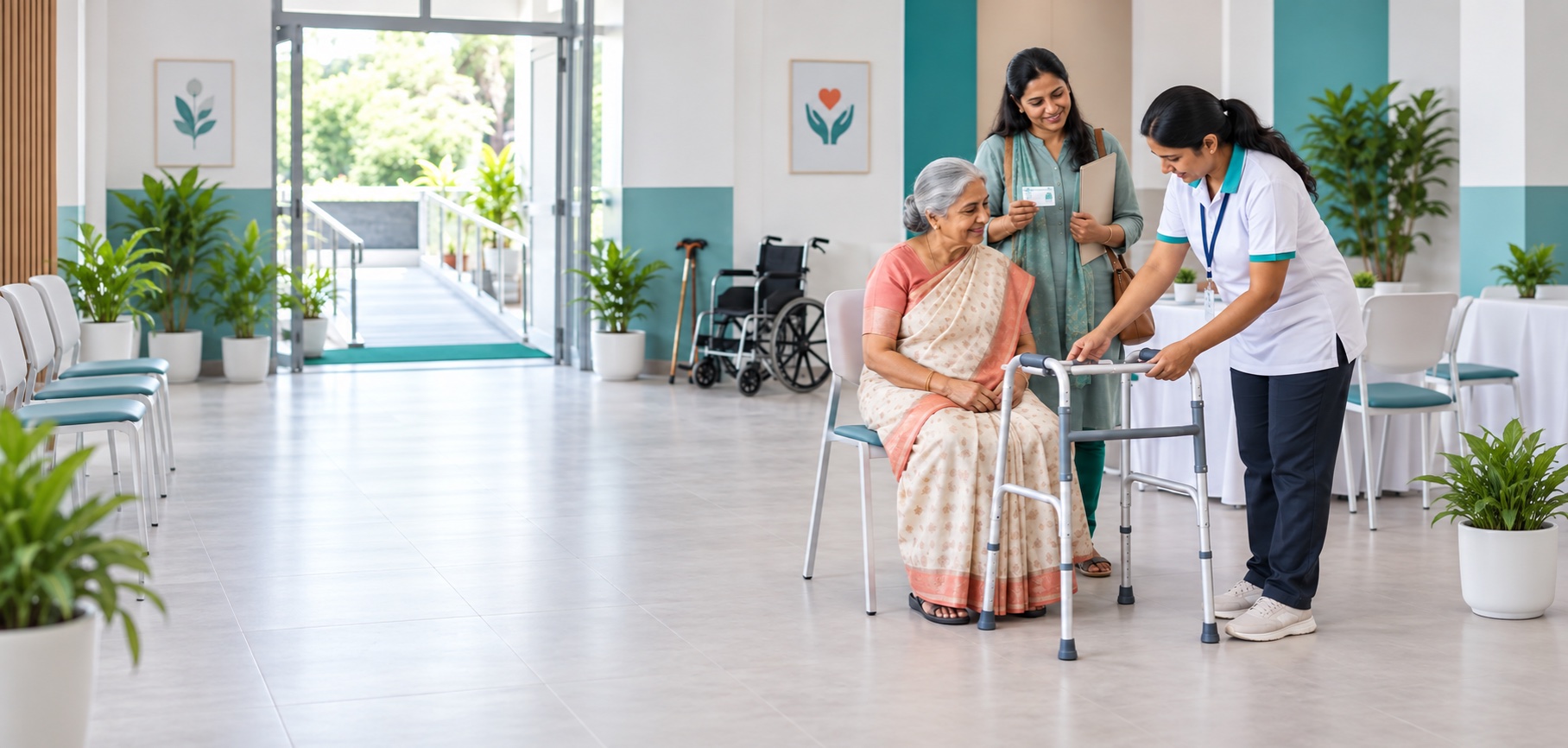
Verified 12 September 2026: Rashtriya Vayoshri Yojana assessment camps are part of a real Government of India scheme implemented by ALIMCO with State Governments and District Administrations. Eligible senior citizens receive assessed assistive devices free of cost. An assessment camp normally records eligibility, functional need, measurements and the suitable device; it does not always distribute equipment on the same day.
This practical guide explains how to locate an authorised camp, prepare documents, complete the assessment and avoid common registration mistakes. It does not list or endorse any privately circulated camp notice. For the complete scheme overview, start with Rashtriya Vayoshri Yojana 2026 eligibility and application.
Who should attend a Vayoshri Yojana assessment camp?
An applicant should meet all of the core conditions published by the Ministry of Social Justice and Empowerment:
- Indian senior citizen aged 60 years or above
- Aadhaar card holder
- Belongs to the BPL category or has monthly income not exceeding ₹15,000
- Has an age-related disability or infirmity that may be helped by an approved assistive device
Age or income alone is not enough. The scheme provides equipment according to assessed need. A senior citizen who wants a wheelchair but can safely use a walking aid may be assessed for a different device. Another person may need more than one compatible item.
How to find an authorised assessment camp
- Start with the official RVY page. The Ministry’s Senior Citizens Welfare portal provides camp and walk-in information and a State and city search.
- Ask the District Social Welfare Office. District officials coordinate or receive information about authorised local activities.
- Call ALIMCO. The official helpline is 1800-180-5129. Ask for the nearest assessment camp, PM Divyasha-Vayoshri Kendra, AASRA centre or ALIMCO centre.
- Call Elderline. The national senior-citizen helpline is 14567 and operates daily from 8 AM to 8 PM according to the official portal.
- Use only official links. Reach registration systems through a government or ALIMCO website rather than a forwarded message.
Ask the official contact to repeat the date, reporting time, complete address, organiser, camp type and document list. A registration camp, medical assessment camp and device distribution camp can be different events.
Document checklist for RVY registration
| Document | Why it is needed | Preparation tip |
|---|---|---|
| Aadhaar card | Mandatory identity and age record on the official RVY page | Carry the original and clear photocopies |
| Income certificate or accepted income proof | Shows monthly income is within the scheme limit | Confirm the issuing authority and validity with the organiser |
| BPL or ration card | Supports BPL eligibility where applicable | Carry the original and copies |
| Old-age pension record | May be accepted as income-related evidence in the ALIMCO process | Take the latest available record |
| Passport photographs | May be required for a local beneficiary form | Carry several recent copies |
| Address and phone details | Used for distribution updates and beneficiary contact | Use a number that the family checks regularly |
| Relevant medical reports | Help explain hearing, vision, dental or mobility history | Arrange them by condition; assessment is still required |
The Ministry portal marks Aadhaar and income certificate as mandatory and also lists ration card, PAN card and driving licence as supporting documents. ALIMCO’s FAQ refers to Aadhaar and proof of income below ₹15,000 per month. The exact accepted certificate format can vary by authorised workflow, so confirm it before travelling.
What happens at the registration desk?
The desk may check identity, age, address, income eligibility and contact information. Staff may create or update a beneficiary record in the authorised system. Names, Aadhaar details and phone numbers should match the supporting documents.
Before leaving the desk:
- Check the spelling of the beneficiary’s name.
- Check the mobile number used for updates.
- Ask whether an acknowledgement, token or registration number will be issued.
- Ask where the medical or functional assessment takes place.
- Ask how the distribution date will be communicated.
- Keep originals with the applicant unless an authorised process clearly requires temporary inspection.
What happens during the medical and functional assessment?
The assessment team considers the age-related impairment and the device that can help restore mobility, hearing, vision, dental function or daily independence. The beneficiary should describe actual daily difficulties rather than requesting an item only because it appears on a scheme list.
Useful information includes:
- How far the person can walk and whether falls have occurred
- Whether the person can stand and transfer independently
- Which hand is stronger and whether grip is painful
- Door widths, steps and bathroom access at home
- Hearing difficulty in quiet and noisy settings
- Current spectacles, dental appliance or support brace
- Skin sensitivity, pressure areas or previous device problems
- Availability of a caregiver for pushing, fitting or maintenance
Walker and walking-stick assessment
For a walker, the team may check balance, gait, upper-body strength, grip, height and the surfaces used at home. A fixed frame, rollator, tripod or quadpod behaves differently. The most mobile-looking device is not always the safest.
Wear the footwear normally used for walking. If the applicant already uses a stick or frame, bring it where practical. It can show whether the current height, rubber tips or grip are causing difficulty.
Wheelchair assessment
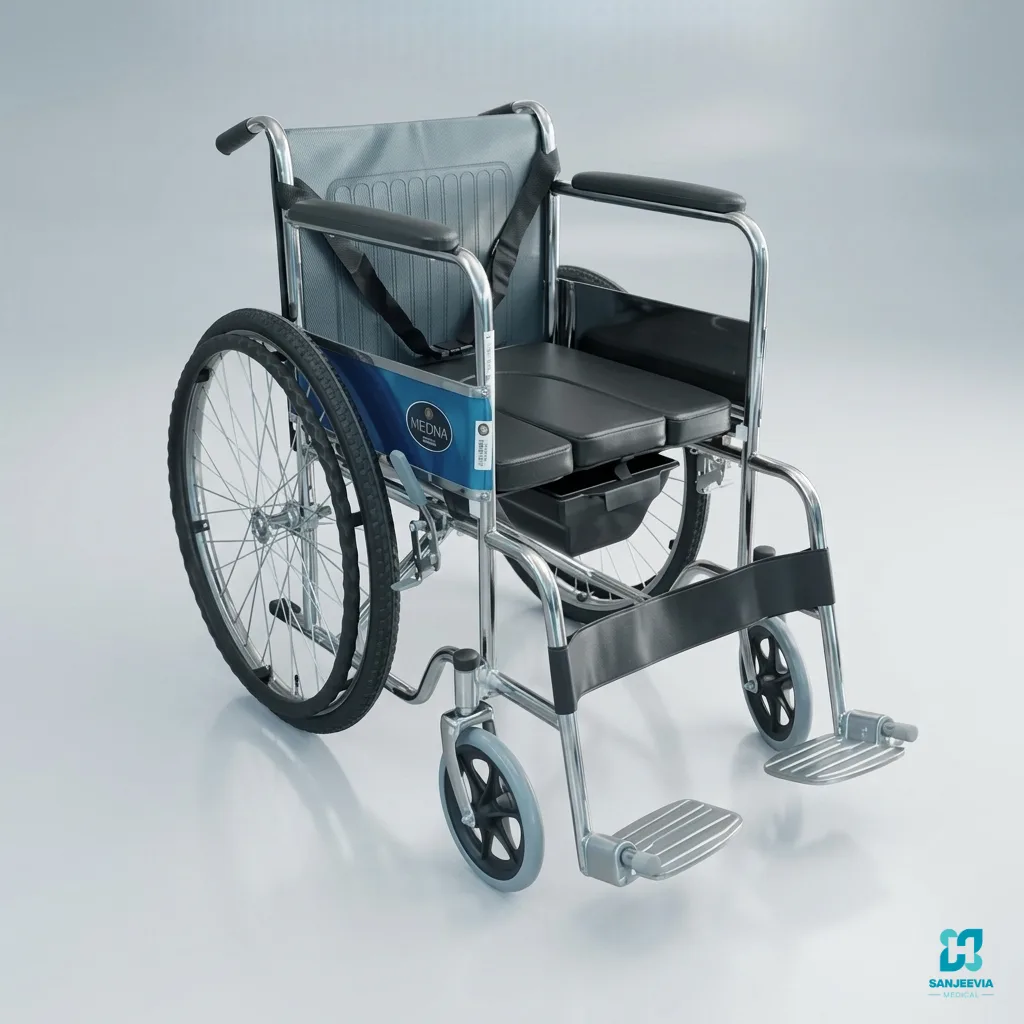
A wheelchair should be matched to the person’s body, transfers, posture, caregiver and home. Assessment may include seat width, seat depth, foot support, armrest needs, ability to self-propel and whether a commode function is required.
Tell the team about narrow doors, stairs, vehicle transport and long sitting periods. A folding wheelchair can help with transport, while a commode wheelchair addresses a separate toileting need. A cushion may be assessed when pressure management is required, but it should not be chosen from appearance alone.
Hearing-aid assessment
Hearing equipment requires an appropriate hearing assessment and fitting. Bring previous audiograms or hearing-aid records if available. Tell the assessor about ear pain, discharge, sudden hearing change, dizziness or one-sided symptoms, because these may require clinical review.
At distribution, ask how to insert the device, change or charge batteries, clean it, control volume and request service. The official scheme lists several hearing-aid types, but the assessment determines suitability.
Spectacles and dental-device assessment
Low vision and loss of teeth are among the age-related impairments covered by RVY. Spectacle or denture provision requires assessment and measurements. Existing prescriptions can provide history, but the authorised team decides the current requirement.
Ask what follow-up is available if spectacles feel incorrect or a denture causes pain. Do not continue using a device that injures tissue or worsens symptoms.
Supports, collars, braces and cushions
The scheme’s official device list includes knee braces, spinal support, cervical collars, lumbosacral belts and gel or silicone cushions. These products must match the assessed condition and size. A belt or collar should not be used simply because the person has pain.
Report skin fragility, poor sensation, wounds, swelling and circulation problems during assessment. Ask how long the item should be worn, how tight it should feel and which symptoms require review.
Will equipment be given on assessment day?
Often, assessment and distribution are separate. After registration and assessment, ALIMCO and the coordinating authority may prepare beneficiary-specific devices, measurements and the distribution list. The applicant is then informed about a distribution camp or collection process.
Before leaving an assessment camp, ask:
- Is any further document required?
- How will approval or distribution information be sent?
- Is there an expected date range?
- Which acknowledgement should be brought to distribution?
- Who should be contacted if the phone number changes?
Distribution-day checklist
- Bring the beneficiary’s Aadhaar and the acknowledgement or registration record.
- Confirm the name and approved device before accepting it.
- Check size, fit, components and visible damage.
- Ask for a complete demonstration.
- Try the device under supervision where appropriate.
- Record the model, serial number and service contact.
- Keep the distribution receipt and warranty information.
- Ask when a fitting, hearing or mobility follow-up is needed.
ALIMCO’s current FAQ states that its products have a one-year warranty and that repairs and maintenance are available through ALIMCO centres, PM Divyasha-Vayoshri Kendras and AASRA centres. Confirm the service route for the exact device received.
Special provision for senior citizens aged 80 or above
The official Senior Citizens Welfare portal says devices are provided at the doorstep for senior citizens aged 80 years or more. Families should still contact the authorised local channel for assessment, eligibility verification and delivery procedure. Do not assume a forwarded form automatically activates doorstep delivery.
There is no registration or device fee
ALIMCO states that eligible beneficiaries receive devices free of cost and that there is no fee to attend an authorised camp. Refuse demands for payment in exchange for a registration token, priority position or guaranteed device.
Protect personal information:
- Never disclose an Aadhaar OTP, bank PIN or card CVV.
- Do not pay into a personal account for government-scheme approval.
- Do not leave original identity documents with an unknown organiser.
- Ask why a copy is needed and write its intended purpose on the copy where appropriate.
- Use official numbers to report suspicious demands.
Common reasons an application may remain incomplete
- Income proof does not show the required monthly-income eligibility
- Name or date-of-birth mismatch across documents
- Applicant attends a distribution camp without prior assessment
- Required originals or photocopies are missing
- The requested item does not match the assessed need
- Phone number is incorrect, preventing distribution updates
- The notice was not from an authorised RVY channel
Delhi residents: official verification routes
The Delhi Department of Social Welfare publishes district contacts on its official website. East Delhi currently lists a helpline number of 9289550129 and an office at Block 10, near Shamshan Ghat, Geeta Colony, New Delhi 110031. Office details may change, so check the government page before travelling.
National official routes are Elderline 14567 and ALIMCO 1800-180-5129. The ALIMCO New Delhi Regional Marketing Centre is currently listed at D-002, Tower D, Ground Floor, WTC, Nauroji Nagar, New Delhi 110029, telephone 011-43628081. Call before visiting to confirm which RVY service is available.
If a suitable camp is not currently available
Ask the district office or ALIMCO about the next assessment schedule and whether an authorised walk-in channel is available. A local camp date is temporary, but the official sources reviewed in September 2026 show the national scheme continuing.
If a clinician says a mobility aid is needed immediately, follow the clinical plan rather than waiting without support. A temporary private rental or purchase remains separate from RVY and does not affect official assessment or allocation.
Independent preparation resources
Sanjeevia does not register RVY applicants and is not affiliated with the Ministry or ALIMCO. To prepare better questions for an authorised assessment, families can read the Zimmer frame height and home-fit guide, compare a standard manual wheelchair with a commode wheelchair, and measure the home’s doors and transfer space.

Official sources
- Department of Social Justice and Empowerment: RVY scheme, eligibility, devices and camp routes
- ALIMCO: beneficiary registration, documents, camps and service FAQ
- Government of India: Elderline 14567
- Government of NCT of Delhi: District Social Welfare contacts
- ALIMCO: official regional-centre directory
- Press Information Bureau: RVY evaluation and current implementation, 4 August 2026
This independent guide was checked against official sources on 12 September 2026. Camp dates, accepted documents and centre services can change. Verify the current instructions through the responsible government or ALIMCO channel.