
Category: Recovery Guides | Reading time: 8 min | Published by Sanjeevia Medical / Home Care After Knee Replacement India
| The surgeon said the operation went well. Your father will be home in three days. You have the discharge summary in your hands. It says: no weight bearing on the left leg, head of bed elevated, no twisting at the hip, physiotherapy starting day five. You look around your home and realise you have none of the things this recovery actually needs. |
Most families are in this situation. The hospital handles the surgery. The discharge summary tells you what not to do. Nobody tells you exactly what to set up, in what order, and why each piece of equipment matters for recovery.
This guide does that. Everything a family in Delhi NCR needs to know about setting up a safe, functional home for a parent recovering from hip or knee replacement. If you need equipment delivered before your parent arrives home, contact Sanjeevia for same-day delivery across Delhi NCR.
Why Home Setup Matters as Much as the Surgery
Joint replacement surgery is one of the most successful procedures in modern medicine. The surgery itself has a very high success rate. What goes wrong, when it does, usually happens at home.
Important post-discharge concerns can include falls, wound problems and blood clots. Their likelihood and the precautions required vary by procedure, medical history and the treating team’s plan.
A clear home environment and suitable equipment can support safer care, but they do not replace the discharge plan, prescribed medicines, mobility guidance or timely clinical review.

What Your Home Needs Before the Patient Arrives
Set everything up at least one day before discharge. Do not wait until your parent is sitting in the car outside. Here is what you need, room by room.
The Bedroom
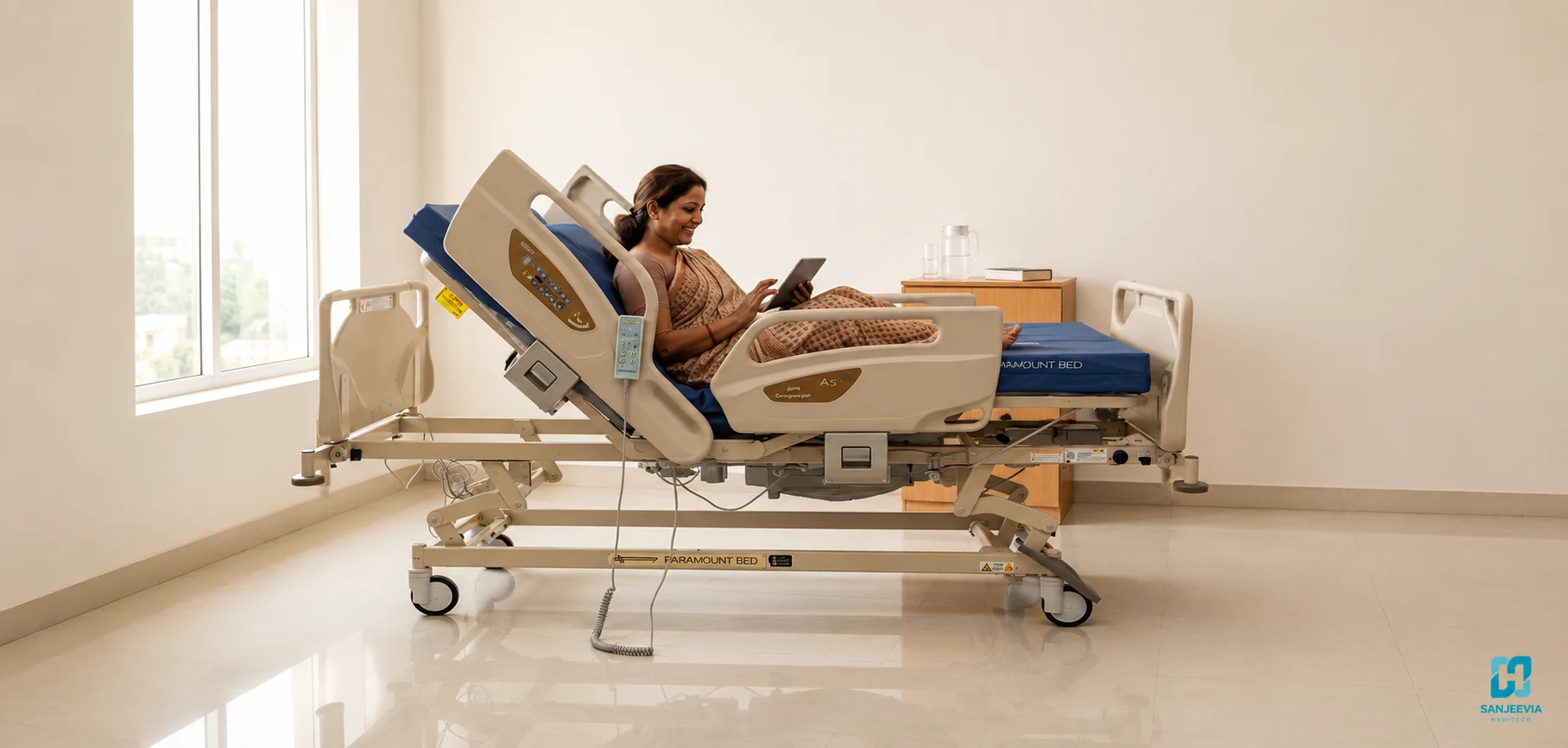
This is where the patient will spend most of the first two to three weeks. The bed setup is the single most important decision you will make.
A standard home bed may not meet every post-operative positioning or transfer need. Check the discharge plan before arranging equipment.
- Adjustable backrest or knee-rest positioning may be required when specifically prescribed
- Bed height and transfer technique should be assessed for the individual patient and caregiver
- Side rails require an individual safety assessment; they are not a default transfer aid or fall-prevention measure
A bed with the functions specified in the patient’s care plan may be appropriate. A Semi Fowler bed typically provides backrest adjustment; a Full Fowler or electric model may provide additional functions. Confirm the exact model and the treating team’s requirements before selection. View hospital bed options on Sanjeevia.
Position the bed so planned care and transfers can be carried out safely. Allow practical access around the bed, remove loose rugs and wires, and keep the route to the bathroom clear. The required space and transfer method should follow the patient’s care plan and the equipment instructions.
The Bathroom
Bathroom transfers are the highest-risk moment in post-joint-replacement recovery. Two things to address:
- Raised toilet seat: A standard Indian toilet is too low for a hip replacement patient. The hip flexion angle required to sit at standard height can violate the precautions given by your surgeon. A raised toilet seat adds 5 to 10 cm to the toilet height and keeps the hip in a safe position. Available at most medical stores.
- Grab bars or a commode chair: If installing grab bars is not possible, a commode wheelchair is the safer option. It can be positioned over the toilet, eliminating the need for the patient to lower themselves to seat height.
For patients who cannot walk to the bathroom at all in the first week, a bedside commode is essential. This is a chair with a toilet seat and a removable pan that sits next to the bed, eliminating any transfer to the bathroom entirely in the early days.
The Living Area
If the patient will spend time outside the bedroom, the living area needs the same preparation. Remove centre tables, coffee tables, and low furniture the patient might trip over or use as support when they should not. Identify one stable, high-backed chair with armrests for sitting during meals. Sofa seating is generally too low and too soft for joint replacement patients in the first few weeks.
The Path Between Rooms
Every surface the patient walks across is a fall risk. Ensure:
- No loose rugs or mats anywhere on the route
- Adequate lighting, including night lighting for bathroom trips
- Clear, unobstructed path at least 90 cm wide for walker or wheelchair movement
The Equipment You Actually Need: Week by Week
Recovery from hip and knee replacement is phased. The equipment needs change as the patient progresses. Here is a realistic week-by-week breakdown for a standard recovery.
| Week | Patient Status | Essential Equipment |
| Week 1 | Minimal mobility, full caregiver dependence | Hospital bed (semi fowler), commode chair or commode wheelchair, walker |
| Week 2 | Beginning supervised walking, physio starting | Hospital bed, walker, wheelchair for longer distances or outings |
| Week 3-4 | Increasing independence, physio ongoing | Hospital bed (may downgrade to simpler model), walker, optional wheelchair |
| Week 5-8 | Most daily activities resuming | Walker for outdoor use, bed may return, monitoring ongoing |
| Week 8+ | Near-normal mobility for most patients | Walker for safety, all equipment typically returned |
Hospital Bed
May be considered when the discharge plan calls for adjustable positioning or a suitable transfer height. The required functions, mattress and any rail use should be confirmed with the treating team. View current pricing on Sanjeevia.
Walker (Zimmer Frame)
The physiotherapist or surgeon should specify the mobility aid, weight-bearing status and level of supervision. Do not introduce or discontinue a walker based on a generic timeline; follow the individual discharge plan.
Wheelchair
Not required for all patients, but highly recommended for any outings during the first four to six weeks, including follow-up appointments. Trying to walk the patient through a hospital corridor two weeks post-surgery is unnecessarily risky. A manual wheelchair solves this. View wheelchair options on Sanjeevia.
Commode Chair or Commode Wheelchair
For the first five to seven days, most patients cannot safely walk to the bathroom. A commode chair next to the bed is the dignified, safe solution. A commode wheelchair doubles as both mobility aid and toilet access, which makes it the more versatile choice for patients who will be using it for more than a few days.
Equipment Comparison: Hip vs Knee Replacement
| Equipment | Hip Replacement | Knee Replacement | Why |
| Hospital bed (semi fowler) | Essential | Essential | Elevation and safe transfers for both |
| Walker | Essential | Essential | Weight bearing progression for both |
| Commode chair | Strongly recommended | Recommended | Hip patients have stricter movement precautions |
| Raised toilet seat | Essential | Recommended | Hip flexion limits are stricter post-THR |
| Wheelchair | Recommended for outings | Recommended for outings | Reduces fall risk for hospital visits |
| Grab bars in bathroom | Strongly recommended | Recommended | Stability during transfers |
| Recliner chair (living area) | Useful | Useful | High-backed seating for daytime comfort |
A Note for Caregivers
The family member providing care is as important to this recovery as the equipment. A few things that are easy to get wrong:
- Do not assist the patient by pulling their arm. Hold them at the torso or use a gait belt. Pulling the arm during transfers changes the weight distribution in a way that risks the joint.
- Hip precautions are procedure- and patient-specific. Follow the written instructions from the orthopaedic surgeon and physiotherapist, including any temporary limits on bending, crossing the legs or rotation.
- Track the medications. Most post-surgical patients are on blood thinners (anticoagulants), pain medication, and sometimes antibiotics. Set phone alarms. Missing blood thinner doses is a DVT risk.
- Watch for warning signs: redness, swelling, warmth around the wound, fever above 38 degrees, or sudden increased pain. These are not normal parts of recovery and require immediate medical attention.
- Encourage movement within the limits given by the physiotherapist. Immobility is the enemy of joint replacement recovery. The physiotherapy exercises prescribed are not optional.
Frequently Asked Questions
Q: How long will my parent need a hospital bed at home?
For most knee and hip replacement patients, three to four weeks is the standard requirement. Some patients, particularly elderly patients or those with complications, may need the bed for up to eight weeks. Renting gives you the flexibility to extend without the cost of a purchase.
Q: Can my parent sleep in their regular bed with extra pillows instead?
It depends on the prescribed positioning and transfer plan. Pillows are not a substitute for an adjustable bed when specific positioning or transfer-height requirements have been prescribed. Do not use side rails as a default support; their suitability must be assessed with the bed, mattress and patient.
Q: My parent had knee replacement, not hip. Do the hip precautions apply?
No. Knee and hip replacement have different precautions. Hip replacement has stricter movement restrictions, particularly around hip flexion angles and rotation. Knee replacement focuses more on leg elevation and progressive weight bearing. Follow the specific precautions your surgeon gave at discharge.
Q: Is a physiotherapist required at home or can the family manage?
A physiotherapist is strongly recommended for the first two to three weeks. The exercises need to be demonstrated correctly the first time, and the progression of weight bearing needs professional assessment. Families can assist with exercises once the physiotherapist has trained them, but the initial sessions should be supervised. Consult your treating physician on this.
Q: How do I order equipment if my parent is being discharged tomorrow?
Same-day delivery is available across Delhi NCR for orders placed before 2 PM. For urgent needs, contact Sanjeevia directly on WhatsApp and we will prioritise your order. Equipment is delivered, installed, and fully demonstrated before we leave.
Q: What is the minimum rental period?
One month. Most orthopaedic recovery rentals run one to two months. Duration discounts apply for longer bookings: 5% off for two months, 10% off for three months, and 20% off for six months.
Q: Is the security deposit refundable?
Yes, fully refundable within 48 hours of pickup with no damage. We photograph equipment at both delivery and pickup so there is never any dispute about pre-existing condition. Full details in our FAQ section.
Pre-Discharge Checklist: Print and Keep
| 48 hours before discharge: Hospital bed ordered and delivery confirmed Walker ordered or collected Commode chair or commode wheelchair ordered Raised toilet seat purchased All rugs and trip hazards removed from bedroom and bathroom path Night lighting in place for bathroom trips Medication schedule written out and phone alarms set On discharge day: Collect discharge summary and read all precautions carefully Confirm physiotherapy appointment dates Wheelchair available for hospital exit and car transfer Emergency contact number saved (surgeon, Sanjeevia, physiotherapist) |
Need Equipment Before Your Parent Comes Home?
Sanjeevia delivers hospital-grade equipment across Delhi NCR. Same-day delivery for orders before 2 PM. Every unit is sanitised, installed, and fully demonstrated at your home.
| Browse hospital beds on Sanjeevia. Browse wheelchairs and mobility aids. View current pricing for all equipment. Have questions? Read our FAQ. Contact us or WhatsApp: +91 92179 10612 |
Keyword Tags
| KEYWORD TAGS: home care after knee replacement India home care after knee replacement Indiahome care after hip replacement Indiaknee replacement recovery at homehip replacement home care Delhi NCRpost surgery home care Delhiorthopaedic recovery at home Indiahospital bed after knee surgeryhospital bed after hip replacementwheelchair after hip replacementwalker after knee replacementcommode chair after hip surgeryequipment needed after knee replacementequipment needed after hip replacementhome setup after joint replacementknee replacement discharge checklisthip replacement discharge home carecaregiver tips after joint replacementfall prevention after hip surgeryfall prevention after knee surgeryraised toilet seat after hip replacementhow to care for elderly after knee surgeryhow long bed rest after knee replacementhow long bed rest after hip replacementknee replacement recovery week by weekhip replacement recovery week by weekphysiotherapy at home after knee replacementphysiotherapy at home after hip replacementsemi fowler bed after surgeryknee break position post surgeryhome medical equipment rent Delhimedical equipment after joint surgerySanjeevia hospital bed DelhiSanjeevia wheelchair rentrent hospital bed Delhi NCRrent wheelchair Delhi NCRrent walker Delhicommode wheelchair rent Delhihome care equipment orthopaedic Delhisame day medical equipment delivery Delhipost surgical recovery equipment Indiajoint replacement home recovery guideTKR recovery home IndiaTHR recovery home Indiaelderly parent home after surgerysenior care after surgery Delhidischarge day preparation knee surgerydischarge day preparation hip surgerycaregiver guide joint replacement India |
Related Guidance and Equipment
These links connect the patient’s positioning and transfer needs with the most relevant bed guidance and exact product specifications.
Continue Reading
- Manual vs Electric Hospital Bed After Surgery — match adjustment frequency to patient and caregiver needs.
- How to Set Up a Hospital Bed at Home Safely — prepare the room, access route and caregiver space.
Relevant Product Pages
- 3-Function Electric Hospital Bed — review backrest, knee-rest and height-adjustment specifications.
- Manual Full Fowler Bed — review a manual backrest and knee-rest option.
Medical Disclaimer
This article is for general informational purposes only and does not constitute medical advice. Post-surgical care and equipment requirements should be guided by your treating surgeon and physiotherapist. Consult your doctor for all clinical decisions.
Published by Sanjeevia Medical | sanjeevia.com | Delhi NCR
Home Care After Knee Replacement India