
Compare the exact Sanjeevia listings
Families often search for the “best 5L oxygen concentrator,” but a safer question is: which exact unit meets the written oxygen prescription and can be supported reliably at home? These two listings cover different models, specifications and service arrangements.
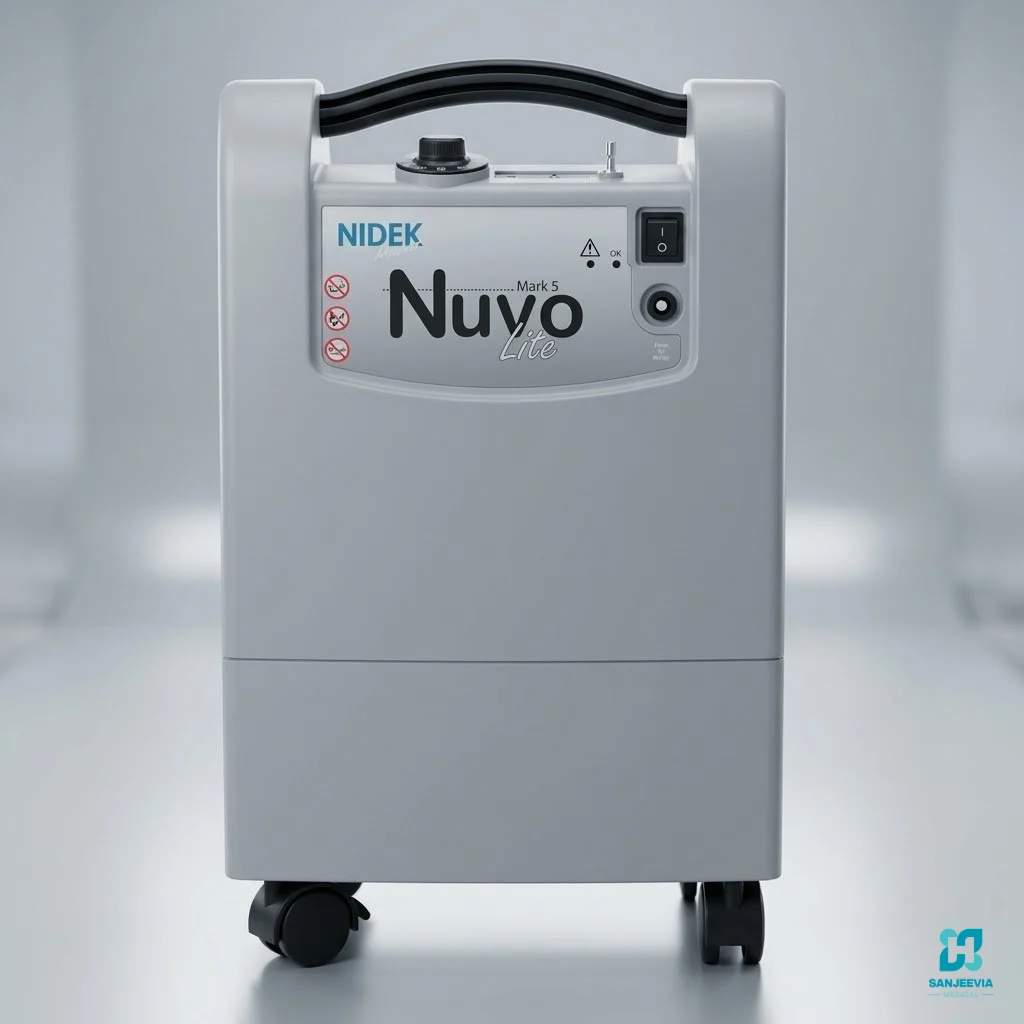
Nidek Nuvo Lite 5L
Continuous-flow Nidek Nuvo Lite 925 listing. Confirm the voltage, serial label and supplied accessories.

Deck Mount Gene O2 5L
Continuous-flow Gene O2 5L listing with flowmeter and humidifier bottle. Confirm the exact current configuration.
Manufacturer-published specification snapshot
| Check | Nidek Nuvo Lite 925 | Deck Mount Gene O2 5L |
|---|---|---|
| Published continuous-flow range | 0.125 to 5 LPM | 0.5 to 5 LPM |
| Published oxygen concentration | At 5 LPM, 87% to 95.5% under the manual’s reference conditions | 93% ±3% in the manufacturer’s 5L brochure |
| Published electrical figure | 300 W average for the 230 V Model 925 | 350 VA for the 5L model |
| Published sound | Less than 58 dBA | Less than 46 dBA |
| Published weight | Approximately 14.5 kg | Approximately 17 kg |
| Published dimensions | 36 × 23 × 58.5 cm | 37 × 30 × 54 cm |
Sources: Nidek Nuvo Lite family instructions and Deck Mount Gene O2 brochure. Specifications can vary by production version and market. Check the label and manual of the unit actually offered.
8 differences to check before renting or buying
1. Minimum continuous-flow setting
The Nidek manual publishes a lower minimum setting than the Deck Mount brochure. That does not make one universally better. It matters only if the prescription and clinician’s plan require a setting within that range. Never select a lower flow independently.
2. How oxygen concentration is stated
The Nidek manual gives a range at 5 LPM under stated conditions, while the Deck Mount brochure states 93% ±3%. These figures should not be reduced to a single marketing number. Ask the provider how output is verified on the exact unit, especially at the prescribed flow.
3. Sound in the intended room
The Deck Mount brochure publishes a lower sound figure. Real-world perception also depends on room surfaces, distance from the bed, machine condition and airflow. Keep the unit in a ventilated position with clearance required by its manual, not inside a cupboard to reduce noise.
4. Weight and footprint
The Nidek manual lists lower weight, while the Deck Mount brochure shows a shorter but deeper cabinet. Measure the placement area, ventilation clearance and route between rooms. Both are stationary concentrators on castors, not battery-powered portable concentrators.
5. Power demand and power-cut planning
The published electrical figures differ. Confirm the exact voltage, plug, safe socket and any backup arrangement with the provider and clinician. A home inverter or generator must be assessed for the actual device load. An unverified backup setup can fail when it is most needed.
Need help checking the exact model?
Share the clinician’s requirement, city and intended use. A Sanjeevia coordinator can confirm the listed equipment and availability. Do not send medical records on WhatsApp.
6. Alarm system
The Nidek family manual describes oxygen-concentration monitoring and alarm behaviour for equipped versions. The Deck Mount brochure lists a low-purity indicator and service alarm. Ask for a delivery demonstration of the exact unit’s audible and visual alarms, and record what the family must do when each alarm appears.
7. Warranty and local service
Warranty wording can depend on the exact model, seller, serial number and current manufacturer policy. Deck Mount publishes warranty information on its official warranty page. For either option, obtain current written coverage, exclusions, response process and replacement support before purchase.
8. The prescribed use case
A brand comparison cannot decide therapy. Confirm required continuous flow during rest, sleep and activity, whether humidification is prescribed, the cannula or mask connection, room ventilation and the escalation plan. If non-invasive ventilation is also used, the respiratory team must specify how equipment is connected.
Delivery and handover checklist
- Match the model and serial label to the booking.
- Verify oxygen output and flowmeter operation at handover.
- Ask for filter, humidifier and cannula hygiene instructions for the supplied setup.
- Test audible and visual alarms without changing clinical settings.
- Keep oxygen away from smoking, flames, oils and heat sources.
- Save the service number and clinician’s escalation instructions.
- Confirm the backup plan before the patient depends on the unit.
For wider context, read Sanjeevia’s Nidek Nuvo Lite versus Philips EverFlo comparison. The US FDA also explains important limitations and safety points in its guide to oxygen concentrators and home oxygen therapy.
Frequently asked questions
Is Nidek Nuvo Lite always better than Deck Mount 5L?
No. The right choice depends on the prescribed continuous flow, the exact unit’s verified performance, alarms, room conditions, service support and the family’s power-cut plan.
Can either 5L concentrator be used without a prescription?
No. Home oxygen is a medical treatment. Use the flow and duration prescribed by the treating clinician and do not change settings from an online comparison.
Do these oxygen concentrators contain an internal battery?
The compared stationary units are mains-powered. Confirm the exact supplied model and arrange a clinician-approved backup plan for power cuts or device faults.
Does a pulse oximeter tell me how to adjust oxygen flow?
No. A pulse oximeter is only one monitoring tool and can have limitations. Follow the clinician’s written target and escalation plan rather than changing oxygen flow independently.
What should be checked at delivery?
Confirm the model label, flow range, outlet, alarm operation, filter and humidifier instructions where applicable, power requirements, service contact and the prescribed setup.
This article provides equipment information only. It does not prescribe oxygen or replace advice from the treating clinician.