

“Three function” is a broad functional description, while Paramount Bed A5 is a product family with more than one model code and configuration. A sensible comparison therefore begins with the exact quoted bed, not a generic photograph or category name.
Compare the bed options
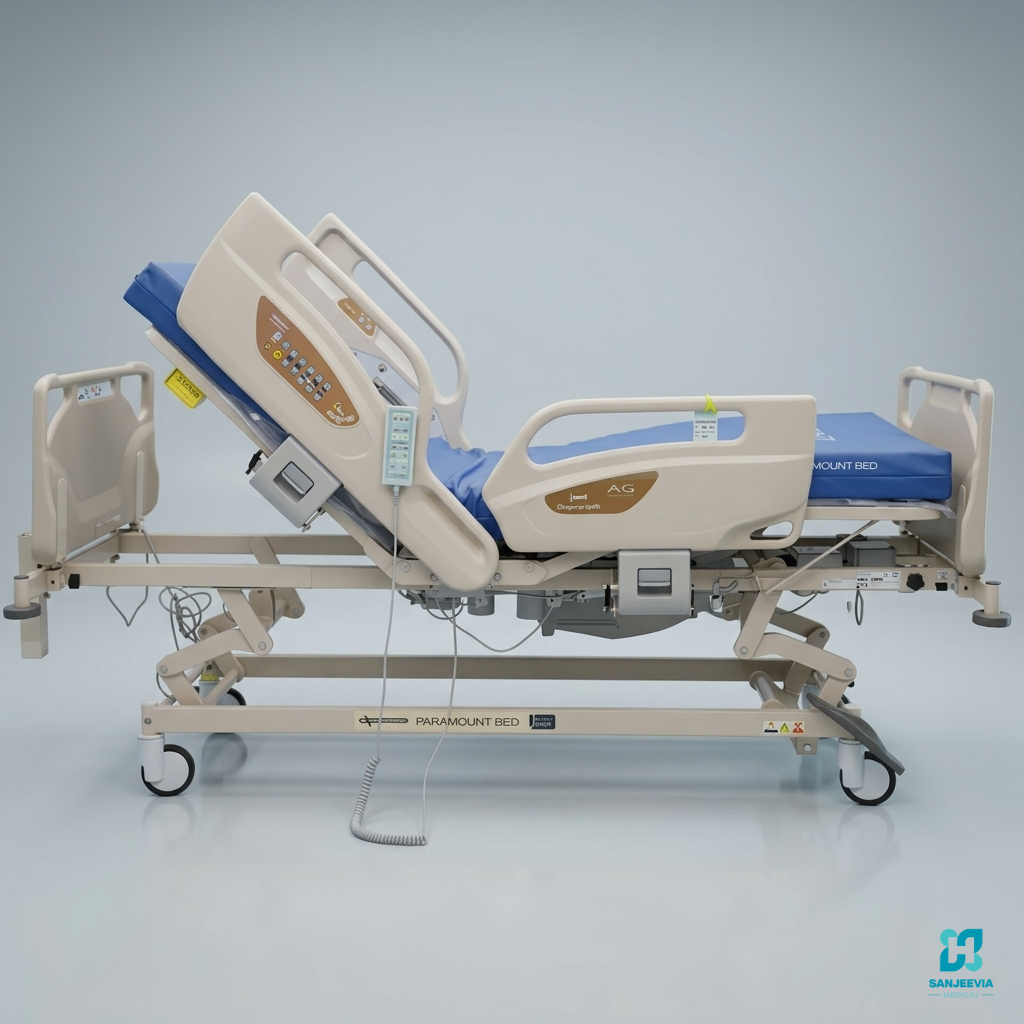
Paramount Bed A5 Series
A premium electric bed family. Confirm the exact model code, functions, accessories and specifications supplied.

3-Function Electric Hospital Bed
A practical electric home-care option with backrest, knee and height functions as listed on the product page.
Seven differences to check
| Decision point | Paramount Bed A5 family | Sanjeevia 3-function electric bed |
|---|---|---|
| Product definition | A named manufacturer series with model-specific configurations. | A functional category offered for home care. Confirm the make and exact supplied unit. |
| Core positioning | Official specifications list powered back and knee functions across referenced A5 models. | Product listing describes powered backrest, knee and height adjustment. |
| Height range | Official A5 specifications list a low platform range of about 350 to 700 mm for referenced models. | Ask for the measured deck height of the actual supplied bed and mattress combination. |
| Additional tilt | Model-dependent. A tilt function appears on a specific four-motor variant in the official range. | Do not infer tilt from “three function.” Ask for a demonstration of the three named movements. |
| Rails and accessories | Manufacturer-compatible rails, controls and accessories depend on configuration. | Confirm rail type, IV pole, head and foot boards, mattress platform and included accessories. |
| Mattress fit | Use the correct dimensions and compatibility guidance for the exact A5 model. | Measure platform length, width and articulation. Avoid gaps and an unsuitable mattress. |
| Support decision | Evaluate model-specific parts, trained service and hand control support. | Evaluate the actual make, spares, motor/control support and replacement arrangement. |
1. Compare the function you need, not the number in the name
Bed functions should answer care tasks. Backrest elevation can support positioning and some daily activities. Knee elevation can help the body remain positioned when the backrest rises. Height adjustment can bring the mattress surface to a safer level for a trained caregiver or transfer. A tilt function is different and should be used only when clinically appropriate and available on the exact model.
Ask the clinician or occupational therapist to translate the care plan into required bed movements. Then ask the supplier to demonstrate them one at a time. Count marketing labels only after you understand what each control actually moves.
2. Check low height and transfer height
A low deck may help some users place their feet more securely or reduce the consequence of a low-level fall, but it does not make every transfer safe. A higher position may help a caregiver work, yet it can become unsafe if left elevated when unattended. The relevant measurement is the top of the loaded mattress, not only the metal deck.
Measure the user’s seated knee height, wheelchair seat height and transfer equipment. Confirm whether the bed can reach the planned transfer position with the chosen mattress. Always return the bed to the position specified in the care plan.
3. Match the mattress and platform
An articulating bed needs a compatible mattress that can flex without bunching, sliding or creating harmful gaps. Confirm platform dimensions, mattress dimensions, thickness and whether pressure-redistribution features are clinically required. Air mattresses need suitable pump placement, power and emergency planning.
Do not place an ordinary household mattress on a medical bed without confirming compatibility. Excessive thickness can reduce rail protection, while an undersized mattress can create entrapment spaces.
Need help checking bed fit?
Share the patient’s care plan, room access, transfer method and city. Sanjeevia can explain current bed configurations and equipment support.
4. Treat rails as a separate risk decision
Bed rails can assist repositioning or provide an edge reminder for selected users, but they also create entrapment and climbing risks. They are not a substitute for observation or a restraint solution. The care team should decide whether rails are appropriate, which rail configuration is required and how gaps will be assessed with the chosen mattress.
The US Food and Drug Administration’s bed-rail safety guidance explains why patient assessment, mattress compatibility and gap checks matter. Families should report loose rails, damaged latches or unexpected spaces immediately.
5. Confirm dimensions, load and room access
Measure doorway width, corridor turns, lift dimensions, stairs, room working space and the route to the final position. Include protruding rails, head and foot boards, control boxes and accessories. The room needs access for transfers, cleaning, emergency response and caregiver movement.
Ask for the safe working load of the exact bed and clarify whether it includes the patient, mattress, bedding and accessories. Do not use patient weight alone. Never exceed the manufacturer’s limit.
6. Compare controls and power planning
The user and caregiver should be able to identify each control and stop movement if clothing, tubing, hands or furniture are at risk. Ask whether the handset can be locked, which functions can be restricted and what happens during a power failure. A backup feature, if present, has manufacturer-defined limits and should not be assumed to provide normal operation for long periods.
Use a suitable wall outlet and keep cables away from wheels, moving sections and walking paths. If an extension, power backup or inverter is being considered, obtain model-specific electrical advice.
7. Judge service for the exact bed
Ask who responds to motor, handset, control-box, caster or rail faults. Confirm whether trained technical support and parts are available for the exact model. The family should know how to place the bed safely while waiting for service and whom to contact outside normal hours.
Sanjeevia can explain the current hospital-bed configurations it supplies and help coordinate delivery, setup and equipment support. Clinical positioning, rail use and transfer technique should be decided by the treating and rehabilitation team.
Bed handover checklist
- Full manufacturer, model and serial number recorded
- All powered functions demonstrated
- Brakes and caster steering checked
- Rails and latches inspected in every position
- Mattress dimensions and compatibility confirmed
- Safe working load documented
- Power-failure procedure explained
- Cleaning, fault and service contacts provided
- User and caregiver practise completed
Which bed is more suitable?
Shortlist the three-function electric bed when the confirmed core movements meet the care plan and the actual supplied bed passes fit, load, access and service checks. Shortlist the Paramount A5 when its specific model’s low-height platform, controls, build, accessories or manufacturer support better meet the need. A brand name cannot compensate for the wrong mattress, unsafe rails or poor room access.
Manufacturer source
Check the exact quoted model against Paramount Bed’s official A5 product information. Specifications and accessories differ by country and model code, so the supplied label, manual and written quotation take priority.
Frequently asked questions
Does every Paramount A5 have Trendelenburg tilt?
No. Official information shows different A5 configurations. Confirm the model code and demonstrate the function.
What are the three functions on a three-function bed?
Sanjeevia’s listed model describes powered backrest, knee and height adjustment. Confirm the actual unit at handover.
Is a low bed automatically safer?
No. Safety depends on the individual, transfer plan, mattress, rails, supervision and how the bed is positioned.
Can any mattress be used?
No. The mattress must match the platform dimensions, articulation, rail system and clinical pressure-care need.